
















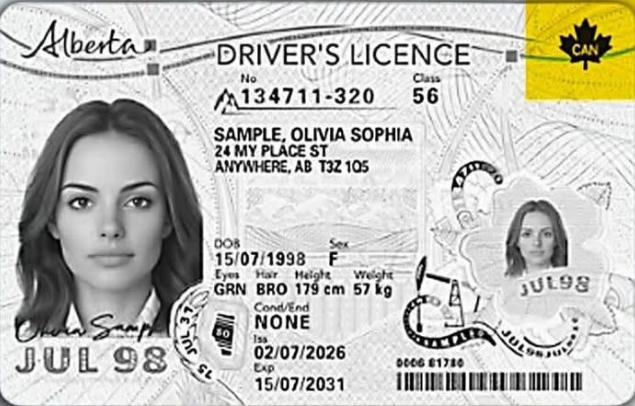
Alberta’s decision to integrate personal health numbers into driver’s licences and provincial identification cards marks one of the most significant changes to everyday identity documents in the province in recent years. The reform is being presented as a modernization effort aimed at simplifying access to services and strengthening identification systems. At the same time, it has triggered serious concerns from privacy experts, who warn that combining medical identifiers with general identity cards could expose residents to new risks.
A move toward a “single-card” identity system
Under the new system, Albertans renewing or applying for a driver’s licence or identification card in person will receive updated cards that may include additional information beyond standard personal details. For eligible residents covered under provincial health insurance, a personal health number will be printed on the back of the card. In cases where citizenship is verified, a citizenship marker will also appear on the front of the document.
Government officials describe the change as part of a broader effort to modernize identity management. The aim is to reduce reliance on multiple physical documents—such as separate health cards and identification cards—and streamline interactions with government and service providers.
In practical terms, this could make certain processes more efficient. Individuals may no longer need to carry separate health cards when accessing medical services. In theory, it could also reduce administrative duplication and help healthcare providers verify eligibility more quickly, especially in high-volume settings such as clinics, hospitals, and pharmacies.
Potential benefits: convenience, efficiency, and administrative simplification
Supporters of the initiative point to several possible advantages.
First, there is the issue of convenience. Many residents currently carry multiple cards for different services, including driver’s licences, health cards, and other forms of identification. Combining key information onto a single credential could reduce the need to manage several documents and decrease the risk of forgetting or losing one.
Second, there is administrative efficiency. Health systems often struggle with verification delays, misplaced records, or mismatched identification data. A unified identifier on a widely used card could potentially streamline verification processes, reduce paperwork, and speed up service delivery in healthcare settings.
Third, the move is also framed as a modernization step. Governments across various jurisdictions are gradually moving toward integrated identity systems that centralize key personal information. In that context, Alberta’s approach aligns with broader digital governance trends aimed at simplifying interactions between citizens and public institutions.
From a service delivery perspective, the change may also reduce duplication between government departments, allowing for more consistent identity validation across systems.
Privacy concerns: increased exposure of sensitive health data
Despite these potential benefits, privacy advocates and oversight bodies have raised significant concerns about the risks associated with placing personal health numbers on widely used identification cards.
One of the primary concerns is exposure. Driver’s licences and ID cards are frequently shown in everyday situations—at bars, stores, airports, workplaces, and service counters. Unlike a health card, which is typically used only in medical contexts, a driver’s licence is shared far more broadly. This increases the number of situations in which sensitive health-related identifiers could be inadvertently exposed.
Health numbers are considered particularly sensitive because they are tied directly to medical records and healthcare access. If compromised, they could potentially be misused to access medical services fraudulently or interfere with a person’s health records. Even small errors or unauthorized use could lead to incorrect medical information being attached to a patient’s file, which may have long-term consequences for treatment and diagnosis.
Another concern involves identity theft. By combining multiple forms of personal data on a single card, the potential value of that card increases significantly for criminals. If lost or stolen, it could provide a more complete profile of an individual, making it easier to impersonate them across multiple systems.
Governance and accountability questions
Beyond direct privacy risks, critics also point to governance challenges. Identity documents are typically issued and managed under strict regulatory frameworks, but the integration of health data into non-health systems raises questions about oversight responsibilities.
A key concern is whether the systems handling these new combined cards are subject to the same level of privacy protection as traditional health information systems. If different agencies manage different parts of the data lifecycle, gaps in accountability could emerge, especially in the event of a data breach or improper access.
There are also questions about enforcement. If sensitive health information is mishandled, it is not always clear what penalties or corrective mechanisms would apply across overlapping administrative systems. Privacy experts warn that without strong oversight, integrated identity systems can unintentionally weaken existing safeguards rather than strengthen them.
Broader implications for data use and digital identity
The change also reflects a broader global trend toward centralized identity systems, where governments seek to link multiple datasets to a single identifier. While this can improve efficiency, it also raises long-term questions about how much personal information should be tied to everyday identification tools.
Increased data integration can improve service delivery and reduce administrative friction, but it also concentrates risk. When more information is stored or displayed in fewer places, the consequences of misuse or security failure become more serious.
Experts often describe this as a trade-off between convenience and control. The more streamlined the system becomes, the more carefully it must be protected to prevent unintended exposure or misuse.
Public reaction and uncertainty ahead
Public response to the change has been mixed. Some residents may welcome the simplicity of having fewer cards and faster access to services, while others may feel uneasy about the visibility of health-related information on a document used in so many everyday situations.
Uncertainty also remains about how the system will be implemented in practice, particularly in terms of how data will be protected, who will have access to it, and how breaches would be handled. As with many large-scale administrative reforms, much will depend on the safeguards put in place during rollout.
Balancing modernization with privacy protection
At the core of the debate is a familiar policy tension: how to modernize public services while maintaining strong privacy protections. The integration of health numbers into identification cards represents a significant shift in how personal data is managed and shared between government systems.
If implemented carefully, the system could improve efficiency and reduce administrative burden for both residents and service providers. However, without strong safeguards, clear oversight, and strict limits on data access, it also introduces new vulnerabilities that could affect millions of people.
As Alberta moves toward implementation, the challenge will be ensuring that convenience and modernization do not come at the expense of privacy, security, and public trust.
Post Disclaimer
The views and content presented in this article, news report, or video are solely those of the respective author or creator and do not necessarily reflect the official policy or position of BW Times Digital Online E-Paper.











Leave a comment