

















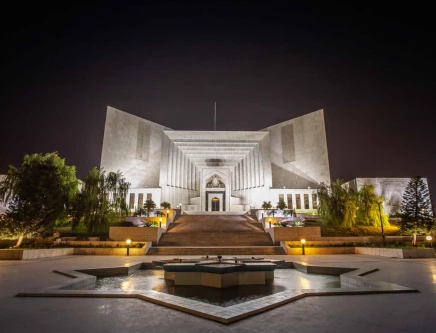
ISLAMABAD: Pakistan’s Supreme Court has sought assistance from the Attorney General for Pakistan on a constitutional question surrounding the Federal Constitutional Court’s authority to take up proceedings connected to an earlier Supreme Court order concerning the hospitalisation of former prime minister and PTI founder Imran Khan.
A three member Supreme Court bench headed by Justice Shahid Waheed and comprising Justice Naeem Akhtar Afghan and Justice Ishtiaq Ibrahim took up the matter on Wednesday. The proceedings arose from a contempt petition concerning the alleged non implementation of the Supreme Court’s August 18 directions regarding Khan’s medical treatment and access to his family.
The dispute emerged after the Federal Constitutional Court, a day earlier, ordered that records relating to Khan’s hospital transfer case be obtained from the Supreme Court. The FCC also sought records of similar cases from the high courts while hearing petitions filed by three inmates of Adiala Jail.
The development has raised an important constitutional question about the respective jurisdictions of the Supreme Court and the Federal Constitutional Court.
Attorney General Mansoor Usman Awan told the Supreme Court that the same matter could not simultaneously remain under the jurisdiction of two superior courts. He said he would assist the bench in determining how the constitutional jurisdictions of the two courts should operate in relation to the cases before them.
Justice Shahid indicated that the Supreme Court would examine whether the FCC’s order requiring the records could have a binding effect on proceedings before the Supreme Court.
The Federal Constitutional Court had relied on Article 175 E of the Constitution when directing that the records be requisitioned. The provision allows the FCC to call for the record of a case pending before another court when it considers that the matter involves a substantial question of law concerning constitutional interpretation.
The FCC is considering constitutional questions arising from petitions filed by three Adiala Jail prisoners who sought medical treatment at private hospitals and other facilities similar to those ordered for Khan.
The prisoners had initially approached the Islamabad High Court after the Supreme Court’s August 18 order. Their petitions were dismissed on August 31. They subsequently approached the FCC rather than pursuing an intra court appeal before the high court.
During Wednesday’s hearing, Justice Shahid raised broader questions about the constitutional division of powers between the two judicial forums.
He referred to Article 10 A, which guarantees the right to a fair trial and due process, noting that issues involving the provision can arise in both civil and criminal proceedings.
The judge said the Supreme Court wanted to understand the purpose and scope of the relevant constitutional provisions and emphasized that the relationship between the two superior courts should be governed by mutual respect.
The bench also discussed constitutional provisions concerning the interpretation of the Quran and Sunnah and the role of the Supreme Court’s Shariat jurisdiction.
Justice Shahid questioned how constitutional interpretations in such matters would operate if the Supreme Court’s Shariat Bench had already ruled on an issue. The attorney general responded by referring to Article 189 and the constitutional provisions governing the binding effect of judgments.
The discussion reflected the broader question now before the courts concerning the division of constitutional jurisdiction following the establishment of the Federal Constitutional Court.
Justice Shahid also asked whether the Supreme Court should remove the relevant cases from its schedule or issue a separate order. The attorney general suggested that proceedings could be deferred until the FCC had determined the constitutional questions before it.
He maintained that there was no ambiguity regarding the status of the Supreme Court’s August 18 order and said the order remained in force.
Justice Naeem Akhtar Afghan stressed that the issue should not be viewed as a confrontation between the two courts. He said both the Supreme Court and the Federal Constitutional Court were superior judicial forums with constitutionally defined jurisdictions.
The bench also questioned whether the government had properly implemented the Supreme Court’s August 18 directions.
Officials from Adiala Jail who had been summoned by the Supreme Court did not appear before the bench. The attorney general acknowledged that the officials should have attended and requested an opportunity for them to explain their absence.
Justice Shahid even questioned whether the jail superintendent could face arrest warrants over the failure to comply with the court’s summons. The bench, however, chose not to immediately pursue that issue.
Instead, the judges temporarily set aside the question of whether Khan should be moved between a private and government hospital.
Justice Shahid asked the attorney general to provide information about compliance with other parts of the August 18 order, particularly meetings between Khan and his family and telephone contact with his sons.
Dr Uzma Khan told the court that only two meetings had taken place under the Supreme Court’s directions. The attorney general said he would verify the details and report back.
The bench noted that the attorney general had acknowledged that the August 18 order remained operative.
The original Supreme Court order directed the government to move Khan from Adiala Jail to Shifa International Hospital in Islamabad for medical examination and treatment. The court also directed that a medical board be formed to oversee his treatment and that arrangements be made for meetings with family members and telephone communication with his sons.
The order was issued after petitions concerning Khan’s medical condition and access to his family were heard by the Supreme Court.
The FCC’s intervention followed petitions by three other Adiala prisoners seeking comparable treatment. They argued that constitutional guarantees of equal treatment should apply to them as well.
The FCC subsequently examined whether the Supreme Court had jurisdiction over matters involving constitutional interpretation and fundamental rights under the constitutional framework introduced through the 27th Amendment.
On September 15, the FCC ordered that records of the relevant Supreme Court proceedings be requisitioned. It also sought records from high courts involving similar questions.
The FCC identified several constitutional issues for consideration, including which court has authority to enforce fundamental rights, the constitutional rights of prisoners, the obligations of the state toward people held in custody and the legal consequences of alleged violations of those rights.
The attorney general had previously argued before the FCC that constitutional changes had altered the Supreme Court’s role in matters involving constitutional interpretation and fundamental rights. He maintained that Article 175 E allowed the FCC to call for records when such questions arose.
The Supreme Court has now been asked to consider the same constitutional framework from the perspective of its own pending proceedings.
The latest hearing did not result in a final determination of the competing jurisdictional questions. Instead, the bench sought further assistance from the attorney general and deferred the proceedings.
The judges emphasized that the objective was to avoid conflicting orders between the two highest judicial forums.
The dispute therefore goes beyond the immediate question of Khan’s hospital treatment. It has opened a broader constitutional issue concerning how the Supreme Court and Federal Constitutional Court will exercise their respective powers when proceedings involve fundamental rights and constitutional interpretation.
The next stage of the proceedings is expected to focus on the constitutional boundaries between the two courts, while the government is also required to respond to questions concerning implementation of the Supreme Court’s August 18 directions.
For now, the Supreme Court’s earlier order remains in force, while the FCC continues examining the constitutional questions arising from the related petitions brought by other Adiala Jail prisoners.
Courtesy: tribune
Post Disclaimer
The views and content presented in this article, news report, or video are solely those of the respective author or creator and do not necessarily reflect the official policy or position of BW Times Digital Online E-Paper.











Leave a comment