
















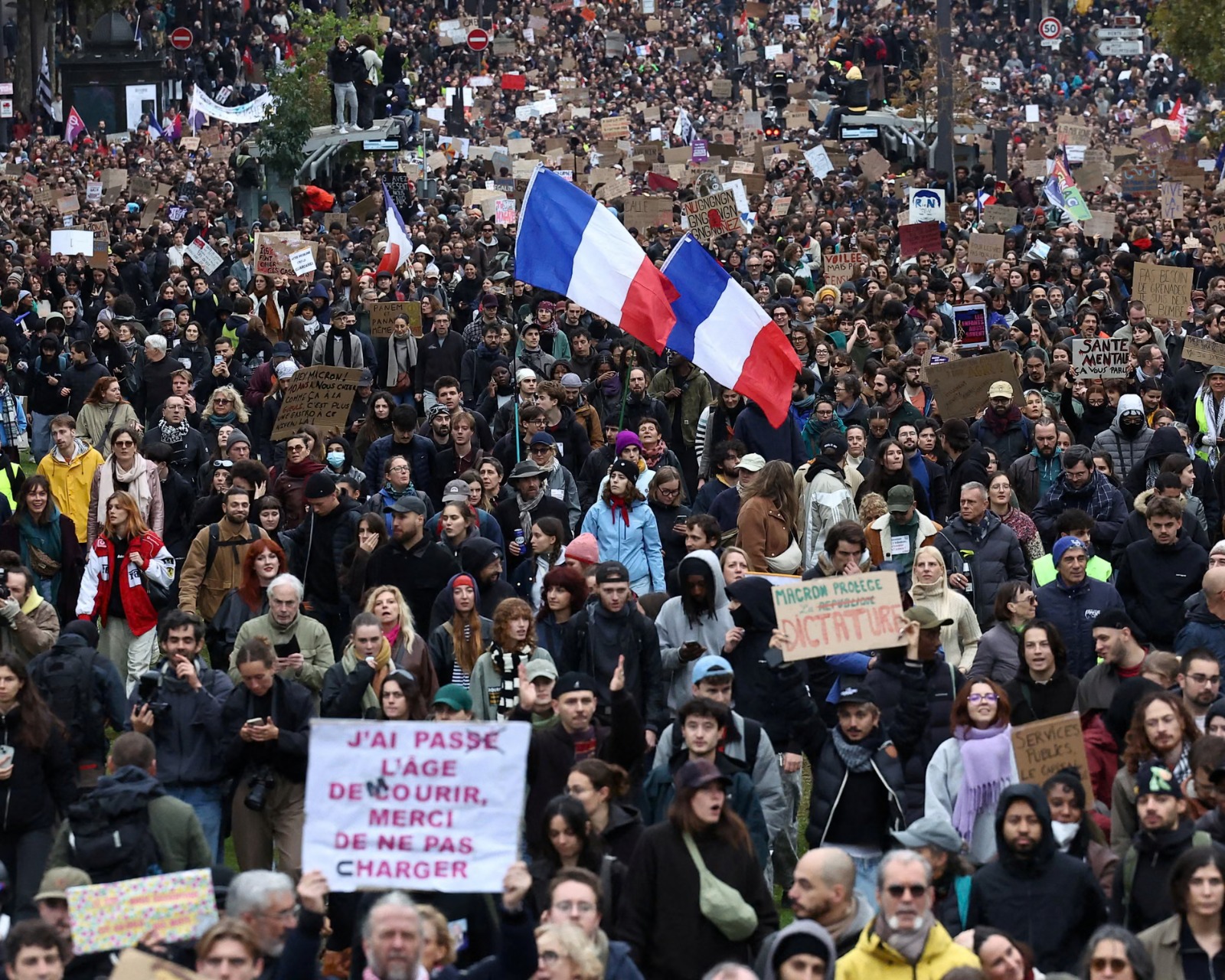
PARIS, FRANCE: Hundreds of thousands of demonstrators took to the streets across France on Saturday, October 24, 2026, as widespread protests over living costs, social protections and government policies unfolded alongside demonstrations in Italy, Spain and Albania. The day of public mobilisation was marked by large peaceful gatherings, heightened security measures and violent confrontations between police and groups of protesters.
French authorities reported that approximately 410,000 people participated in demonstrations across the country, including an estimated 110,000 in Paris. Nearly 1,000 people were arrested as clashes erupted in several locations, prompting police to deploy tear gas, water cannons and other crowd control measures.
Interior Minister Laurent Nunez confirmed that the number of arrests was expected to increase as authorities continued collecting information from police departments nationwide.
The scale of the demonstrations reflected growing public frustration over economic pressures, the cost of living and concerns about government policies affecting ordinary citizens.
Although most marches proceeded peacefully, confrontations involving masked groups overshadowed parts of the demonstrations, particularly in the French capital.
Paris Sees Massive Turnout as Peaceful March Ends in Violence
Thousands of protesters gathered in Paris during the afternoon, carrying banners demanding greater social protections, economic fairness and respect for the right to demonstrate.
The atmosphere remained largely peaceful throughout much of the march. Families attended with children, musicians performed along the route and demonstrators expressed their grievances through speeches, slogans and placards.
Several banners criticised the government’s policing methods, reflecting concerns among protesters about restrictions on demonstrations and the use of force during previous confrontations.
However, tensions escalated towards the end of the march near Porte de Vincennes on the eastern outskirts of Paris.
Groups of masked individuals dressed in black reportedly appeared after the main demonstration had largely concluded. Some threw stones and glass bottles at police officers, while others set off fireworks in the direction of security personnel.
A rubbish bin was also set on fire as the situation deteriorated.
Police responded by deploying tear gas, water cannons and stun grenades to disperse those involved in the disturbances and prevent further escalation.
The violence created a sharp contrast with the earlier scenes of peaceful public participation, raising renewed questions about how authorities should manage large demonstrations while protecting the right to protest.
French officials distinguished between the majority of peaceful demonstrators and those involved in violent confrontations.
Interior Minister Nunez said that while demonstrations over economic concerns had generally proceeded without major incidents, police later encountered serious violence involving groups he described as belonging to the radical left.
He defended the security response and indicated that further arrests could follow as investigators reviewed incidents across the country.
Demonstrations Spread Across Major French Cities
The unrest was not confined to Paris.
Large gatherings were reported in several major French cities, with demonstrators voicing dissatisfaction over economic conditions and government decisions.
In Lyon, police deployed tear gas during confrontations with protesters, while demonstrations also took place in Orléans and other urban centres.
Authorities had prepared extensive security arrangements in anticipation of large crowds and possible disturbances.
In Paris, 24 metro stations were closed as officials sought to manage the movement of demonstrators and reduce the risk of disorder in sensitive areas.
The planned protest route was also modified, moving demonstrators away from the historic Bastille area and delaying the start of the capital’s main march until the afternoon.
Some restrictions imposed on planned demonstrations were challenged in court, with several protest bans overturned shortly before the events began.
The legal disputes highlighted the difficult balance between maintaining public order and safeguarding freedom of assembly.
Despite the security concerns, the participation of hundreds of thousands of people demonstrated the continuing importance of street protests in French political life.
France has a long history of mass demonstrations influencing national debates, particularly over pensions, wages, public services and economic reforms.
Saturday’s mobilisation once again illustrated the willingness of citizens to use collective action to express dissatisfaction with political and economic decisions.
Rising Living Costs Fuel Public Anger
Economic insecurity remained a central theme of the demonstrations.
Protesters expressed concerns about the rising cost of everyday necessities, pressure on household budgets and the ability of public institutions to provide essential services.
For many families, the combination of living expenses and uncertainty over future economic conditions has increased demands for stronger government intervention.
Social protections, affordable public services and financial security have become particularly sensitive issues as European governments face competing demands involving public spending and economic stability.
The protests also included concerns about conditions in educational institutions.
Some demonstrators highlighted the deterioration of school buildings, raising questions about maintenance, infrastructure investment and the safety of students and teachers.
Reports of ageing facilities, damaged ceilings and poor sanitation have contributed to wider debates over the quality of public education and the responsibility of authorities to maintain safe learning environments.
These concerns reflect a broader frustration among citizens who believe essential public services are not receiving sufficient attention.
For demonstrators, the protests were not simply about immediate economic pressures but also about the direction of government priorities and the future of public welfare.
Italy Faces Protests as Police Conduct Raids in Milan
Elsewhere in Europe, Italian authorities prepared for demonstrations in several cities as public mobilisation extended beyond France.
Police in Milan carried out raids on homes ahead of planned protests, reflecting heightened security concerns surrounding the demonstrations.
The operations came as authorities sought to prevent potential disorder and identify individuals suspected of involvement in planned disturbances.
In Rome, tensions escalated when groups of protesters reportedly attempted to force their way into the Colosseum, one of Italy’s most famous historical landmarks.
The incident added to concerns about the potential for confrontations at prominent public locations during periods of political unrest.
Italian authorities faced the challenge of maintaining security around major tourist attractions while allowing lawful demonstrations to proceed.
The developments in Milan and Rome highlighted the different security challenges confronting European governments as protests unfolded across multiple countries.
Thousands Rally in Madrid Over Pension Security
Spain also witnessed significant public mobilisation, with approximately 25,000 people gathering in Madrid to demand stronger guarantees for pensions.
Demonstrators called for greater protection of retirement benefits and financial security for older citizens.
Pension policy remains an important issue across Europe as governments confront ageing populations, rising public expenditure and pressure to maintain sustainable retirement systems.
For pensioners and workers approaching retirement, concerns about future benefits have become closely connected to broader questions of economic fairness and social responsibility.
The Madrid demonstration reflected fears that financial pressures could threaten the stability of retirement arrangements and reduce the purchasing power of pensioners.
Participants demanded assurances that pension protections would remain a priority in government policymaking.
Although the demonstrations in Spain focused on different immediate demands from those in France, both reflected public anxiety about economic security and the role of the state in protecting citizens.
Albania Joins Wave of European Demonstrations
Fresh protests were also reported in Albania, adding another country to the series of public gatherings taking place across Europe.
The demonstrations contributed to a day of widespread political activity, although the causes and demands differed between countries.
The simultaneous protests demonstrated how economic concerns, political dissatisfaction and questions about government accountability can generate public mobilisation across national boundaries.
While there was no indication that the demonstrations were part of a single coordinated European movement, their occurrence on the same day highlighted the range of pressures confronting governments throughout the continent.
Police Response Raises Questions About Protest Rights
The scale of arrests in France has brought renewed attention to the relationship between public demonstrations and law enforcement.
French authorities maintain that security operations are necessary to protect residents, prevent property damage and respond to violence.
However, the use of tear gas, water cannons and stun grenades during confrontations has also revived debate about the appropriate level of force during protests.
The distinction between peaceful demonstrators and individuals involved in violence remains particularly important.
The majority of participants in Paris reportedly marched peacefully, while clashes developed towards the conclusion of the demonstration when masked groups confronted police.
The presence of families, children and musicians during the earlier stages of the march illustrated the broad social participation behind the protests.
At the same time, attacks on officers and damage to property created additional risks for the public and emergency services.
Authorities are expected to continue reviewing incidents and determining whether further legal action is warranted.
The number of arrests alone does not establish the guilt of those detained, and individual allegations will require appropriate legal examination.
A Major Political Challenge for European Governments
Saturday’s demonstrations have highlighted the continuing political importance of economic security, public services and government accountability across Europe.
In France, the turnout of approximately 410,000 people represents a substantial expression of public dissatisfaction.
The participation of 110,000 demonstrators in Paris alone underlines the strength of public engagement, even as violence at the end of the march threatened to overshadow the wider message.
For French authorities, the challenge will be responding to the concerns raised by protesters while addressing the security incidents that accompanied the demonstrations.
In Spain, pension protections remain a central demand, while Italian authorities are dealing with protests alongside heightened security operations.
The events also demonstrate that public frustration can take different forms depending on national circumstances, even when underlying concerns about economic stability and political representation overlap.
As governments across Europe assess the demonstrations, attention will turn towards whether political leaders respond through dialogue, policy changes or further security measures.
The protests have once again shown that large sections of the European public are prepared to mobilise when they believe their economic interests, public services or democratic rights are under pressure.
For the hundreds of thousands who marched peacefully, the central message was a demand to be heard.
For authorities, the immediate responsibility remains ensuring public safety while protecting the democratic right to peaceful assembly.
The coming days will determine whether Saturday’s demonstrations lead to meaningful political engagement or become another chapter in the growing confrontation between frustrated citizens and European governments.
Courtesy: theguardian
Post Disclaimer
The views and content presented in this article, news report, or video are solely those of the respective author or creator and do not necessarily reflect the official policy or position of BW Times Digital Online E-Paper.












Leave a comment