



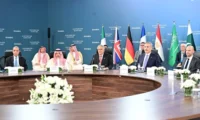









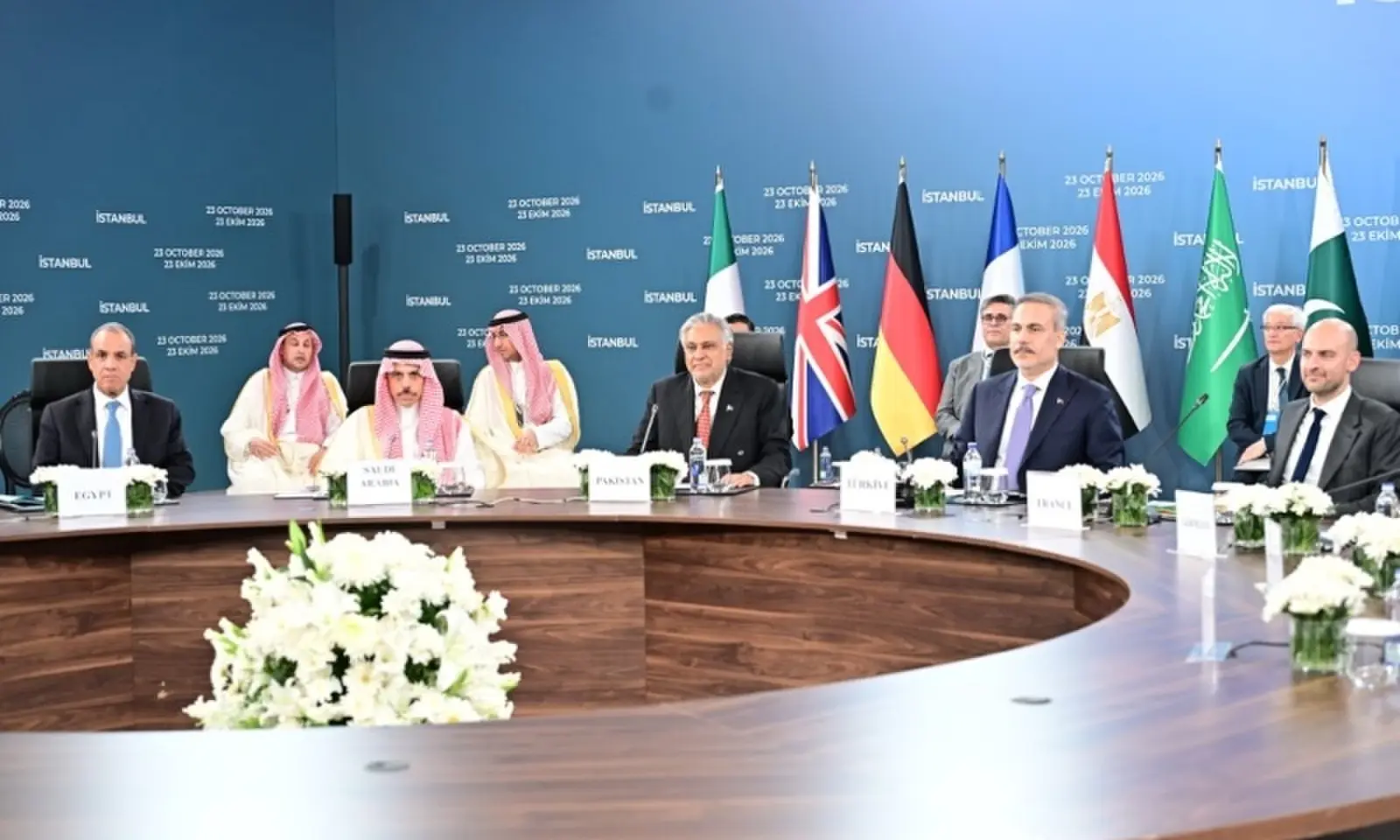
ISTANBUL, TURKIYE: Pakistan joined Saudi Arabia, Turkiye, Egypt and four major European countries in high-level diplomatic discussions in Istanbul on Friday, October 23, 2026, as international concern intensified over the conflict involving the United States, Israel and Iran, threats to vital maritime trade routes and the deteriorating security situation across the Middle East.
Deputy Prime Minister and Foreign Minister Ishaq Dar represented Pakistan at the meetings, which brought together the four-member regional diplomatic group known as R4 and representatives from France, Germany, Italy and the United Kingdom.
The discussions marked the first formal engagement between the R4 grouping and the four European powers, reflecting growing international efforts to prevent further military escalation and address the economic and security consequences of instability in the Gulf.
The R4 framework, established in March, consists of Pakistan, Saudi Arabia, Turkiye and Egypt. The group has increasingly focused on regional diplomacy, conflict prevention and efforts to encourage negotiations between Washington and Tehran.
According to Pakistan’s Foreign Office, the Istanbul meeting provided an opportunity for participating countries to exchange assessments of developments in the Gulf, examine the wider economic and humanitarian consequences of the conflict and explore coordinated diplomatic approaches to restoring regional stability.
Dar briefed the participating foreign ministers on Pakistan’s continuing diplomatic efforts to reduce tensions between the United States and Iran, prevent renewed hostilities and encourage a negotiated settlement.
The participants agreed to maintain consultations through the expanded diplomatic format, indicating their intention to strengthen cooperation between regional governments and European partners.
The discussions took place against a backdrop of serious concerns over the security of international shipping, attacks targeting Saudi Arabia and the possibility of further disruption to global energy supplies.
A major focus was the Strait of Hormuz, one of the world’s most strategically important maritime passages, through which substantial volumes of international oil and gas shipments normally travel.
The ministers expressed concern that continued restrictions or military threats affecting navigation could create severe consequences for international trade, energy markets and vulnerable populations already facing economic difficulties.
The participating governments emphasised that the conflict involving Iran and the United States must be addressed through dialogue rather than further military confrontation.
Pakistan has sought to position itself as an important diplomatic participant in efforts to reduce regional tensions, maintaining contact with several governments involved in the crisis.
Dar highlighted Islamabad’s mediation initiatives and reaffirmed Pakistan’s commitment to supporting diplomatic arrangements capable of preventing further escalation.
The ministers also discussed the importance of protecting civilians, commercial vessels and essential infrastructure from attacks during the continuing regional confrontation.
In a separate meeting, the four R4 foreign ministers reviewed developments since their previous gathering in New York in September.
The session included Turkish Foreign Minister Hakan Fidan, Egyptian Foreign Minister Badr Abdelatty, Saudi Foreign Minister Prince Faisal bin Farhan Al Saud and Pakistan’s Ishaq Dar.
The ministers examined security challenges across the Middle East and expressed particular concern about attacks targeting Saudi Arabia and commercial shipping routes near Yemen.
They reaffirmed their support for Saudi Arabia’s sovereignty and territorial integrity while condemning attacks attributed to Yemen’s Houthi movement.
A joint statement issued following the discussions criticised strikes against civilian populations and infrastructure in Saudi Arabia, as well as attacks on commercial vessels operating in the Red Sea and the Bab al-Mandab Strait.
The ministers called on the Houthis to immediately halt military operations, threats and attacks and return to political negotiations aimed at resolving the conflict in Yemen.
They also expressed solidarity with the internationally recognised Yemeni government and emphasised that lasting peace could only be achieved through political engagement and respect for national sovereignty.
The situation in Yemen has become increasingly significant because of its proximity to major maritime trade routes connecting Asia, Europe and the Middle East.
The Bab al-Mandab Strait serves as a critical passage between the Red Sea and the Gulf of Aden, linking shipping traffic to the Suez Canal.
Disruptions along this route can force commercial vessels to take longer journeys, increasing transportation costs and placing additional pressure on international supply chains.
The R4 ministers warned that instability affecting the Strait of Hormuz, the Red Sea and Bab al-Mandab could have consequences extending far beyond the Middle East.
They noted that disruptions to maritime trade threaten the movement of energy, food, fertilisers and other essential commodities, potentially worsening economic pressures in countries dependent on international imports.
The ministers therefore called for the restoration of safe and unrestricted commercial navigation and rejected measures that interfere with lawful maritime passage.
They also welcomed continuing diplomatic initiatives associated with the Islamabad Memorandum of Understanding, expressing support for efforts intended to prevent further military escalation and advance a negotiated settlement.
The participating governments agreed that maintaining maritime security and protecting international trade routes would require sustained cooperation among regional and international stakeholders.
The Palestinian situation also featured prominently in the discussions.
The R4 ministers expressed serious concern about continuing Israeli military actions and settlement activity in the occupied Palestinian territories, arguing that the unresolved Palestinian question remains a central source of instability in the Middle East.
They reiterated their support for a negotiated two-state solution consistent with relevant United Nations resolutions.
The ministers called for the establishment of an independent, sovereign and territorially connected Palestinian state based on the boundaries of June 4, 1967, with East Jerusalem as its capital.
They also condemned settlement expansion and violence against Palestinians in the occupied West Bank and Jerusalem.
The joint statement urged an end to further destruction in Gaza and called for uninterrupted humanitarian assistance to reach civilians affected by the conflict.
The ministers stressed that reconstruction, humanitarian relief and political negotiations must remain essential elements of any sustainable peace initiative.
They also opposed attempts to alter the historical and legal status of Jerusalem, warning that such actions could deepen tensions throughout the region.
Alongside the multilateral meetings, Ishaq Dar held several bilateral discussions aimed at strengthening Pakistan’s diplomatic relationships and coordinating responses to regional developments.
During his meeting with Turkish Foreign Minister Hakan Fidan, Dar thanked Ankara for hosting the diplomatic gathering and acknowledged Turkiye’s role in facilitating discussions among regional and European governments.
Both ministers reviewed bilateral relations and exchanged views on the situation in the Middle East, particularly the conflicts involving Iran and Palestine.
They expressed concern about threats to regional stability and emphasised the importance of coordinated diplomatic efforts to prevent further escalation.
Dar and Fidan also condemned attacks targeting Saudi Arabia and reaffirmed their commitment to cooperation under the Makkah Defence Agreement.
The agreement, signed on August 7 between Pakistan, Turkiye and Saudi Arabia, was designed to strengthen collective deterrence and security cooperation among the three countries.
The arrangement reflects growing strategic coordination among Islamabad, Ankara and Riyadh at a time when regional security challenges are becoming increasingly complex.
The two foreign ministers also reaffirmed their intention to expand cooperation across areas of mutual interest and strengthen the longstanding relationship between Pakistan and Turkiye.
Dar subsequently met Egyptian Foreign Minister Badr Abdelatty, with discussions focusing on regional security, the Palestinian issue and opportunities to expand bilateral cooperation.
The ministers stressed the importance of sustained dialogue in addressing conflicts across the Middle East and agreed to maintain closer consultations under the R4 framework.
They also explored opportunities to strengthen economic relations between Pakistan and Egypt, including trade, agriculture, pharmaceuticals, renewable energy, connectivity, defence cooperation and business partnerships.
Both sides expressed interest in increasing high-level diplomatic engagement and encouraging stronger connections between their respective business communities.
In another significant meeting, Dar held discussions with Saudi Foreign Minister Prince Faisal bin Farhan.
The Pakistani foreign minister reaffirmed Islamabad’s support for Saudi Arabia’s sovereignty, territorial integrity and security amid continuing regional tensions.
Both ministers emphasised the strength of Pakistan-Saudi Arabia relations and their commitment to expanding strategic cooperation.
They also discussed the importance of their bilateral Strategic Mutual Defence Agreement and the broader Makkah defence arrangement involving Turkiye.
The discussions highlighted the increasing importance of security cooperation among the three countries as they seek to respond collectively to emerging threats.
Dar also met German Foreign Minister Johann Wadephul, with both sides reviewing bilateral relations and international developments.
The ministers expressed interest in strengthening cooperation between Pakistan and Germany and agreed that continued diplomatic engagement was necessary to address regional security challenges.
Dar welcomed the participation of Germany, France, Italy and the United Kingdom in the expanded R4 discussions, describing cooperation between European and regional governments as an important element of efforts to achieve peace.
European officials also emphasised the importance of resolving the maritime crisis through diplomatic negotiations.
British Foreign Minister Ed Miliband’s office indicated that discussions would focus heavily on the Strait of Hormuz and attacks affecting Saudi Arabia.
The United Kingdom stressed the need to restore navigational rights and freedoms while addressing threats to strategic maritime passages, including Bab al-Mandab and the Suez Canal.
French officials similarly described the meeting as an important opportunity to improve coordination during a period of exceptional regional uncertainty.
Paris emphasised that instability in the Middle East affects European countries as well as regional governments, particularly through its consequences for trade, energy supplies and international security.
The participation of major European powers alongside Pakistan, Saudi Arabia, Turkiye and Egypt demonstrated the growing international recognition that the Gulf crisis cannot be addressed through isolated diplomatic initiatives.
For Pakistan, the Istanbul meetings provided an opportunity to reinforce its position as an active participant in regional diplomacy while strengthening relationships with important political, economic and security partners.
Islamabad’s engagement with both regional governments and European powers reflects its interest in preventing a wider confrontation that could threaten international commerce, regional stability and economic recovery.
The discussions also highlighted the increasingly interconnected nature of conflicts across the Middle East, where developments involving Iran, Saudi Arabia, Yemen and Palestine continue to influence wider international security concerns.
Although the Istanbul meetings did not produce an announced comprehensive settlement to the regional conflicts, the participating governments agreed to maintain close consultation and continue diplomatic coordination.
The central message emerging from the gathering was that military escalation, threats to civilian populations and disruption of international shipping must give way to sustained negotiations and collective efforts to restore stability.
As tensions continue across the Gulf and surrounding regions, the effectiveness of the R4 framework and its cooperation with European powers will depend on whether diplomatic commitments can translate into meaningful progress towards de-escalation.
For Pakistan and its regional partners, the challenge now is to convert high-level discussions into practical initiatives that reduce the risk of renewed hostilities, protect international trade and create conditions for a lasting political settlement in the Middle East.
Courtesy: Dawn
Post Disclaimer
The views and content presented in this article, news report, or video are solely those of the respective author or creator and do not necessarily reflect the official policy or position of BW Times Digital Online E-Paper.











Leave a comment