















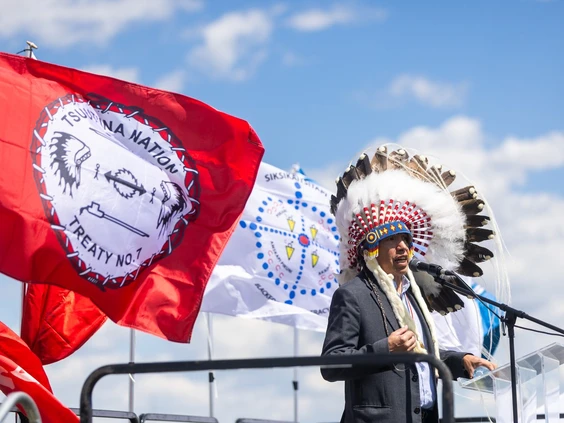
WINNIPEG — First Nations leaders in Manitoba are calling on the federal government to pass legislation that would eliminate one of the most controversial provisions of the Indian Act before Parliament rises for its summer break.
Speaking at a news conference in Winnipeg, Assembly of Manitoba Chiefs Grand Chief Kyra Wilson urged members of the House of Commons to immediately approve Bill S-2, legislation that seeks to remove the second-generation cutoff rule that has affected Indigenous families for decades.
“Parliament is running out of time to finally end one of the most discriminatory provisions that remains in the Indian Act,” Wilson said. “No child should lose recognition because of who their parent or grandparent married or chose to have children with.”
Bill S-2 was introduced in the Senate in May 2025 to address long-standing inequities within the Indian Act. The proposed legislation would eliminate the second-generation cutoff provision introduced in 1985, which prevents certain descendants of First Nations people from obtaining status if they come from two successive generations where one parent did not have status under the Act.
The bill would also address historical injustices linked to enfranchisement, a former federal policy that stripped many First Nations individuals and their descendants of their legal Indigenous status.
According to Indigenous Services Canada, passage of the legislation could immediately restore status eligibility to approximately 3,500 individuals across the country.
Status under the Indian Act provides access to various programs and benefits, including health services, educational support, tax exemptions, and other federal assistance programs. However, First Nations leaders stressed that the issue extends far beyond access to government benefits.
Grand Chief Garrison Settee of Manitoba Keewatinowi Okimakanak described the legislation as a matter of identity, cultural continuity, and justice.
“If we allow this to continue, generations from now, will there be any treaty people left in this nation?” Settee asked. “The time has come to stop allowing bureaucrats in Ottawa to determine who is Indigenous and who is not.”
Wilson shared her personal experience, revealing that her own daughter was denied status despite an application being submitted shortly after birth.
“The day she was born, I applied for status on her behalf, and Canada denied that registration,” Wilson said, explaining that the decision was linked to historical family circumstances involving Métis scrip.
Federal Conservative Indigenous Services critic Billy Morin joined Indigenous leaders in supporting the bill, arguing that the current system contradicts the government’s stated commitment to nation-to-nation relationships with First Nations communities.
“How can government leaders claim to respect Indigenous nations while maintaining laws that erase the identities of future generations?” Morin said.
He praised the Senate for advancing the legislation and said its passage would help reconnect families with their communities and cultural heritage.
“We will see people return to communities they have been separated from and ensure that future generations do not lose their identity because of who they choose to marry or have children with,” Morin said.
Despite widespread support among Indigenous leaders, Morin expressed concern that the legislation may not be passed before Parliament adjourns for the summer.
“Unfortunately, many First Nations families who have been waiting for action may have to wait until the fall because the government has not treated this as an urgent priority,” he said.
The office of Indigenous Services Minister Mandy Gull-Masty responded by stating that the federal government has accelerated consultations aimed at addressing the second-generation cutoff and related registration issues.
According to the minister’s office, a legal advisory committee is currently reviewing proposals, while additional consultations with First Nations partners are planned during the summer months.
However, Manitoba chiefs argue that further consultation is unnecessary and that immediate legislative action is required.
“They need to pass this now,” Wilson said. “Not in the fall, not after another study, and not after another delay. Indigenous families have waited long enough.”
She emphasized that Indigenous communities have been advocating for changes to the registration system for many years and that Parliament now has an opportunity to correct a historic injustice.
“There is no justification for further delay,” Wilson said. “This legislation is about fairness, equality, and ensuring future generations are not denied their identity.”
As Parliament approaches its summer recess, Indigenous leaders across Manitoba and Canada continue to press Ottawa to act before lawmakers leave Ottawa, arguing that every delay prolongs the impact of a policy they describe as discriminatory and harmful to Indigenous families and communities.
Courtesy: CBC
Post Disclaimer
The views and content presented in this article, news report, or video are solely those of the respective author or creator and do not necessarily reflect the official policy or position of BW Times Digital Online E-Paper.









Leave a comment