
















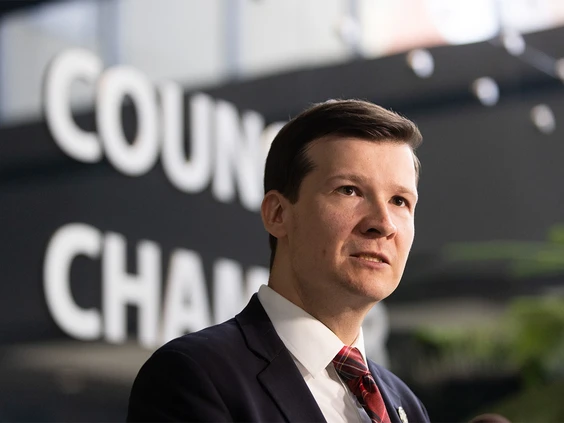
Calgary Mayor Jeromy Farkas is receiving strong public approval in a new opinion poll, while a debate over Premier Danielle Smith’s education property-tax reduction has exposed continuing disagreements between the provincial government and Calgary city councillors.
A survey conducted by Canada Pulse Insights for CityNews found that 74 per cent of Calgarians believe Farkas is doing a good job as mayor. Of those surveyed, 26 per cent described his performance as very good, while 26 per cent said he was doing a bad job.
The poll also indicated that Farkas has considerable support for another term, with 65 per cent of respondents saying he deserves re-election, compared with 35 per cent who believe it is time for a change.
However, the findings reveal a more complicated picture of public confidence in municipal leadership. A majority of respondents, 56 per cent, said the mayor and city council are out of touch with residents’ needs and expectations. Meanwhile, 44 per cent disagreed with that assessment.
The survey found that 53 per cent of Calgarians believe the city is moving in the right direction, while 47 per cent said it is heading in the wrong direction. Despite those mixed views, 64 per cent expressed pride in Calgary and the way the municipality operates.
City council also received relatively positive ratings, with 65 per cent of respondents saying it is doing a good job. In addition, 67 per cent gave favourable assessments of their own ward councillor.
The online survey was conducted between September 30 and October 9, involving 401 Calgary residents and 383 Edmonton residents aged 18 and older.
While Farkas’s polling numbers have drawn attention, the mayor is also dealing with a significant financial debate involving Alberta’s education property tax system.
Premier Danielle Smith announced on October 30 that her government would introduce a standardized provincial education property-tax rate and freeze it for three years. The province estimates the changes will save property owners nearly $100 million in 2027-28.
Under the new system, residential properties and farmland will be assessed at a rate of $2.65 per $1,000 of assessed value, while non-residential properties will be taxed at $3.975 per $1,000. The revised rates are scheduled to take effect in 2027.
Smith presented the announcement as a measure to improve affordability and create a more consistent tax system across Alberta.
Farkas welcomed the decision, saying the province’s move would provide greater transparency and predictability for municipalities as Calgary prepares its next budget cycle. He has repeatedly criticized the provincial education levy, arguing that a substantial portion of the increase in Calgary property-tax bills this year resulted from the provincial government rather than municipal spending.
The provincial education tax increased by 21 per cent in 2026. For a typical Calgary homeowner, the increase added approximately $338 to the annual bill, while the city’s own 1.8 per cent municipal tax increase accounted for about $49.
However, not everyone at City Hall considers the latest announcement sufficient.
Ward 10 Councillor Andre Chabot questioned whether standardizing the education tax rate would resolve the underlying imbalance affecting rapidly growing municipalities. He argued that Calgary and other expanding communities continue to carry a disproportionate share of the education tax burden because their property assessments and values are increasing faster than those in some other municipalities.
Chabot also pointed to the difference between the limits placed on municipal taxation and the provincial government’s approach to collecting education taxes. He said he would continue advocating for a fairer distribution of the burden among Alberta taxpayers or an upper limit tied to the municipality in which they live.
The debate highlights the complicated relationship between provincial tax policy and municipal finances. Although the province collects the education portion through municipal property-tax bills, city councils do not control how those provincial funds are determined or spent.
For Calgary homeowners, the new rates are expected to provide some relief beginning in 2027. However, the actual amount residents pay will also depend on changes in their property assessments and the separate municipal tax rate set by city council.
The latest poll and the ongoing tax discussion come as Calgary enters another important period of municipal decision-making. Farkas’s approval ratings suggest that many residents are satisfied with his early performance, but concerns about affordability, housing, infrastructure and the responsiveness of City Hall remain significant challenges for the mayor and council.
Courtesy: calgaryherald
Post Disclaimer
The views and content presented in this article, news report, or video are solely those of the respective author or creator and do not necessarily reflect the official policy or position of BW Times Digital Online E-Paper.



Leave a comment