











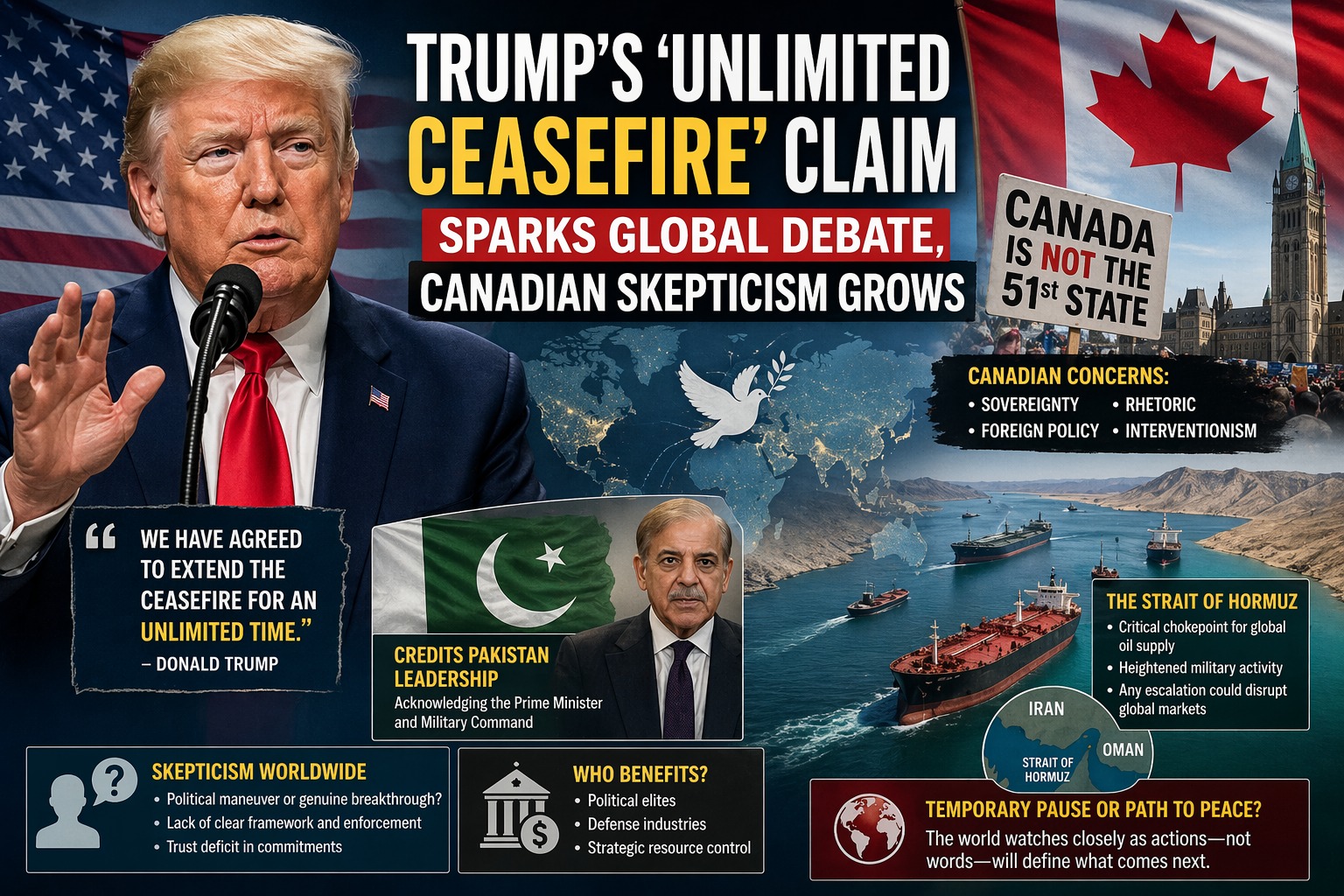
From a political analyst’s perspective, recent remarks by Donald Trump regarding an “unlimited ceasefire extension” have ignited widespread debate across global political circles, with particularly strong reactions emerging in Canada. A notable segment of Canadian public opinion remains critical of Trump’s leadership style, questioning both his rhetoric and broader foreign policy direction.
Concerns intensified after controversial suggestions that Canada could become the “51st state” of the United States circulated publicly. While some dismissed the remarks as rhetorical, many Canadians interpreted them as dismissive of national sovereignty, prompting visible backlash. Additionally, Trump-era approaches toward regions such as Venezuela and Iran have drawn criticism among Canadians who view such policies as interventionist and destabilizing.
Within this climate of skepticism, Trump’s latest ceasefire claim—crediting Pakistan’s leadership—has been received cautiously. While officials in Pakistan have welcomed the acknowledgment as a diplomatic success, many international analysts interpret the move differently. For them, the announcement appears less like a breakthrough and more like a strategic communication effort aimed at shaping perception rather than delivering lasting peace.
Critics argue that Trump has consistently framed geopolitical developments in ways that align with short-term political objectives. This pattern has contributed to a broader trust deficit, with observers noting that while his statements often generate immediate headlines, they are frequently followed by uncertainty regarding execution and consistency.
A Tactical Pause or Genuine Peace?
The ceasefire itself is increasingly being analyzed not as a final resolution but as part of a broader strategic timeline. Many experts believe it could represent a tactical pause rather than a definitive step toward peace. In conflict-prone regions, temporary halts are often used to reassess positions, consolidate resources, and prepare for future engagements.
Focus Shifts to the Strait of Hormuz
Particular attention has turned to the Strait of Hormuz, one of the world’s most critical energy corridors. A significant portion of global oil supply passes through this narrow waterway, making it central to both economic stability and geopolitical strategy.
Recent developments indicate heightened alertness in the region, including increased naval activity and strategic positioning by multiple actors. Although no direct confrontation has occurred, tensions remain elevated, and even minor escalations could have immediate global consequences.
Analysts suggest that if the ceasefire is temporary, it may serve as a time-gaining tactic within a broader framework involving Iran. Given Iran’s regional influence and control over key maritime routes, its role remains pivotal in shaping future developments.
Who Stands to Gain?
Another dimension under scrutiny is the question of beneficiaries. Historically, prolonged geopolitical tensions have often created advantages for political elites, defense sectors, and influential economic networks. Increased military spending, control over strategic resources, and shifting alliances can generate opportunities for those within established power structures.
Some international discussions have also pointed to broader influence networks surrounding major political figures, suggesting that policy decisions may at times align with interests beyond immediate public narratives.
Global Reactions Remain Divided
Reactions worldwide remain mixed. While some governments cautiously welcome any reduction in immediate tensions, others remain skeptical due to the absence of a clear framework, timeline, or enforcement mechanism. Without transparent diplomacy and verifiable commitments, such ceasefire declarations risk being perceived as symbolic rather than substantive.
From a Canadian standpoint, skepticism is reinforced by a strong preference for multilateralism and rules-based global order. Abrupt or unilateral announcements—particularly those lacking institutional backing—are often viewed with caution. Public discourse in Canada continues to emphasize accountability, clarity, and long-term strategic vision.
Global Impact Beyond the Region
The interconnected nature of modern geopolitics means that instability in one region can ripple across the world. Any disruption in the Strait of Hormuz would impact global energy markets, trade routes, and economic stability. Countries like Canada, despite geographical distance, remain vulnerable to fluctuations in oil prices and supply chains.
Rhetoric vs Reality
Political statements, especially in high-stakes international contexts, often serve multiple purposes—signaling intent, influencing allies, deterring adversaries, and shaping domestic opinion. However, their true significance lies in implementation. Without concrete actions and sustained diplomatic engagement, even ambitious declarations risk fading into uncertainty.
Conclusion
While Trump presents the “unlimited ceasefire” as a major diplomatic achievement, the broader geopolitical context suggests a far more complex reality. Canadian public sentiment, along with international analysis, reflects deep caution regarding both intent and sustainability.
The situation surrounding the Strait of Hormuz remains fragile, and Iran’s role continues to be central. The coming weeks will be critical in determining whether this ceasefire represents a genuine toward de-escalation or merely a temporary pause in a larger strategic play.
For now, the global community watches closely—aware that in geopolitics, moments of calm can be as uncertain and consequential as moments of conflict.
Post Disclaimer
The views and content presented in this article, news report, or video are solely those of the respective author or creator and do not necessarily reflect the official policy or position of BW Times Digital Online E-Paper.









Leave a comment