

















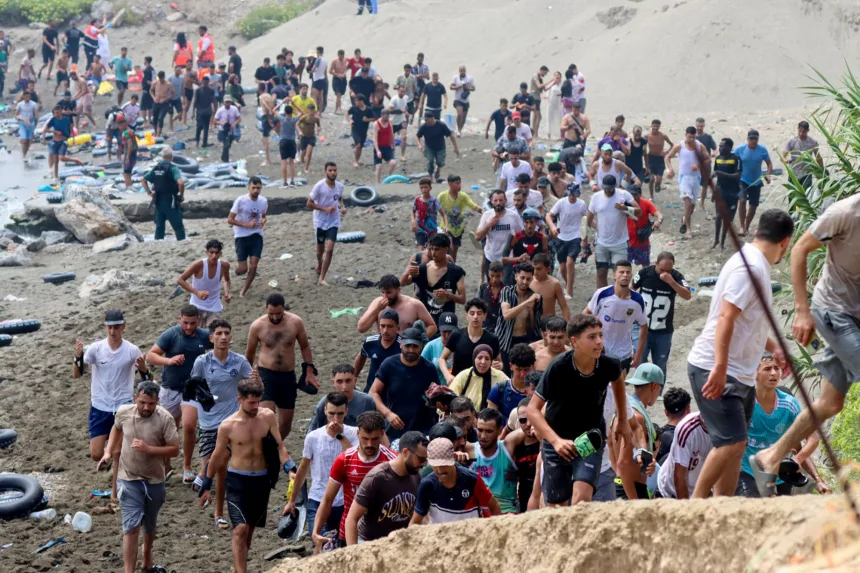
Spanish authorities say most of the estimated 50,000 migrants who crossed from Morocco into the Spanish enclave of Ceuta this week have now returned, easing pressure after one of the largest migration surges ever recorded at the border.
The mass crossing took place over two days as tens of thousands of people entered the North African territory by land and sea, overwhelming border security and emergency services. Spanish officials said the situation created a major humanitarian and security challenge in the enclave, which has a population of about 84,000.
The Spanish government confirmed that at least 57 people lost their lives during the crossings, with many believed to have drowned while attempting to swim around border barriers or cross through dangerous coastal waters.
Prime Minister Pedro Sánchez travelled to Ceuta following the crisis and described the mass entry as a violation of Spain’s territorial integrity. He said the surge had been fuelled by misinformation spread by human trafficking networks following a recent court ruling concerning migrants arriving by sea.
Although Spanish authorities initially announced plans to rapidly deport those who entered illegally, many migrants reportedly returned to Morocco voluntarily. Large numbers were seen crossing back through official border checkpoints and openings in the border fence after struggling to find food, shelter and basic services inside Ceuta.
The unprecedented influx has triggered political tensions across Europe. Italy announced temporary restrictions on air and maritime travel involving Spain, arguing that additional measures were necessary to protect European borders. Italian leaders also called for a review of Spain’s participation in the Schengen free-travel system.
European Union officials expressed concern over the situation while reaffirming that migration into the bloc must take place according to established legal procedures. France also strengthened border checks with Spain in response to the crisis.
The events have intensified debate over immigration policy across Europe, where migration remains one of the continent’s most politically sensitive issues. Spain’s comparatively open immigration approach has faced growing criticism from opposition parties, with conservative and far-right leaders accusing the government of failing to secure the country’s borders.
The United States also criticised Spain’s immigration policies, while President Donald Trump pointed to the incident as an example of the challenges posed by irregular migration.
The migration crisis also sparked unrest on the Moroccan side of the border, where clashes were reported near the city of Fnideq as authorities attempted to control crowds gathering near crossing points.
Ceuta and the nearby Spanish enclave of Melilla have long served as key entry points into Europe for migrants seeking a better future. Although both territories are part of Spain and the European Union, they remain geographically separated from mainland Europe and share land borders with Morocco.
A similar migration surge occurred in Ceuta in 2021, when thousands of migrants crossed into the enclave over a two-day period. However, officials say this week’s movement of around 50,000 people represents an unprecedented challenge in both scale and speed.
Spanish authorities continue to monitor the situation while reinforcing border security and coordinating with Moroccan officials to prevent further mass crossings. The latest developments have once again placed migration policy at the centre of political debate in Spain and across Europe as governments seek to balance humanitarian responsibilities with border security.
Courtesy: CNN
Post Disclaimer
The views and content presented in this article, news report, or video are solely those of the respective author or creator and do not necessarily reflect the official policy or position of BW Times Digital Online E-Paper.









Leave a comment