

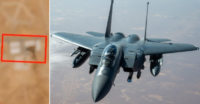












Newly released satellite imagery appears to show damage to aircraft shelters at King Faisal Air Base in Jordan following Iranian claims that one of its missile strikes successfully hit the strategically important military facility.
The images show a heavily damaged aircraft hangar with thick black smoke rising from the site, suggesting that military equipment inside the structure may have been destroyed. Iranian officials have claimed that a shelter housing a U.S. Air Force F-15E Strike Eagle fighter was among the targets hit during the attack. However, there has been no independent confirmation from U.S. or Jordanian authorities regarding the reported destruction of any aircraft.
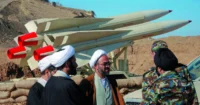
The strike is part of a broader escalation in regional tensions, with Iran stating that several military facilities used by U.S. forces and allied nations have been targeted in recent operations. King Faisal Air Base has long served as a key location supporting U.S.-led military activities in the Middle East, making it a strategically significant installation.
Iranian military officials have maintained that the missile attack successfully struck its intended target, while analysts continue to examine available satellite imagery to assess the extent of the damage. If confirmed, the incident would represent another example of the increasing vulnerability of military aircraft stationed at fixed air bases within range of modern precision-guided missile systems.
Military experts note that recent conflicts have demonstrated how advanced ballistic missiles can threaten even heavily protected military installations. As missile technology continues to evolve, air forces around the world are placing greater emphasis on hardened aircraft shelters, dispersal strategies and integrated air defence systems to reduce the risk of aircraft being destroyed while on the ground.
The F-15E Strike Eagle remains one of the U.S. Air Force’s primary long-range multirole combat aircraft, valued for its extended operational range, heavy weapons payload and ability to conduct precision strike missions. Its capabilities have made it an important asset during operations across the Middle East.
The reported attack has also renewed discussion about the effectiveness of missile defence systems protecting military facilities throughout the region. Although Iran has claimed successful strikes against several U.S.-linked installations during the ongoing confrontation, many of those claims have not been independently verified.
King Faisal Air Base is one of several military locations in allied Middle Eastern countries that have reportedly faced missile threats as regional hostilities continue. Previous reports have also suggested damage to military infrastructure, including aircraft shelters, drone facilities and support buildings at other bases, although official confirmation has remained limited.
Defence analysts say the latest imagery underscores the changing nature of modern warfare, where long-range precision missiles are increasingly capable of threatening high-value military assets without direct engagement between opposing air forces. This has prompted militaries worldwide to reconsider how they protect aircraft and other critical equipment at forward operating bases.
At the time of publication, neither the United States nor Jordan had publicly confirmed the reported destruction of F-15 aircraft or provided an official assessment of the damage shown in the satellite images. The situation continues to be closely monitored as further information becomes available.
Courtesy: militarywatchmagazine
Post Disclaimer
The views and content presented in this article, news report, or video are solely those of the respective author or creator and do not necessarily reflect the official policy or position of BW Times Digital Online E-Paper.






Leave a comment