












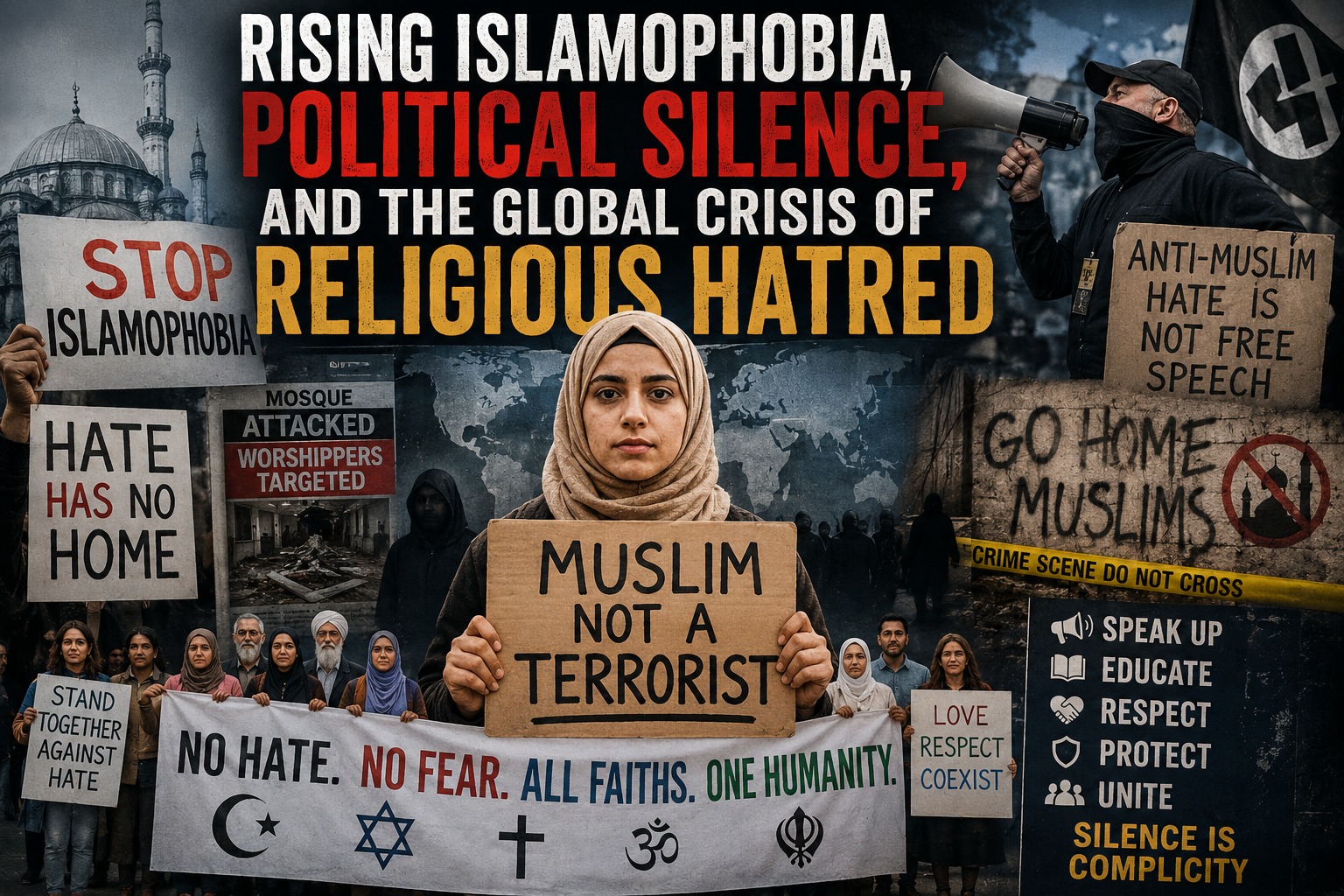
Across the United States, Canada, the United Kingdom, and several European countries, Islamophobia has become one of the most serious social and political challenges of modern times. Muslim communities living in Western societies increasingly report fear, insecurity, discrimination, and growing hostility in their daily lives. Mosques are being vandalized, Muslim women are facing harassment in public spaces, online hate campaigns are expanding rapidly, and far-right extremist groups are openly spreading anti-Muslim propaganda. Yet despite the growing number of incidents, many critics believe that world leaders and major international institutions have failed to respond with the urgency and seriousness this crisis demands.
Over the past two decades, particularly after the September 11 attacks in the United States, Muslims in many Western countries have faced increasing suspicion and stereotyping. Although millions of Muslims have peacefully integrated into Western societies and contribute positively as doctors, engineers, teachers, journalists, artists, business owners, and public servants, extremist narratives often portray Muslims collectively as outsiders or security threats. Human rights advocates warn that such generalizations are dangerous because they normalize prejudice and encourage hate-driven violence.
Political rhetoric in several countries has also intensified social divisions. In the United States, immigration and Islam became major political issues during highly polarized election campaigns. Critics argued that fear-based narratives targeting Muslims and immigrants created an atmosphere where intolerance became more socially acceptable. Similar trends emerged in Europe, where far-right political movements used concerns over migration, refugees, and national identity to gain public support. In countries such as France, Germany, the Netherlands, Italy, Austria, and Sweden, anti-Muslim demonstrations and inflammatory political speeches contributed to growing tensions within multicultural societies.
The United Kingdom has also experienced increasing reports of Islamophobic incidents. Muslim organizations have documented verbal abuse, attacks against mosques, discrimination in workplaces, and harassment of visibly Muslim women. Many British Muslims say they feel unfairly judged because of global political conflicts or terrorist incidents carried out by extremists who do not represent the beliefs of ordinary Muslims. Community leaders repeatedly stress that collective blame only deepens division and weakens social harmony.
One of the most alarming developments has been the rise of white supremacist and neo-fascist extremist groups across North America and Europe. These groups use online platforms and social media to spread conspiracy theories and anti-Muslim propaganda. Some extremists promote the false narrative that Muslims are attempting to replace Western culture or undermine national values. Analysts warn that such hateful ideologies have inspired violent attacks against mosques and Muslim communities in different parts of the world.
In recent years, several deadly attacks targeting Muslims have shocked the international community. Worshippers inside mosques have been attacked during prayers, Islamic centers have received bomb threats, and Muslim families have been targeted because of their faith. Yet many activists believe that the global reaction to anti-Muslim violence is often weaker than responses to attacks against other religious groups. This perception has created frustration and anger among Muslims who feel their pain is not treated equally on the international stage.
Critics argue that there is often a noticeable silence from powerful world leaders when Muslims become victims of hate crimes or religious violence. While some governments issue brief statements condemning attacks, many Muslims feel these responses lack seriousness, consistency, and moral clarity. Human rights advocates say this silence sends a dangerous message that anti-Muslim hatred is somehow more acceptable or politically convenient to ignore.
Many Muslim intellectuals and civil society organizations argue that Islamophobia has now become institutionalized in parts of the Western world. They point to discriminatory policies, media stereotyping, aggressive immigration debates, and public discourse that frequently associates Islam with extremism. They also warn that sensationalized media coverage often amplifies fear instead of promoting understanding between communities.
At the same time, Jewish communities across the West are also facing rising antisemitism. Synagogues have been vandalized, Jewish institutions threatened, and antisemitic hate speech has spread online. Human rights experts emphasize that hatred against Muslims and Jews often emerges from the same extremist ideologies. White supremacist groups, neo-Nazi movements, and far-right extremists frequently target multiple minority communities simultaneously. Experts therefore argue that combating Islamophobia and antisemitism should be a shared struggle for all democratic societies.
Canada, known internationally for multiculturalism and diversity, has also witnessed disturbing incidents targeting Muslims. Mosques have received threats, Islamic schools have faced intimidation, and Muslim citizens report increasing hostility both online and in public life. Several violent incidents in recent years deeply affected Canadian Muslim communities and raised concerns about radicalization among far-right extremist groups. Many Canadians have expressed solidarity with Muslim communities, yet activists say stronger action is still needed to confront organized hate networks.
Social media has become a major factor in spreading Islamophobia globally. Extremist influencers and hate groups use digital platforms to circulate misinformation, conspiracy theories, and anti-Muslim propaganda. Algorithms that reward sensational and emotionally charged content often allow hateful narratives to spread faster than factual information. Experts warn that young people can become radicalized online through constant exposure to racist and extremist content.
Religious scholars and interfaith leaders continue to emphasize that Islam, like Christianity, Judaism, Hinduism, Sikhism, and other faiths, teaches principles of peace, compassion, justice, and coexistence. They argue that the actions of violent extremists should never be used to judge entire religious communities. Collective blame not only harms innocent people but also strengthens extremists by creating fear and social division.
The silence or weak response from political leaders has become a central issue in discussions about Islamophobia. Many Muslims believe governments often hesitate to confront anti-Muslim hate because of political pressure, electoral calculations, or fear of criticism from far-right groups. Critics argue that this hesitation undermines democratic values and weakens public trust in institutions meant to protect all citizens equally.
Human rights organizations stress that defending religious freedom must apply equally to everyone. If attacks against mosques are ignored while attacks against other religious institutions receive strong international condemnation, it creates a perception of unequal humanity. Activists say justice and empathy cannot depend on political convenience or the religion of victims.
Despite these challenges, many ordinary citizens across North America and Europe continue to reject hatred and extremism. After attacks on Muslim communities, thousands of people from different religious and cultural backgrounds have participated in vigils, solidarity marches, and interfaith events. Churches, synagogues, temples, and community organizations have stood beside Muslims to show support against intolerance and racism. These moments of unity demonstrate that many people still believe in coexistence and mutual respect.
Muslim communities themselves continue to contribute positively to society despite facing discrimination and hostility. Across Western countries, Muslims are serving in hospitals, universities, government institutions, media organizations, businesses, and cultural industries. Younger generations of Muslims are increasingly active in civic engagement, journalism, education, arts, and social activism, working to challenge stereotypes and build bridges between communities.
Experts warn that if Islamophobia continues to grow unchecked, the consequences could be dangerous for the future of democratic societies. Hatred against minorities creates polarization, weakens social trust, and increases the risk of radicalization on all sides. Extremist groups thrive in environments of fear and division. When political systems fail to protect vulnerable communities equally, democracy itself becomes weaker.
The growing crisis of Islamophobia is no longer only a Muslim issue. It has become a global test of whether modern societies truly believe in equality, human rights, religious freedom, and justice for all people. Many observers argue that world leaders must move beyond symbolic statements and take meaningful action against hate speech, extremist violence, online radicalization, and discrimination.
Silence in the face of hatred only allows intolerance to grow stronger. Whether the victims are Muslims, Jews, Christians, Sikhs, Hindus, or any other community, violence and racism must be condemned consistently and without hesitation. The future of peaceful multicultural societies depends on the willingness of governments, institutions, media, and citizens to stand united against all forms of religious hatred and extremism.
Post Disclaimer
The views and content presented in this article, news report, or video are solely those of the respective author or creator and do not necessarily reflect the official policy or position of BW Times Digital Online E-Paper.








Leave a comment