

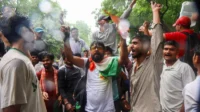









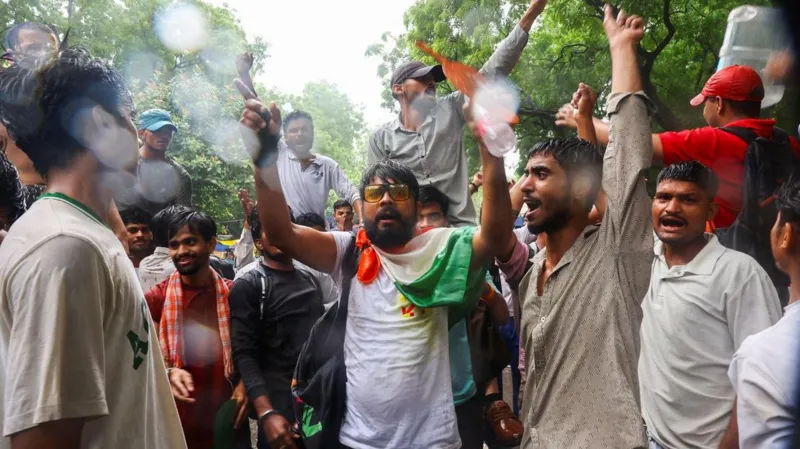
India’s federal government is facing growing political pressure as the youth-led Cockroach Janta Party (CJP) protest movement continues to expand, drawing thousands of demonstrators to the streets of New Delhi and several other major cities despite heavy monsoon rains and a recent police crackdown.
The movement, which began as a campaign demanding sweeping education reforms and the resignation of Education Minister Dharmendra Pradhan, has rapidly evolved into one of the most significant public protest movements seen during Prime Minister Narendra Modi’s current term in office.
Protesters have maintained a continuous sit-in at Jantar Mantar in New Delhi after police dismantled temporary stages and protest camps during efforts to disperse demonstrators earlier this week. Thousands have continued gathering at the site, refusing to end their demonstration despite adverse weather conditions and heightened security measures.
The protests gained additional political momentum after leaders of the opposition Congress Party staged a demonstration outside the prime minister’s residence, condemning the police response to earlier protests in which dozens of demonstrators and police officers were injured.
Congress leader Rahul Gandhi and several party members were briefly detained after police removed protesters from the area. Videos circulating widely on social media showed opposition leaders being escorted into police vehicles before later being released.
The latest wave of demonstrations follows a massive march toward Parliament at the beginning of the monsoon session, where tens of thousands of protesters gathered to press for reforms. Police used batons and tear gas to disperse crowds after tensions escalated, leaving dozens of people injured.
Since then, the protest movement has attracted support from several senior opposition leaders, including former Delhi Chief Minister Arvind Kejriwal and veteran politician Sharad Pawar, who visited demonstrators and expressed solidarity with their demands.
Rahul Gandhi accused the government of refusing to allow a parliamentary debate on the issues raised by protesters and called for the resignation of Education Minister Dharmendra Pradhan, Home Minister Amit Shah and Prime Minister Narendra Modi.
The government has rejected those allegations. Federal Minister Jitendra Singh said the administration had agreed to discuss education-related concerns in Parliament, accusing the opposition of escalating political demands after their original request had been accepted.
Education Minister Dharmendra Pradhan also defended the government’s position, stating that the administration remains committed to improving the education system while accusing opposition parties of using students for political purposes rather than working toward practical solutions.
Although Pradhan did not directly mention the Cockroach Janta Party in his public remarks, he emphasized that students deserve meaningful reforms, accountability and constructive dialogue instead of political confrontation.
The Cockroach Janta Party began as a satirical movement inspired by controversial remarks made earlier this year by India’s Chief Justice, who used the word “cockroach” while referring to unemployed young people entering journalism and activism. Following widespread criticism, the Chief Justice later clarified that his comments were directed only at individuals possessing fraudulent academic qualifications.
Rather than fading away, the controversy inspired young activists to adopt the label as a symbol of protest against unemployment, educational inequality and broader concerns about opportunities for young people in India.
The movement has received additional national attention following the involvement of activist and education reform campaigner Sonam Wangchuk, who joined protesters in late June and began an indefinite hunger strike in support of their demands. Wangchuk was later removed from the protest site by police and transferred to a hospital, where reports indicate he continues his hunger strike.
Support for the demonstrations has expanded beyond the national capital, with solidarity protests taking place in Mumbai, Bengaluru, Hyderabad and Ahmedabad, reflecting growing dissatisfaction among sections of India’s youth over education policies and employment opportunities.
Political analysts say the movement has developed into one of the most visible expressions of public dissent in recent years, combining student activism with broader political opposition at a time when Parliament has resumed its legislative session.
As demonstrations continue across the country, attention remains focused on whether the government will pursue further dialogue with protest leaders or whether the movement will continue to grow in the weeks ahead.
Courtesy: BBC
Post Disclaimer
The views and content presented in this article, news report, or video are solely those of the respective author or creator and do not necessarily reflect the official policy or position of BW Times Digital Online E-Paper.










Leave a comment