











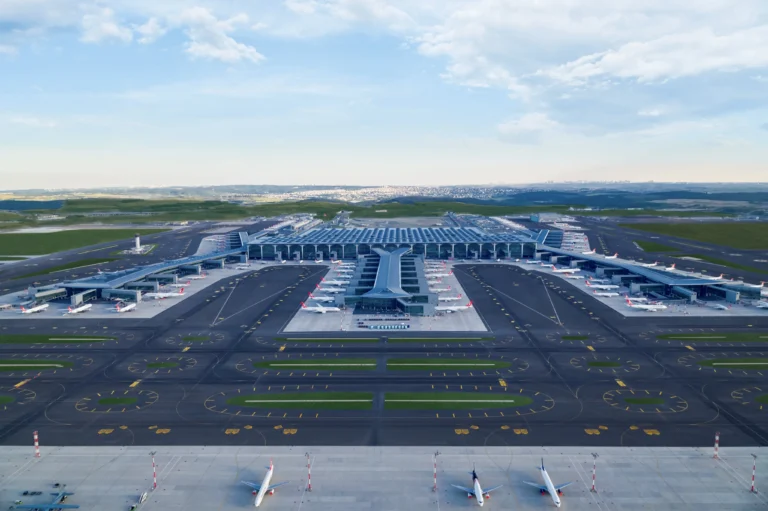
Istanbul Airport is preparing to open its fourth main runway this week, marking another major step in the rapid expansion of one of Europe’s fastest growing aviation hubs.
The new runway is scheduled to become operational on September 18. Measuring 2,820 metres long and 45 metres wide, it will introduce an east west runway alignment to an airport whose three existing main runways operate on a north south orientation.
The additional infrastructure is expected to give air traffic controllers greater flexibility, particularly when changing wind and weather conditions affect airport operations. It will also provide advantages for some domestic and eastbound flights by reducing aircraft taxiing requirements and potentially shortening overall journey times.
Turkey’s Transport and Infrastructure Minister Abdulkadir Uraloglu has announced the opening, with President Recep Tayyip Erdogan expected to attend the inauguration.
The fourth runway comes at a significant moment for Istanbul Airport. Passenger numbers have risen rapidly since the airport replaced Istanbul Ataturk Airport, bringing the Turkish hub increasingly close to London Heathrow in the European traffic rankings.
In 2025, Istanbul Airport handled approximately 84.44 million passengers, only around 40,000 fewer than Heathrow’s 84.48 million. That narrow difference demonstrated how quickly Istanbul has emerged as a major competitor to Europe’s traditional aviation leaders.
The airport has continued to record exceptionally high traffic levels in 2026. Flight movements have approached 1,800 in a single day, highlighting the growing pressure on airport infrastructure and the importance of additional runway capacity.
The new runway is expected to help address that pressure while giving the airport greater operational resilience.
A New Direction for Istanbul’s Runway Network
One of the most important characteristics of the new runway is its east west alignment.
The three existing main runways are positioned north south, meaning the new runway will provide an alternative operating direction. This can become particularly valuable when wind conditions make certain runway configurations less efficient.
A runway’s orientation plays a major role in aircraft operations because planes normally take off and land into the wind. Having runways pointing in different directions allows an airport to adapt more effectively to changing weather.
Officials also expect the new runway to benefit flights operating toward eastern destinations and domestic routes. Shorter taxiing distances on some operations could reduce fuel consumption and improve aircraft turnaround times.
For an airport handling tens of millions of passengers each year, even small improvements in aircraft movement can produce significant operational benefits.
From Ataturk to a New Global Hub
Istanbul Airport was developed because the city’s former main airport, Ataturk Airport, faced severe limitations.
Ataturk had served Istanbul for decades after opening in 1953, but the airport had little room for major expansion. The site was surrounded by the growing city on three sides, while the Sea of Marmara restricted development in another direction.
Turkey therefore faced a strategic decision. Authorities could attempt to expand the existing airport or build a completely new aviation hub with enough land to accommodate future growth.
The government eventually chose the second option.
The new airport site near the Black Sea was located roughly 20 miles north of Ataturk Airport. The location provided far more room for expansion, although developing the site presented major engineering and environmental challenges.
Construction began in 2014. The project involved extensive earthworks because portions of the area had previously been used for open cast mining, while the development also generated controversy over environmental impacts and working conditions.
Despite those challenges, construction continued and Istanbul Airport opened in 2018.
The transfer from Ataturk was an enormous logistical operation. Thousands of workers and thousands of pieces of equipment were moved to the new airport during a tightly coordinated relocation process lasting only around 29 hours.
The airport initially operated with two main runways before a third independent runway was added in 2020.
That expansion allowed Istanbul Airport to become the first airport in Europe capable of operating three independent runways simultaneously.
The fourth runway now represents another stage in that long term development strategy.
Designed for Long Term Expansion
Istanbul Airport was not built simply to replace Ataturk. Its development was designed around the expectation that passenger demand would continue increasing for decades.
The initial design provided annual capacity of roughly 90 million passengers, while later development phases are intended to raise capacity substantially, with long term plans reaching as high as 200 million passengers annually.
That scale is central to Istanbul’s ambitions to remain a major connecting hub between Europe, Asia and Africa.
The airport currently links hundreds of destinations through a large network of airlines. Its geographic position gives it a natural advantage for connecting passengers travelling between different regions.
Its principal airline partner, Turkish Airlines, has also built Istanbul into one of the most important connecting points in its worldwide network.
The combination of location, airline connectivity and expanding infrastructure has allowed Istanbul Airport to compete directly with established European hubs.
Istanbul’s Challenge to Heathrow
The growth of Istanbul Airport has also intensified comparisons with Heathrow.
London Heathrow remains one of the world’s most important airports, but its location presents significant physical constraints. Expanding an airport in a densely populated metropolitan area is considerably more complicated than developing a new airport on a large site.
Istanbul Airport’s chief executive has argued that the British capital could benefit from a completely new airport rather than relying solely on expansion at Heathrow.
The argument reflects two fundamentally different approaches to aviation infrastructure.
Istanbul was designed from the beginning as a new hub with substantial room for future development. Heathrow, by contrast, is an established airport that has been operating for generations within a highly developed urban environment.
The British government continues to pursue additional capacity at Heathrow through plans for a proposed northwest runway. The expansion remains subject to consultation, parliamentary scrutiny and the required planning process.
The debate over Heathrow expansion has lasted for decades. Various alternatives have been considered over the years, including proposals for entirely new airports in different parts of southeast England.
The central question remains whether expanding an existing airport provides the best solution or whether a new hub would offer greater opportunities for future growth.
Cost and Capacity
The economics of airport development are another important part of the comparison.
Istanbul Airport was built with long term capacity in mind, while Heathrow’s proposed expansion would require major investment at an already heavily developed site.
However, construction cost alone does not determine whether an airport is competitive.
Airline demand, passenger access, airport charges, available land, surrounding infrastructure and the value of existing routes and landing slots all influence an airport’s position in the international market.
Heathrow benefits enormously from its location in London and its established network of airlines and passengers. Its limited capacity has also made airport slots extremely valuable.
Istanbul has taken a different approach by creating a large new hub capable of expanding as traffic increases.
The fourth runway reflects that philosophy.
A Single Terminal Built Around Connections
Another defining feature of Istanbul Airport is its large single terminal.
Rather than dividing passengers among several separate terminal buildings, the airport was designed around one main passenger terminal capable of handling large numbers of connecting travellers.
The design is intended to simplify transfers, particularly for passengers moving between international flights.
The concept can also create challenges because the terminal is enormous and passengers may have to walk significant distances between gates and other facilities.
For a major connecting hub, however, the single terminal approach is designed to keep passenger and baggage transfers within one integrated complex.
The airport’s operating structure is also based on a long term private concession. The facility is operated by iGA, with major Turkish construction companies among its ownership interests, under a contract that provides for operation over a defined period before control is expected to return to the Turkish state.
The arrangement forms part of Turkey’s wider strategy for financing and operating major transport infrastructure.
Istanbul’s Rise Among the World’s Major Airports
The rapid rise of Istanbul Airport is particularly striking because the facility has been operating for less than a decade.
Traditional global aviation rankings have long been dominated by airports such as Atlanta, Heathrow, Dubai, Chicago and Tokyo.
Istanbul has increasingly moved into that group.
Its passenger numbers have grown to a level where it is now challenging Heathrow for the position of Europe’s busiest airport.
The difference between the two airports in 2025 was remarkably small. Istanbul handled approximately 84.44 million passengers compared with Heathrow’s 84.48 million.
That gap shows that Istanbul is no longer simply an emerging competitor. It is now operating at a scale comparable with Europe’s most established aviation hubs.
What the Fourth Runway Means
The fourth runway is important not only because it adds another piece of infrastructure but because it gives Istanbul Airport greater flexibility.
The east west orientation complements the existing north south runway system, allowing airport authorities to respond more effectively to changing wind conditions.
It should also improve aircraft movements for selected routes, potentially reducing taxiing distances, fuel consumption and turnaround times.
As passenger numbers continue to rise, those efficiencies could become increasingly important.
The runway also demonstrates that Istanbul’s expansion strategy is continuing rather than slowing after the completion of its original airport project.
The airport was conceived as a long term alternative to Ataturk, with sufficient land and infrastructure to support growth for many years.
A New Era for European Aviation
The opening of the fourth runway on September 18 will strengthen Istanbul Airport’s position at a time when competition between major European hubs is becoming increasingly intense.
The airport has moved from being a new facility replacing Ataturk to becoming one of the continent’s largest aviation centres in a remarkably short period.
Its growing passenger numbers, extensive international network and large scale expansion plans give Istanbul a powerful platform for further growth.
The fourth runway will add another layer to that strategy, improving flexibility while preparing the airport for increasing traffic.
For Heathrow, the rise of Istanbul offers a striking example of what can happen when an entirely new airport is designed around future capacity rather than the limitations of an existing urban site.
The two airports now represent different visions for the future of European aviation. Heathrow is attempting to expand within one of the world’s most established cities, while Istanbul continues to build outward around a purpose designed international hub.
As the fourth runway opens, Istanbul Airport will take another major step toward its ambition of becoming one of the world’s leading aviation gateways.
Courtesy: aviationa2z
Post Disclaimer
The views and content presented in this article, news report, or video are solely those of the respective author or creator and do not necessarily reflect the official policy or position of BW Times Digital Online E-Paper.







Leave a comment