















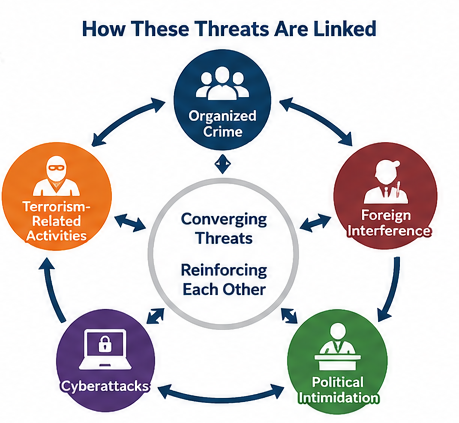
Although the world continues to strive for peace, stability, and economic development, it is increasingly confronted by a complex range of interconnected security threats. Organized crime, foreign interference, politically motivated intimidation, cyberattacks, and terrorism-related activities are no longer isolated challenges. Instead, they have become closely linked, creating one of the most significant public safety and national security concerns facing both developed and developing countries, including Canada. Because Canada is not immune to these evolving threats. As an open, democratic, and technologically advanced nation, Canada faces increasing risks from domestic and transnational criminal organizations, cyber-enabled crime, foreign interference, and violent extremist activities. Addressing these interconnected challenges requires a comprehensive approach that recognizes the links between different threat actors rather than viewing them as independent problems.
Historically, these threats were often treated as separate issues, with different government agencies responsible for addressing each one independently. Today, however, criminal and hostile actors increasingly cooperate, exchange resources, exploit common vulnerabilities, and adapt their methods to achieve shared objectives. This convergence makes these threats more resilient, sophisticated, and difficult to detect, investigate, and disrupt.
A useful analogy is that of a pack of jackals. A single jackal can pose a threat, but when jackals hunt together, they become far more effective, coordinated, and dangerous. Similarly, organized criminal groups, foreign actors, cybercriminals, and terrorist networks often operate within interconnected ecosystems. They may share financial resources, communication technologies, intelligence, logistical support, and digital platforms. When one network benefits, others may also gain operational advantages, increasing the overall threat to society.
Modern organized criminal networks, hostile foreign actors, cybercriminals, and extremist organizations increasingly exploit vulnerabilities that exist not only within security systems but also within society itself. Like a coordinated pack of hunters that identifies the weakest points before striking, these actors carefully study and exploit weaknesses across multiple domains to maximize their influence and achieve their objectives.
Their strategies are no longer limited to identifying physical security gaps or technological vulnerabilities. Instead, they target the broader fabric of society by exploiting emotional, moral, social, financial, cultural, and religious vulnerabilities. These interconnected weaknesses can become powerful tools for manipulation, recruitment, financial exploitation, and the spread of misinformation.
Canada has long been recognized as one of the world’s safest, most democratic, and multicultural nations. Its openness, diversity, and respect for civil liberties have made it a destination for immigrants, entrepreneurs, and international investment. However, these same strengths have increasingly attracted sophisticated criminal networks, foreign interference activities, transnational repression, and security threats that seek to exploit Canada’s democratic institutions and diverse communities.
Canada also faces continuing threats from external, internal terrorism and violent extremism. These threats may be inspired by ideological, religious, political, or grievance-based motivations. Online platforms, encrypted communications, and transnational digital networks have accelerated the spread of extremist narratives, creating new challenges for prevention and intervention.
One of the most concerning trends in recent years has been the rise of organized extortion targeting businesses and community members. Victims may experience intimidation through threatening communications, property damage, or other forms of bullying intended to force payment or silence.
Beyond financial losses, extortion creates fear within communities, discourages victims from reporting crimes, and erodes confidence in public institutions. It also places pressure on law enforcement agencies that must investigate offences spanning multiple jurisdictions and involving sophisticated financial networks.
Technology has transformed both the opportunities and challenges facing law enforcement. Artificial intelligence, block chain analytics, digital forensics, and advanced data analysis can help investigators identify criminal networks more quickly. At the same time, criminals increasingly exploit encrypted communication platforms, cryptocurrencies, and sophisticated laundering techniques, requiring continuous investment in investigative capabilities and specialized training.
Protecting Canada’s peace, multi cultures, security, and democratic institutions is a shared responsibility of both government institutions and the people of Canada. In today’s rapidly changing global environment shaped by technological advancement, social transformation, and increasing information flows, security can no longer be maintained by institutions alone. It requires active public awareness, education, and collective engagement across all communities.
Strengthening resilience begins with educating citizens about emerging risks and ensuring that accurate information is accessible to all segments of society. Public awareness campaigns, community engagement programs, and responsible communication strategies play a vital role in reducing vulnerabilities and preventing manipulation or misinformation.
The Royal Canadian Mounted Police (RCMP), Canadian Security Intelligence Service (CSIS), provincial police services, and other federal partners have consistently emphasized that Canada’s threat environment has become increasingly complex. According to the 2025 CSIS Public Report, the agency investigates threats including foreign interference, espionage, terrorism, violent extremism, sabotage, and subversion, while working with law enforcement partners to protect Canada’s national security.
References
- Canadian Security Intelligence Service. (2025). CSIS Public Report 2025.
- Financial Transactions and Reports Analysis Centre of Canada (FINTRAC). (2026). Money Laundering Indicators Related to Extortion.
- Public Safety Canada. Foreign Interference.
- Royal Canadian Mounted Police. Serious and Organized Crime.
- Royal Canadian Mounted Police. National Security.
- United Nations Office on Drugs and Crime. (2023). Global Study on Organized Crime.
- Financial Action Task Force (FATF). International Standards on Combating Money Laundering and Terrorist Financing.
Post Disclaimer
The views and content presented in this article, news report, or video are solely those of the respective author or creator and do not necessarily reflect the official policy or position of BW Times Digital Online E-Paper.











Leave a comment