












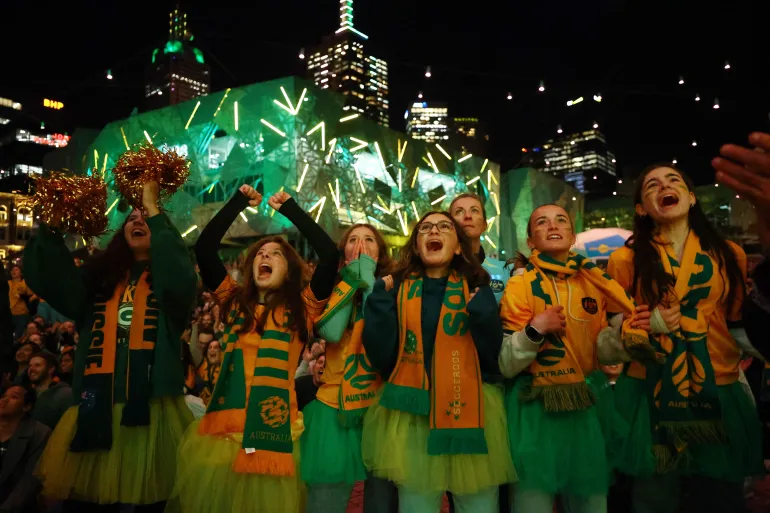
Australian football fans, players and sporting officials are expressing outrage after Melbourne’s Federation Square announced it will not screen FIFA World Cup matches this year, ending a tradition that has united supporters for more than two decades.
The management of Federation Square confirmed that no World Cup games will be shown on the venue’s giant public screen during the 2026 tournament, citing safety concerns and incidents of poor crowd behaviour during previous international football events.
The decision marks the first time in at least 20 years that fans will not be able to gather at the iconic Melbourne location to watch World Cup action collectively.
Federation Square has long served as the heart of football celebrations in Australia, attracting hundreds of thousands of supporters during past tournaments, particularly since the 2006 FIFA World Cup in Germany. The atmosphere reached global attention during the 2022 World Cup in Qatar, when videos of massive celebrations after Australia reached the Round of 16 spread widely across social media.
However, officials say several incidents during recent tournaments raised serious concerns. Fans were reportedly injured by flares and projectiles during celebrations, while barricades were stormed during the 2023 FIFA Women’s World Cup semifinal between Australia and England. Following those incidents, authorities had already cancelled plans to show the Matildas’ third-place playoff match at the venue.
Melbourne Arts Precinct Director and CEO Katrina Sedgwick said the decision followed careful review of previous events and crowd management issues.
She stated that the behaviour of a small number of attendees during earlier screenings caused damage to the venue and created unacceptable safety risks.
The move immediately triggered criticism from across Australia’s football community, with many arguing that the overwhelming majority of supporters should not be punished for the actions of a few individuals.
Patrick Clancy, chair of the Football Supporters Association Australia, said Federation Square had become a symbol of football culture in the country and played a major role in showcasing Australia’s passion for the sport to the world.
Football Australia also condemned the decision and urged the Victorian government and venue management to reconsider. Chief Executive Officer Martin Kugeler described Melbourne as one of Australia’s major sporting and multicultural cities and said the ban contradicts the city’s reputation as a hub for major sporting events.
He emphasized that Federation Square has hosted some of the country’s most memorable football moments, from the Socceroos’ historic 2006 World Cup campaign to the celebrations surrounding the 2023 FIFA Women’s World Cup.
Australian women’s national team captain Sam Kerr also reacted publicly, criticizing the decision in a brief but widely shared social media response.
Australia will compete against Türkiye, Paraguay and the United States during the FIFA World Cup, which runs from June 11 to July 19, 2026.
The controversy has sparked broader debate about balancing public safety with preserving sporting traditions and fan culture. Critics argue that instead of eliminating screenings altogether, authorities should have invested in stronger security measures and crowd management strategies.
Local businesses are also expected to feel the impact, as Federation Square screenings have historically attracted large crowds that boosted tourism, hospitality and retail activity during major tournaments.
With public pressure mounting, football supporters are now calling on Melbourne authorities to reverse the decision before the tournament begins next month.
Courtesy: Aljazeera
Post Disclaimer
The views and content presented in this article, news report, or video are solely those of the respective author or creator and do not necessarily reflect the official policy or position of BW Times Digital Online E-Paper.









Leave a comment