









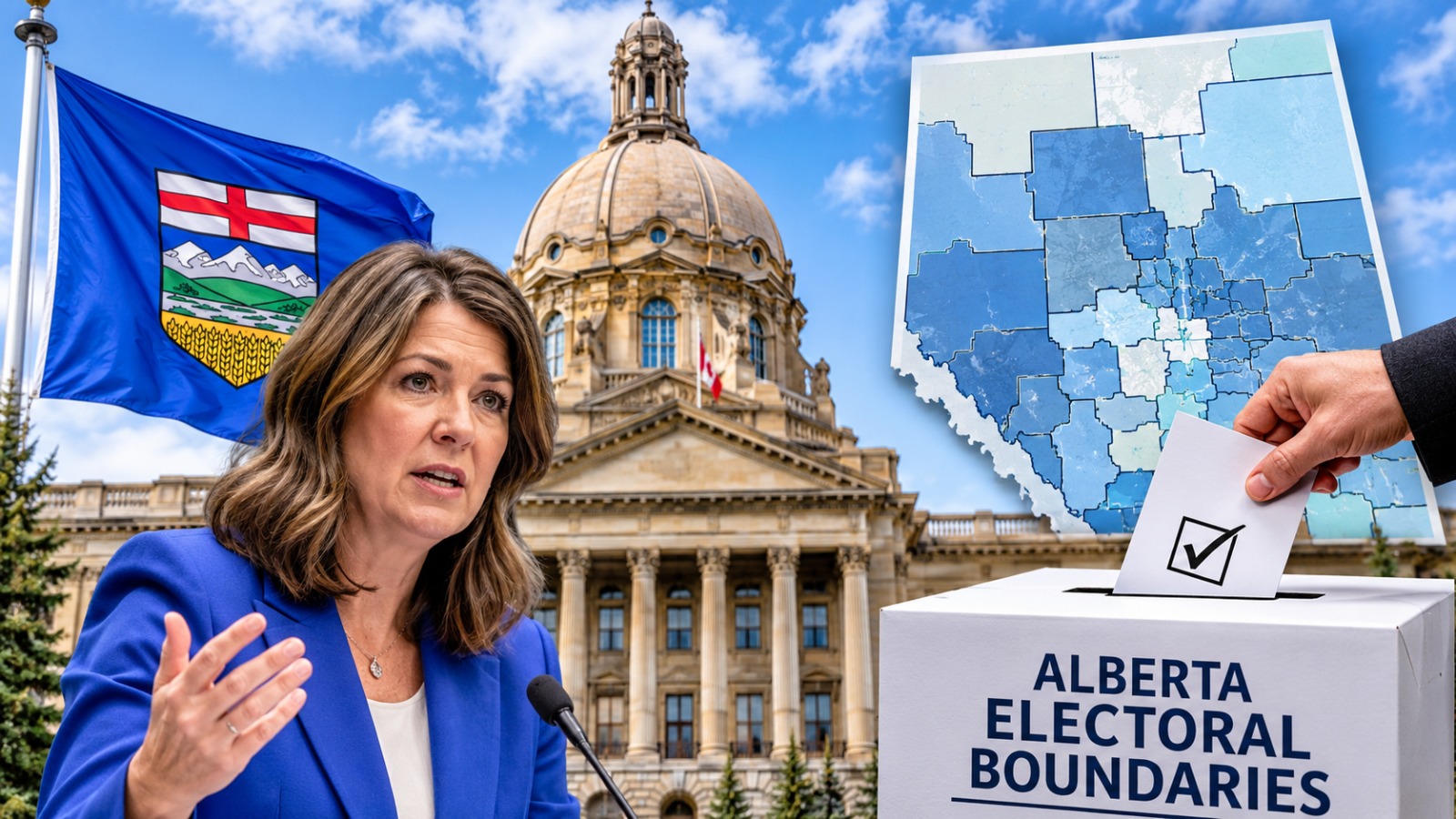
Alberta’s electoral boundaries have become the centre of an increasingly important political debate as the United Conservative Party (UCP) government of Premier Danielle Smith moves forward with plans to redraw provincial voting districts ahead of the next provincial election scheduled for October 18, 2027.
The proposed changes have raised questions about democratic representation, the independence of the electoral boundary process and the political influence of the government in determining how Albertans will be represented in the Legislative Assembly.
The debate is not simply about changing lines on an electoral map. It concerns how communities are represented, how many people each elected Member of the Legislative Assembly (MLA) should represent and whether urban and rural voters will receive fair and effective representation.
Alberta has experienced significant population growth in recent years, particularly in Calgary, Edmonton and surrounding communities. Population increases have placed additional pressure on existing constituencies, making a review of electoral boundaries necessary. The previous electoral map contained 87 constituencies, but the provincial government has legislated an increase to 89 and subsequently approved legislation to establish 91 electoral divisions.
The issue gained political attention following the work of the 2025–2026 Electoral Boundaries Commission, which was established to examine population changes and recommend adjustments to provincial electoral districts. The commission conducted consultations and considered submissions from Albertans concerning the representation of their communities.
Its final report was tabled in the legislature on March 26, 2026. The commission’s recommendations included proposals for adjusting urban and rural constituencies to reflect population changes. However, disagreements emerged over the number of electoral divisions and the geographical distribution of the proposed ridings.
The commission’s chair, Justice Dallas K. Miller, recommended that the legislature consider increasing the number of constituencies to 91 to address concerns about representation. The proposal became an important part of the subsequent political discussion.
In April 2026, the UCP government introduced Bill 32, officially known as the Electoral Boundaries Commission Amendment Act, 2026. The legislation proposed increasing the number of electoral divisions from 89 to 91. The bill passed through the legislative process and received Royal Assent on May 14, 2026, becoming law.
Another significant development occurred on April 21, when the Alberta Legislature approved Government Motion 37, establishing the Select Special Committee on Electoral Boundaries. The committee was assigned the responsibility of examining a new electoral boundary proposal with assistance from an independent advisory panel.
The committee consisted of six MLAs, including four representatives from the governing UCP and two from the opposition NDP. Brandon Lunty served as chair, alongside UCP members Chantelle de Jonge, Tara Sawyer and Ron Wiebe. The opposition was represented by Kathleen Ganley and Christina Gray.
The independent advisory panel was expected to examine population distribution, geographical considerations, community interests and the need for effective representation across Alberta. The new process, however, became controversial because opposition representatives questioned whether it offered sufficient public consultation and independence.
The controversy intensified in October after the advisory panel completed its work and submitted its report to the committee on October 22. Opposition representatives subsequently raised concerns about proposed changes affecting Calgary and Lethbridge.
One of the major concerns involved the reported proposal to divide Lethbridge into four electoral constituencies. NDP MLA Kathleen Ganley questioned the reasoning behind the proposed arrangement and raised concerns about population differences and the potential impact on local representation.
Opposition representatives also questioned proposed changes to Calgary’s electoral map, arguing that the new arrangements could have political consequences for voters and the distribution of electoral representation.
NDP leader Naheed Nenshi has criticized the government’s approach, arguing that electoral boundaries should be determined through a fair and independent process rather than political considerations. The UCP government, meanwhile, maintains that Alberta requires an updated electoral structure to reflect population growth and provide appropriate representation.
These competing positions have made the electoral boundaries issue a significant political discussion inside and outside the legislature.
An additional concern emerged on October 31, when Alberta’s Chief Electoral Officer, Gordon McClure, warned provincial legislators about the practical difficulties of implementing a completely new electoral map before the next general election.
In a letter dated October 30 and addressed to Legislative Assembly Speaker Ric McIver and MLAs, McClure outlined two possible approaches. The province could conduct the next provincial election using the existing electoral boundaries, or the government could consider postponing the election if a new map is implemented and insufficient preparation time remains.
The next provincial election is currently scheduled for October 18, 2027. However, Elections Alberta requires considerable time to prepare for an election, including updating voter information, establishing polling locations, assigning returning officers, preparing electoral materials and informing voters about changes to their constituencies.
McClure indicated that Elections Alberta generally requires between 12 and 18 months to prepare for a provincial election. He also referred to the additional administrative demands following Alberta’s October 19 provincial referendum.
His warning has added another dimension to the controversy because the timing of the final electoral map could directly affect election preparations. The Justice Minister’s office indicated that it was reviewing the letter and would respond after considering the issues raised.
Meanwhile, the Select Special Committee on Electoral Boundaries continued examining the advisory panel’s work. At its October 28 meeting, committee members discussed the report. A motion introduced by UCP MLA Ron Wiebe to conclude the committee’s review without additional observations passed by a vote of 3–2, with the three UCP members supporting the motion and the two NDP members opposing it.
The committee was expected to submit its report to the legislature by November 2, 2026. Its recommendations and the publication of the proposed electoral map are expected to provide greater clarity about the government’s intentions and the future organization of provincial constituencies.
For Alberta residents, the most important question is whether the new electoral boundaries will provide meaningful representation to all communities. Calgary and Edmonton have experienced substantial population increases, while rural communities face different geographical and demographic challenges. Any electoral arrangement must consider these differences while respecting the principle of effective representation.
Under Canada’s democratic framework, the right to vote and the right to effective representation are protected by the Canadian Charter of Rights and Freedoms. Effective representation does not necessarily require every constituency to have exactly the same population. Geography, community interests, transportation and the challenges of representing remote areas can also be considered.
The Alberta electoral boundaries controversy therefore extends beyond the political disagreement between the UCP and NDP. It raises fundamental questions about public confidence, transparency and the independence of the institutions responsible for organizing elections.
As the November 2 reporting deadline approaches, Albertans are waiting to see how the legislature will proceed with the proposed 91 constituencies, whether the government will accept the advisory panel’s recommendations and whether Elections Alberta will have sufficient time to prepare for the next provincial election.
Ultimately, electoral boundaries should ensure that every Albertan, regardless of whether they live in a major city, a growing suburban community or a rural region, has a meaningful opportunity to elect a representative and have their concerns heard in the provincial legislature.
Post Disclaimer
The views and content presented in this article, news report, or video are solely those of the respective author or creator and do not necessarily reflect the official policy or position of BW Times Digital Online E-Paper.








Leave a comment