















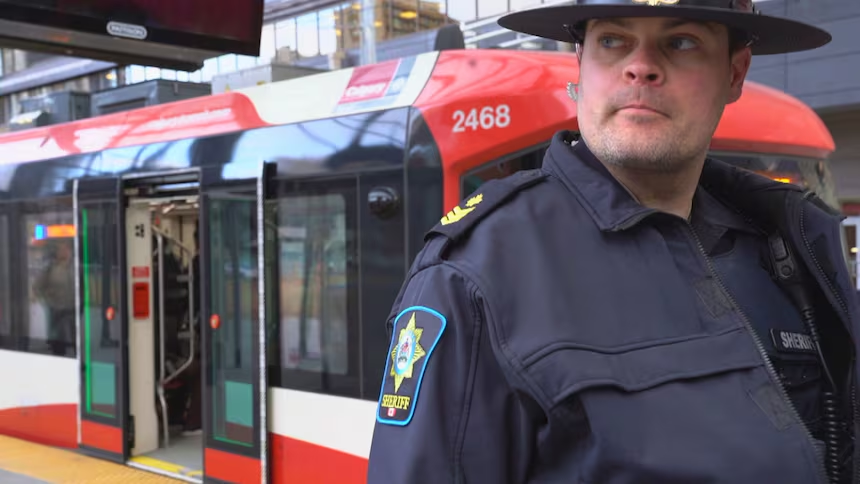
A growing number of residents in Calgary say daily life has changed because they no longer feel as secure in public spaces as they once did. Concerns about aggressive behaviour, unpredictable encounters, and visible disorder are now shaping how many people travel, shop, and move around the city.
Police data shows that officers respond to roughly 220 disorder related calls every day. These incidents often involve suspicious individuals, disturbances, unwanted guests, mental health concerns, or aggressive behaviour that may not always qualify as criminal offences but still create fear among the public.
For many residents, public transit has become one of the main sources of anxiety. Some longtime transit users now prefer driving after uncomfortable encounters at train stations and downtown platforms, especially during evening hours. What was once considered a practical and affordable option has become stressful for those who feel vulnerable when travelling alone.
Officials describe social disorder as behaviour that may include shouting, erratic actions, public substance use, or unpredictable conduct in crowded areas. Even when no direct crime occurs, such situations often leave residents feeling intimidated.
The downtown core remains one of the most discussed areas because of the concentration of businesses, nightlife, transit stations, shelters, and social services. Public calls to police regarding disorder in central Calgary have increased beyond recent averages, reflecting both rising frustration and reduced public tolerance.
Safety concerns are also spreading into suburban communities. Residents in different neighbourhoods report disturbing incidents in parking lots, shopping areas, and residential streets, causing many older residents in particular to avoid going out alone at night.
Although total crime numbers have declined in recent years, violent crime continues to rise. Assault related incidents increased compared with previous years, reinforcing public concern that safety challenges are becoming more serious.
Population growth is another factor influencing public perception. Rapid migration into Calgary has increased pressure on housing, emergency services, and public spaces. As more people use transit systems and downtown areas, visible social challenges have become harder to ignore.
Authorities have increased patrols involving police, sheriffs, and bylaw officers in targeted areas. Special enforcement operations have resulted in arrests, warrant executions, and social service referrals, showing an effort to combine policing with support measures.
Jeromy Farkas has identified public safety as a major civic priority, emphasizing long term solutions that address both enforcement and underlying causes.
Meanwhile, provincial changes including the planned closure of the supervised consumption site at Sheldon M. Chumir Health Centre are expected to further influence how disorder is managed in the city.
For many residents, the issue is no longer only about crime statistics. It is about confidence, routine, and whether people feel comfortable returning to public spaces they once used without hesitation.
Courtesy: CBC
Post Disclaimer
The views and content presented in this article, news report, or video are solely those of the respective author or creator and do not necessarily reflect the official policy or position of BW Times Digital Online E-Paper.








Leave a comment