














A major tragedy involving a Canadian mining operation has deepened after Vizsla Silver confirmed that nine of its ten abducted workers in Mexico have now been found dead.
The company, based in Vancouver, said the victims were among a group of employees taken in January from a residential compound in Concordia in the northwestern state of Sinaloa.
According to the company, one worker remains missing while support continues for the family and investigators.
The abduction took place on January 23, when ten workers connected to the company’s mining activity were taken from a gated living compound used by staff.
The case immediately drew national attention because of the severe security conditions already affecting the Sinaloa region.
Weeks after the kidnapping, bodies were discovered in the area east of Mazatlán.
Initial forensic work identified some of the victims, while additional confirmations followed over time until the company officially acknowledged that nine workers had died.
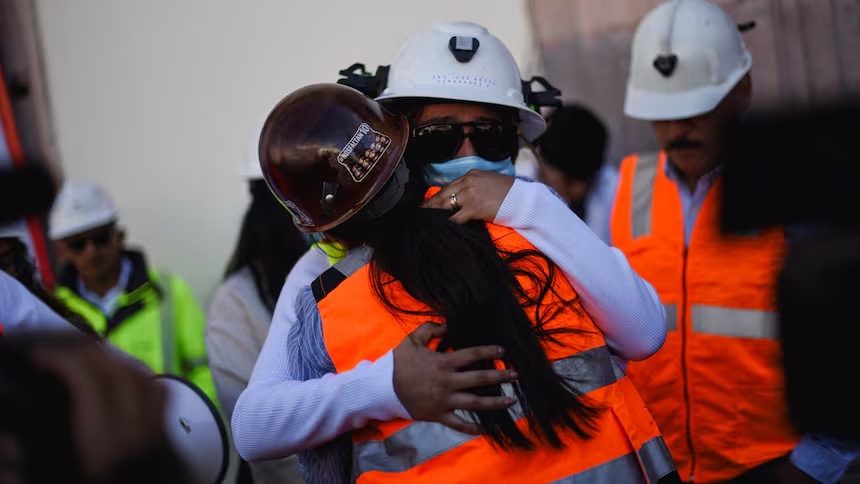
The emotional impact has been severe for families, many of whom publicly gathered during funeral processions and protest marches demanding justice and stronger protection for workers.
The case has also intensified concern over how mining operations continue functioning inside areas affected by cartel conflict.
Mexican authorities have linked the kidnappings to internal violence involving factions connected to the Sinaloa Cartel.
Investigators believe one faction known as Los Chapitos and another rival structure linked to La Mayiza are engaged in violent territorial competition across parts of Sinaloa.
These internal confrontations have created unpredictable security conditions even for civilian industries operating in the region.
The fact that mining workers were taken directly from a residential compound has raised serious questions about local protection capacity.
Authorities in Mexico have also examined whether workplace conditions or company level risk planning may have contributed to employee vulnerability.
Earlier public statements from Mexican leadership indicated that labour conditions and company security arrangements were part of the broader investigation.
That reflects a wider concern in Latin American mining zones where industrial activity often overlaps with criminal influence, transport routes and armed territorial disputes.
For Canadian companies operating abroad, such incidents also trigger scrutiny regarding duty of care responsibilities for local employees.
Mining projects in high risk regions often rely on layered private security, local coordination and movement restrictions.
However, cartel violence can quickly overwhelm ordinary industrial safeguards.
Vizsla Silver says it continues full cooperation with Mexican authorities and remains engaged with affected families.
Company leadership described the outcome as devastating and emphasized support for relatives of the workers.
The deaths also highlight the human cost of operating in zones where industrial investment intersects with organized crime pressure.
While mining remains economically important in several Mexican states, workers often face risks beyond normal industrial hazards.
For families, the case is no longer only about criminal investigation but about accountability, security and recognition of those lost.
For Canada, it also raises wider questions about overseas corporate operations in unstable security environments.
The remaining missing worker keeps one part of the case painfully unresolved as investigators continue searching for answers.
Courtesy: cbc
Post Disclaimer
The views and content presented in this article, news report, or video are solely those of the respective author or creator and do not necessarily reflect the official policy or position of BW Times Digital Online E-Paper.







Leave a comment