









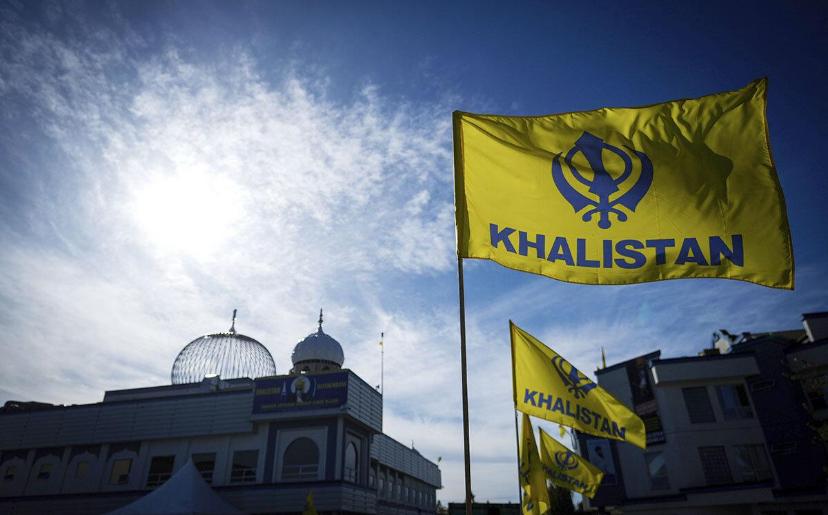
The idea of Khalistan refers to a proposed independent homeland for Sikhs, envisioned as a separate state carved out of the Punjab region. The word itself combines “Khalsa,” which represents the collective body of initiated Sikhs, with the suffix “stan,” meaning land. For those who support the concept, it symbolizes self determination, religious identity, and political autonomy. For others, it is seen as a divisive idea that challenges national unity and stability.
The roots of this movement go back to the final decades of British rule in the Indian subcontinent. During that time, different communities were negotiating their political futures as independence approached. Sikh leaders, concerned about becoming a minority in a Hindu majority India or a Muslim majority Pakistan, discussed the possibility of securing political safeguards or even a separate homeland. However, when the subcontinent was partitioned in 1947, Punjab itself was divided between India and Pakistan, and no separate Sikh state was created. This moment left a lasting emotional and political impact on many Sikhs, as large scale migration and violence reshaped the region.
In the decades after independence, the demand for greater autonomy in Punjab continued in various forms. Political parties representing Sikh interests raised issues related to language, water rights, economic control, and the preservation of religious identity. While many of these demands were constitutional and political in nature, a small section of activists gradually began to push for full independence instead of autonomy within India.
The movement became more visible internationally in the early 1970s when a Sikh leader living abroad publicly promoted the idea of Khalistan and attempted to gather global attention. Around the same time, internal tensions in Punjab were growing due to political rivalries, economic concerns, and disputes between state and central authorities. These conditions created an environment where more radical voices began to gain influence.
The late 1970s and early 1980s marked a turning point. A religious preacher emerged as a powerful figure who attracted support among sections of Sikh youth. His message combined religious revival with political resistance, and his presence intensified the conflict between militants and the state. The situation escalated as violence increased, including attacks on civilians and officials.
A major and deeply controversial event occurred in 1984 when the Indian military launched an operation inside the most sacred Sikh shrine in Amritsar to remove armed militants who had taken shelter there. This action caused heavy casualties and damage, and it deeply hurt Sikh sentiments around the world. Many saw it as an attack on their faith, while the government argued it was necessary to restore order. The aftermath was even more tragic. The Prime Minister was assassinated by her Sikh bodyguards later that year, which was followed by widespread anti Sikh violence in different parts of the country. Thousands of innocent people lost their lives, and this period remains one of the darkest chapters in modern Indian history.
Following these events, the movement entered a phase of armed insurgency, particularly during the late 1980s and early 1990s. Militant groups carried out attacks, and the state responded with strong security measures. Punjab experienced years of instability, fear, and loss. Eventually, through a combination of policing, political efforts, and public fatigue with violence, the insurgency declined. By the mid 1990s, normalcy had largely returned to the region.
In the present day, the situation is very different from the peak years of conflict. Inside India, especially in Punjab, there is limited support for a separate state. Most people are focused on economic development, education, and social stability. Elections and public discourse in the region rarely revolve around the idea of Khalistan. While some individuals and small groups still express support, it does not represent a widespread or dominant view.
Outside India, the picture is somewhat different. In countries with large Sikh populations such as Canada, the United Kingdom, the United States, and Australia, there are organizations and activists who continue to promote the idea. These groups organize protests, public campaigns, and symbolic referendums. For many in the diaspora, the issue is tied to historical grievances, identity, and a sense of justice related to past events. At the same time, even within these communities, opinions are diverse, and not all Sikhs support the movement.
The government of India maintains a firm stance against the idea of Khalistan. It views the movement as a threat to the country’s unity and security. Organizations linked to separatist activities are banned, and individuals associated with such efforts are often monitored or prosecuted under strict laws. The government also raises concerns with foreign countries when it believes that separatist activities are being allowed or encouraged on their soil. This has occasionally led to diplomatic tensions.
An important question is whether the movement represents the will of the Sikh community as a whole. The answer is complex but generally points toward a lack of majority support. Sikhs are a diverse and global community with a wide range of political views. Many take pride in their identity while also feeling a strong connection to the countries where they live. In India, a large number of Sikhs participate actively in national life, including politics, the military, business, and culture. Their contributions are widely recognized, and many see their future within the framework of the existing nation.
At the same time, the memory of past events, especially those of the 1980s, continues to shape discussions around identity and justice. For some, unresolved grievances keep the idea of Khalistan alive, even if only symbolically. For others, the focus is on reconciliation, progress, and ensuring that such conflicts are not repeated.
Today, the Khalistan issue exists more as a political and emotional topic than an active movement on the ground in Punjab. It surfaces periodically in international debates, community discussions, and diplomatic relations, but it does not define everyday life for most Sikhs. The reality is shaped by a mix of history, identity, politics, and changing global dynamics.
In simple terms, the movement began as a response to concerns about identity and political rights, grew into a violent conflict during a turbulent period, and has since diminished significantly within India while continuing to exist in parts of the global diaspora. Its future remains uncertain, influenced by how communities remember the past and envision their place in the world moving forward.
Post Disclaimer
The views and content presented in this article, news report, or video are solely those of the respective author or creator and do not necessarily reflect the official policy or position of BW Times Digital Online E-Paper.









Leave a comment