















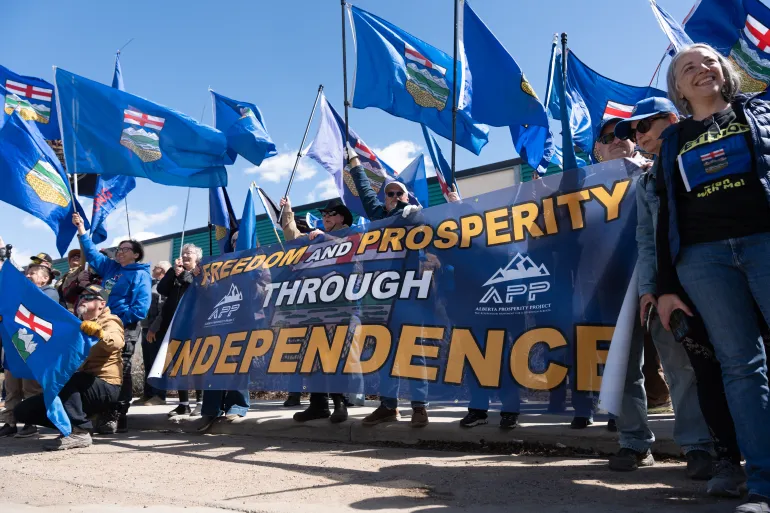
A growing secessionist movement in Alberta has pushed the province closer than ever to a potential independence referendum, raising questions about regional tensions, economic control, and Canada’s political unity.
Separatist organizers recently claimed they submitted roughly 300,000 signatures to provincial election authorities—well above the threshold required to trigger consideration of a referendum. If validated, this could set the stage for a provincewide vote as early as October.
A long-standing idea gaining momentum
The idea of Alberta leaving Canada is not new. It has circulated for decades, driven by the perception among some residents that the province is economically strong but politically constrained by decisions made in Ottawa.
At the center of this sentiment is Alberta’s oil and gas industry. The province is one of Canada’s most resource-rich regions, and supporters of independence argue that federal environmental regulations and climate policies limit its economic potential.
Economic frustration and identity politics
Much of the separatist argument is rooted in three recurring themes:
- Economic contribution vs. federal control
Supporters argue Alberta contributes heavily to Canada’s national economy through energy exports but receives limited influence over national policy decisions. - Energy and environmental policy conflict
Climate regulations and pipeline debates are frequently cited as examples of federal policies seen as harming Alberta’s fossil fuel industry. - Political and cultural divide
Many separatists describe Alberta as politically more conservative than the rest of Canada, claiming a mismatch with federal leadership in Ottawa.
Separatist leader Mitch Sylvestre has framed the movement as a response to what he calls political and economic misalignment between Alberta and the federal government.
What the referendum would ask
If approved, the proposed question would reportedly ask voters whether Alberta should:
“cease to be part of Canada and become an independent state.”
However, reaching the ballot is only one step in a complex and uncertain process.
Legal and political obstacles remain
Even if the signature requirement is met, several major hurdles remain:
- Verification of signatures by Elections Alberta
- Court challenges from Indigenous groups
- Constitutional questions about secession rights
- Federal negotiations if a “yes” vote were ever achieved
Indigenous leaders argue that separation could violate treaty rights, adding a significant constitutional barrier to any potential independence process.
Public support remains limited
Polling suggests support for independence is still a minority position, with roughly 30 percent of Albertans expressing support in some surveys. That level of backing raises doubts about whether a referendum could succeed even if it reaches the ballot stage.
Political reaction and controversy
The movement has triggered strong reactions across Canada.
Federalist critics argue secession threatens national unity, while others view it as a political pressure tactic rather than a realistic independence effort.
Some commentators have also pointed to external political attention—including remarks from figures in the United States—as a factor that has energized separatist supporters, though this has been widely criticized in Canada.
Alberta is not alone in separatist history
The province’s push for independence echoes earlier movements in Canada, most notably in Quebec, where referendums in 1980 and 1995 narrowly rejected separation.
Unlike Quebec’s language-based nationalism, Alberta’s movement is primarily economic and resource-driven, centered on energy policy and fiscal control.
What happens next?
A final decision on whether the referendum can proceed depends on:
- Court rulings on legal challenges
- Validation of petition signatures
- Government approval of the referendum process
Even if approved, a referendum vote would not guarantee independence, which would still require negotiations with the federal government and likely years of constitutional and legal disputes.
For now, Alberta’s secession debate remains one of the most significant political flashpoints in modern Canadian politics—driven by economic identity, regional frustration, and long-standing tensions over how power is shared in the country.
Courtesy: Aljazeera
Post Disclaimer
The views and content presented in this article, news report, or video are solely those of the respective author or creator and do not necessarily reflect the official policy or position of BW Times Digital Online E-Paper.










Leave a comment