













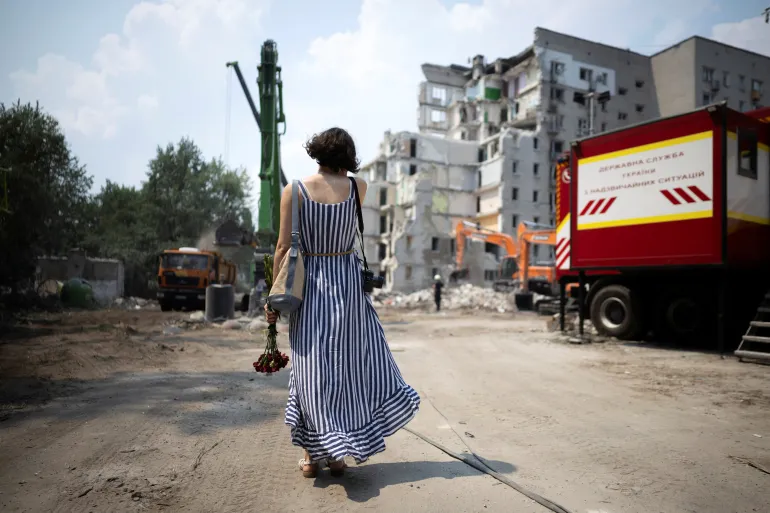
Russia’s campaign to seize full control of Ukraine’s eastern Donetsk region is facing mounting military and economic challenges, with battlefield gains slowing dramatically despite continued offensives and heavy troop losses.
According to recent battlefield assessments, Russian forces are seeking to capture the remaining portion of the partially occupied Donetsk region before the end of the year. However, military analysts say the pace of Russia’s territorial advances has slowed considerably compared with previous campaigns, raising questions about whether Moscow can achieve its stated objectives within the desired timeframe.
Independent assessments indicate that Russian territorial gains during the first half of 2026 have fallen sharply compared with the same period last year. Analysts monitoring the conflict through open source intelligence report that Russian forces have captured significantly less territory while sustaining increasingly high casualties during prolonged offensive operations.
The slowdown has become particularly evident in recent months, with the daily rate of Russian advances declining substantially. Military observers note that when temporary battlefield penetrations and Ukrainian counteroffensives are taken into account, Russia’s net territorial gains have become even more limited.
Ukrainian President Volodymyr Zelenskyy has argued that the reduced pace of Russian advances reflects the effectiveness of Ukraine’s evolving military strategy, which increasingly relies on domestically produced drones, long range missiles and precision strikes against Russian logistics networks.
Kyiv says a series of decisions taken over the past year to expand domestic defence production has enabled Ukrainian forces to target supply depots, ammunition warehouses, fuel infrastructure, transport routes and command centres deep behind Russian front lines.
Ukraine’s Defence Ministry has described the strategy as an effort to disrupt Russia’s ability to sustain military operations by attacking the logistical systems supporting frontline troops rather than concentrating solely on direct battlefield engagements.
Military officials say Ukrainian drone operations have expanded significantly, with hundreds of strikes targeting Russian supply lines and infrastructure during recent months. Ukrainian commanders claim these operations have damaged thousands of military targets, including fuel depots, transportation hubs, communications facilities and military equipment.
Crimea has remained a major focus of Ukrainian operations, with repeated attacks targeting energy infrastructure and military facilities in an effort to complicate Russian logistics on the occupied peninsula.
At the same time, Ukrainian officials contend that Russia continues to suffer heavy battlefield losses that exceed its recruitment capacity. Ukrainian military estimates suggest Russian casualties remain high, placing additional pressure on Moscow’s ability to sustain large scale offensive operations.
While casualty estimates from both sides cannot be independently verified during wartime, analysts agree that the conflict continues to inflict significant human losses on both militaries after more than four years of full scale fighting.
Despite the slowing battlefield momentum, Russia has maintained its military objectives while continuing diplomatic contacts with the United States regarding possible negotiations.
Russian officials have indicated they remain open to international mediation, while also rejecting several Ukrainian proposals for limited ceasefires covering specific regions or restrictions on long range strikes.
President Vladimir Putin has argued that Russian long range attacks remain an important military tool and has resisted proposals that would limit such operations.
Meanwhile, Ukraine has continued targeting Russian military and industrial infrastructure far from the front lines. Recent strikes have reportedly affected oil refineries, military airfields, communications facilities, ammunition production sites and defence related manufacturing centres across several Russian regions.
Alongside military challenges, Russia is also facing increasing economic pressure as the war continues.
Energy exports remain one of the country’s primary sources of government revenue, but analysts report that oil income has declined during the first part of the year. Ukrainian officials attribute part of that reduction to repeated attacks on Russian oil terminals, pumping stations and refining facilities, although broader market conditions and international sanctions have also influenced export revenues.
Fuel shortages have been reported in several parts of Russia, prompting government officials to reassure the public that supplies remain sufficient despite disruptions within domestic distribution networks.
Russian authorities have acknowledged logistical challenges while insisting that fuel reserves remain adequate and market conditions will stabilize over time. The government has also extended restrictions on diesel exports in an effort to prioritize domestic supply.
As the conflict enters another year, the military situation remains highly contested. Ukraine continues to emphasize precision strikes, drone warfare and attacks on Russian logistics, while Russia maintains pressure along multiple fronts in eastern and southern Ukraine despite increasingly slow territorial progress.
With both sides showing little willingness to compromise on their core objectives, the conflict continues to evolve into a prolonged war of attrition, combining intense battlefield operations with growing economic and logistical pressures that are expected to shape the next phase of the war.
Courtesy: aljazeera
Post Disclaimer
The views and content presented in this article, news report, or video are solely those of the respective author or creator and do not necessarily reflect the official policy or position of BW Times Digital Online E-Paper.








Leave a comment