










The political movement of Imran Khan once stood as a powerful symbol of hope, accountability, and change. It inspired millions, especially overseas Pakistanis, who saw in it a rare promise of honest leadership and a break from traditional politics. Today, however, that promise appears increasingly hollow in North America, where the overseas structure of Pakistan Tehreek-e-Insaf is failing to match the spirit it claims to represent.
On paper, the presence is significant. More than 35 chapters operate across the United States, and around 13 chapters exist in Canada. This should have translated into a strong, coordinated, and influential voice for the movement. Instead, what is visible is silence, inactivity, and a growing disconnect between leadership and supporters. The structure exists, but the purpose seems to be fading.
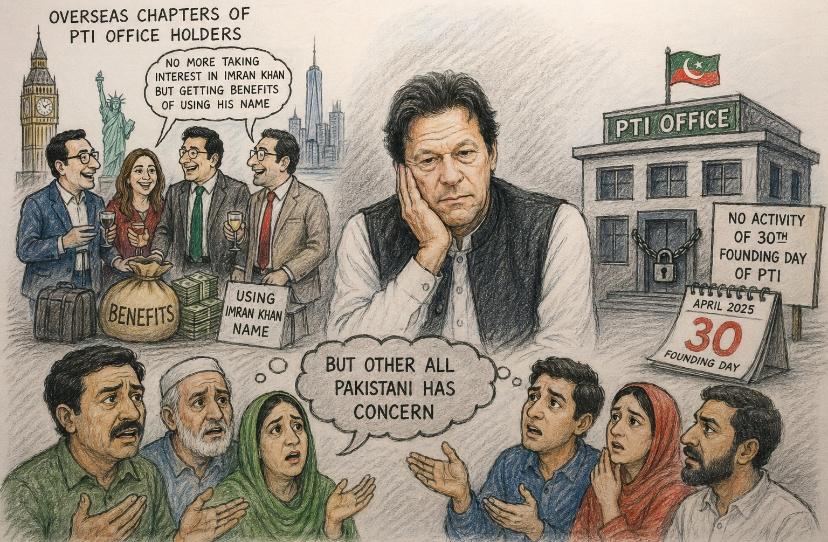
The most recent example of this failure was the 30th foundation day of PTI. A milestone that should have been marked with energy, unity, and visible commitment passed with little to no meaningful activity in many overseas chapters. There were no strong gatherings, no impactful programs, and no clear effort to remind communities of the movement’s ideals. For a party that prides itself on mobilization and passion, this absence was not just disappointing, it was telling.
It is difficult to ignore the pattern. A movement that once relied on its overseas supporters to amplify its message now appears muted in those very spaces. The question is unavoidable: what are these chapters doing, and who are they serving?
Imran Khan’s political journey has been defined by resistance, persistence, and a willingness to challenge powerful systems. That struggle continues, yet the expected support from overseas leadership remains weak. Instead of being active voices, many office holders appear content with holding positions without demonstrating responsibility. Titles have taken precedence over action.
More troubling is the perception, widely discussed within communities, that many office holders are using Imran Khan’s name for personal benefit. His name carries influence, credibility, and emotional connection. To use that name without actively working for his cause is not just a failure of leadership, it raises serious ethical concerns. Visibility, recognition, and personal standing seem, in some cases, to matter more than the movement itself.
This pattern is damaging. It erodes trust among supporters who once gave their time, energy, and belief to the cause. It creates a gap between what PTI claims to stand for and what is actually being practiced. A movement built on accountability cannot afford to ignore questions about its own conduct.
Across both the United States and Canada, the same issue repeats itself. Chapters exist, but their impact is minimal. Leadership is present, but its voice is absent. When a political movement loses its ability to speak, organize, and inspire, it risks becoming irrelevant. Silence, in this context, is not neutral; it is a sign of decline.
The failure to mark the 30th foundation day meaningfully reflects a deeper problem. It suggests a lack of urgency, a lack of direction, and a lack of seriousness about the responsibilities that come with leadership. Political movements do not survive on history alone. They require continuous effort, renewed commitment, and visible action.
It is important to recognize that not everyone within these chapters fits this pattern. There are still committed supporters who believe in Imran Khan’s vision and continue to advocate for it. However, their efforts are often overshadowed by a broader culture of inactivity at the leadership level. This imbalance weakens the overall structure and discourages genuine participation.
Overseas chapters are not ceremonial bodies. They are meant to represent a movement that claims to stand for justice, integrity, and change. When office holders prioritize titles over action and visibility over responsibility, they undermine the very foundation of that movement.
There is a need for honest reflection. Leadership should not be about status; it should be about service. Using the name of Imran Khan without actively contributing to his struggle contradicts the principles that brought supporters together in the first place. It turns a movement of purpose into a platform of convenience.
The consequences of this disconnect are already visible. Supporters are questioning, engagement is declining, and the sense of unity is weakening. If these issues are not addressed, the credibility of Pakistan Tehreek-e-Insaf in North America will continue to erode.
A political movement cannot survive on names alone. It survives on action, credibility, and the willingness to stand up when it matters most. At present, that willingness appears to be missing where it is needed the most.
Post Disclaimer
The views and content presented in this article, news report, or video are solely those of the respective author or creator and do not necessarily reflect the official policy or position of BW Times Digital Online E-Paper.








i do watch for bw times news