













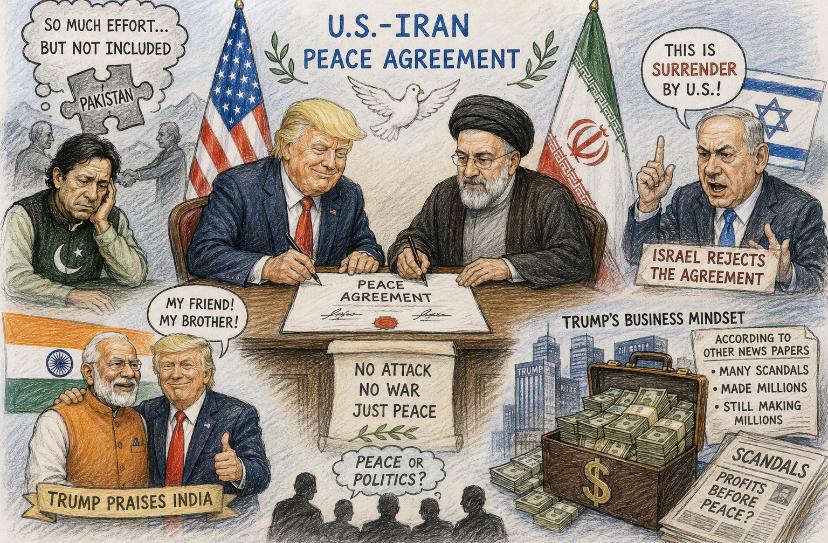
Any easing of tensions between Iran and the United States must be viewed not merely as a diplomatic achievement but as a political necessity. For Donald Trump, foreign policy has always been closely connected to domestic political objectives. Throughout his political career, Trump has attempted to present himself as a leader who can project strength while avoiding long and expensive wars. If tensions with Iran are reduced, the immediate beneficiary may not be Tehran or Washington’s allies in the region, but Trump himself as he prepares for future electoral battles and seeks to maintain support among American voters concerned about inflation and economic stability.
The first reality is that prolonged conflict in the Middle East carries significant economic risks. Every confrontation involving Iran threatens shipping routes, oil supplies, and global energy markets. Rising oil prices quickly translate into higher fuel costs, increased inflation, and voter dissatisfaction. American presidents understand that voters are often more concerned about gasoline prices than geopolitical theories. Therefore, any reduction in tensions helps stabilize markets and strengthens the political standing of the White House.
Trump’s history demonstrates a consistent pattern. While he frequently uses aggressive rhetoric and applies maximum pressure against adversaries, he has generally avoided committing the United States to large-scale new military campaigns. His administration withdrew from the Iran nuclear deal, imposed severe sanctions, and authorized the strike that killed Iranian General Qassem Soleimani. Yet despite these confrontational moves, Trump stopped short of launching a broader war with Iran. This reflected both strategic calculation and political reality.
A full-scale war with Iran would be vastly different from previous American military operations in the Middle East. Iran possesses significant military capabilities, regional proxies, and strategic influence across multiple countries. Such a conflict would be costly, unpredictable, and politically dangerous for any American president. Consequently, while Trump often employs pressure tactics, he also recognizes the limits of military escalation.
Another important factor is the role of financial interests during periods of instability. Historically, geopolitical tensions have created enormous opportunities for energy traders, defense contractors, and commodity investors. Every missile launch, naval confrontation, or diplomatic crisis introduces uncertainty into markets. Uncertainty often generates profits for a small group of stakeholders while increasing costs for consumers worldwide. In that sense, conflict can become economically beneficial for certain sectors even when it damages broader global stability.
Israel’s position remains one of the most important variables. Israeli leaders have long viewed Iran as their primary regional security challenge. Any agreement that reduces immediate tensions may be welcomed if it improves security, but skepticism remains regarding Iran’s long-term intentions. This creates a structural challenge for any diplomatic breakthrough. Even if Washington and Tehran reach an understanding, regional actors may not fully share the same objectives.
Pakistan’s role in this equation is considerably more limited. Islamabad has historically sought balanced relations with competing powers, including the United States, China, Saudi Arabia, and Iran. However, major geopolitical agreements involving Washington and Tehran rarely produce immediate strategic gains for Pakistan. Instead, Pakistan often finds itself observing developments that primarily affect larger regional players.
India, by contrast, has steadily strengthened its strategic relationship with the United States over the past two decades. Washington increasingly views New Delhi as an important partner in balancing China’s influence in Asia. As a result, American administrations, regardless of party, frequently emphasize cooperation with India on economic, technological, and security issues. This trend is likely to continue regardless of developments in the Middle East.
The key question is whether any current understanding represents a genuine resolution or merely a pause. Historical evidence suggests caution. The Middle East has repeatedly witnessed agreements that temporarily reduced tensions without addressing underlying rivalries. Regional competition between Iran and its opponents remains unresolved. Disputes over security, influence, and ideology continue to shape strategic calculations throughout the region.
Therefore, the most likely scenario is not permanent peace but managed instability. Tensions may decrease for weeks, months, or even years, but the structural causes of conflict remain intact. Unless broader regional issues are addressed, future crises are almost inevitable.
From a political perspective, Trump’s objective has never been simply peace for its own sake. His goal has been to demonstrate strength, maintain economic stability, and avoid the political costs of another major Middle Eastern war. If tensions decline, he can present himself as both a strong leader and an effective negotiator. Whether that translates into lasting regional stability is a separate question.
The broader lesson is that Middle Eastern diplomacy is often driven as much by domestic political calculations as by international strategy. Leaders pursue agreements when the political benefits outweigh the costs. The challenge is that political incentives can change rapidly, while regional rivalries endure for decades. For that reason, any current calm should be viewed not as the end of the story but as another chapter in a conflict that has repeatedly evolved rather than disappeared.
Post Disclaimer
The views and content presented in this article, news report, or video are solely those of the respective author or creator and do not necessarily reflect the official policy or position of BW Times Digital Online E-Paper.










Leave a comment