











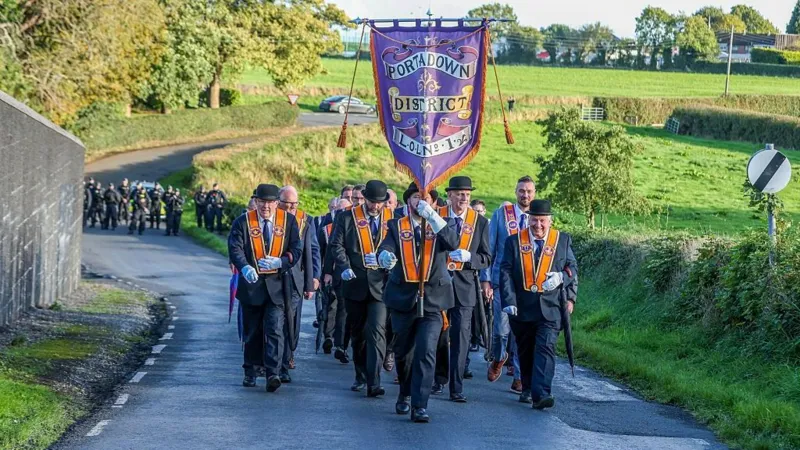
A long running dispute over an Orange Order parade in Portadown remains unresolved as representatives of the main groups involved continue talks aimed at preventing further tension in Northern Ireland.
The dispute centres on the Drumcree parade and the proposed route along Garvaghy Road, an area that is predominantly Catholic and nationalist. The Orange Order, a Protestant organisation associated with unionism and support for maintaining Northern Ireland’s place within the United Kingdom, has sought to complete the route despite strong opposition from local residents.
The parade was due to take place on Sunday morning after the Parades Commission granted permission for it to proceed under strict conditions. However, protesters gathered along Garvaghy Road and blocked the route, preventing the march from going ahead.
The Drumcree parade has not completed its route along Garvaghy Road since 1998. The dispute surrounding the march was at the centre of some of the most serious disorder in Northern Ireland during the 1990s, involving riots, roadblocks and deaths.
Talks Continue as Both Sides Remain Firm
Northern Ireland Secretary Sir Chris Bryant has been meeting representatives from both sides in an effort to find a way forward.
The two senior representatives of the Portadown Orange Order met the secretary at Hillsborough Castle on Monday for about an hour. Following the meeting, they described the discussions as constructive.
Portadown district master Nigel Dawson said the Orange Order continued to expect the law to be applied, indicating that the organisation had not abandoned its intention to complete the permitted route.
Representatives of the Garvaghy Road Residents Coalition have also met Sir Chris Bryant. Breandán Mac Cionnaith said the Orange Order should use the route it takes toward Drumcree Church as its return route instead of travelling back along Garvaghy Road.
Mac Cionnaith said he was open to some form of mediation but expressed a lack of trust in the Orange Order.
Sir Chris said he remained in contact with the different parties and was exploring possible solutions. He described the talks as positive and said people on both sides appeared to be working in good faith.
Police Block Attempts to Start Parade
Tensions remained high on Monday, although the situation on Garvaghy Road was relatively calm and traffic was moving.
Shortly before 04:00 BST, a group of Orangemen attempted to begin their parade but encountered police vehicles blocking the route. Further attempts were made later, but officers did not allow the march to proceed.
The Police Service of Northern Ireland said a major public safety operation remained in place.
Assistant Chief Constable Ryan Henderson defended the police decision, saying officers had been unable to facilitate what he described as the Orange Order’s lawful right to parade because of what police regarded as an unlawful and unnotified protest.
He said removing an estimated 1,000 people from the road, including children, women and older residents, would have required a level of force that could have seriously endangered public safety and potentially triggered disorder.
The Portadown Orange Order has called for the resignation of Chief Constable Jon Boutcher and Assistant Chief Constable Henderson.
However, Liam Kelly, chair of the Police Federation for Northern Ireland, praised officers for showing restraint and professionalism during what he described as an extremely difficult situation.
The Grand Orange Lodge of Ireland has also criticised the actions of elected representatives involved in the protests and said there were serious political questions surrounding the events.
Political Tensions Grow
The dispute has also created tensions within Northern Ireland’s political institutions.
First Minister Michelle O’Neill joined protesters on Garvaghy Road on Sunday and later defended her participation. Speaking in the Northern Ireland Assembly, she said she was proud to stand alongside residents and argued that the community had experienced generations of sectarian pressure and intimidation.
O’Neill urged people to remain committed to their protest and said Northern Ireland should focus on its future rather than returning to what she described as an era of unionist dominance.
Her comments were strongly criticised by Deputy First Minister Emma Little-Pengelly of the Democratic Unionist Party.
Little-Pengelly accused O’Neill of failing to provide leadership at a time when calm was required. She also alleged that the first minister had encouraged others to participate in an unlawful protest.
DUP leader Gavin Robinson said he would refer assembly members and other elected representatives who attended the protest to the Stormont standards commissioner. However, he stopped short of saying his party would withdraw from the power sharing institutions.
SDLP leader Claire Hanna argued that collapsing the Stormont executive would not resolve the dispute and would instead create a political vacuum.
Alliance leader and Justice Minister Naomi Long urged politicians to avoid increasing tensions through ultimatums. She said the situation was extremely difficult and warned that the dispute risked reopening painful divisions.
Other unionist politicians expressed concern that the political institutions themselves could be placed at risk.
Calls for Mediation and Calm
The Irish government has also expressed concern about the situation.
Taoiseach Micheál Martin said tensions surrounding Drumcree remained a serious issue and called on all sides to step back and work toward a mediated solution.
Church leaders have similarly urged the parties to seek a peaceful outcome.
Catholic Archbishop of Armagh Eamon Martin and Church of Ireland Archbishop of Armagh John McDowell called for an urgent and inclusive effort to resolve the dispute, warning that too much was at stake.
Two local schools also announced closures on Monday, citing concerns over the safety and wellbeing of pupils, families and staff.
A Dispute With a Long History
The Orange Order organises thousands of parades across Northern Ireland each year, most of which take place without serious disruption. However, marches through or close to predominantly Catholic and nationalist communities have historically generated strong opposition.
The Garvaghy Road became one of the most controversial parade routes during the 1990s. Attempts by the Orange Order to march along the road led to major confrontations between unionists, nationalists and police.
The Drumcree dispute was particularly intense in 1995, when a police blockade prevented the Orange Order from completing the route. Similar confrontations followed during the next three years, with the wider dispute contributing to riots, roadblocks and killings in different parts of Northern Ireland.
In 1998, the Parades Commission ruled that the Orange Order should not march along Garvaghy Road. That position remained in place for almost three decades.
The latest development followed a court case that overturned an earlier decision by the commission. After years of unsuccessful applications, the commission ruled on Friday that the Drumcree parade could proceed, but under significant restrictions.
The march was originally expected to begin at 13:00 on Sunday with up to 60 participants. The commission instead required it to begin no later than 08:00 and limited participation to 35 people.
The decision was challenged in several Belfast courts on Saturday before the legal process finally cleared the way for the parade only hours before it was due to begin.
Despite that ruling, protesters remained on Garvaghy Road and prevented the march from proceeding.
The immediate standoff remains unresolved, leaving political leaders, community representatives and police searching for a way to prevent the dispute from escalating further while addressing the competing claims surrounding the historic parade route.
Courtesy: BBC
Post Disclaimer
The views and content presented in this article, news report, or video are solely those of the respective author or creator and do not necessarily reflect the official policy or position of BW Times Digital Online E-Paper.








Leave a comment