








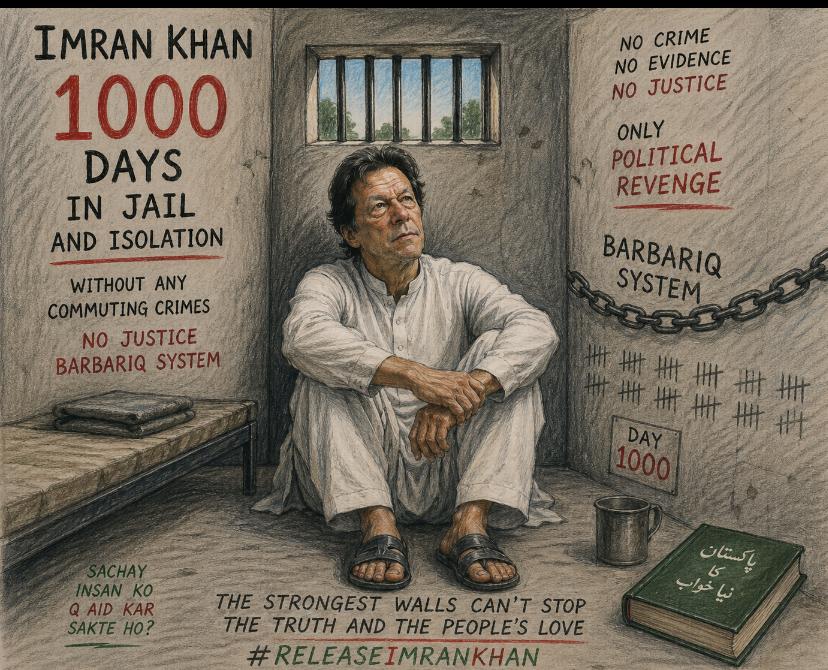
The completion of one thousand days in prison for Imran Khan has become more than a passage of time; it has evolved into a powerful and deeply polarizing symbol of Pakistan’s political reality. Supporters see it as the punishment of a man who refused to compromise his principles, while critics argue it reflects the consequences of legal and political battles catching up with a former leader. Regardless of perspective, the prolonged imprisonment of a figure who once held the highest office in the country continues to raise serious questions about justice, power, and accountability.
During this period, reports from his legal team and family have consistently described restrictive and difficult conditions. Access to medical care has been a recurring concern, with claims that treatment has not always been timely or adequate. Meetings with lawyers have often been limited or delayed, adding further complications to his legal defense. Communication with the outside world has also been tightly controlled, leaving him largely dependent on intermediaries to convey his messages. These conditions have contributed to a sense of isolation that goes beyond physical confinement and enters the realm of psychological pressure.
The psychological impact of such a long period in custody is significant. A man who once addressed massive crowds and navigated the complexities of national governance now faces the monotony and restrictions of prison life. The contrast is stark and carries both personal and symbolic weight. Extended confinement, limited interaction, and uncertainty about the future create a form of strain that tests endurance and resilience. For his supporters, the fact that he continues to project defiance despite these pressures reinforces their belief in his commitment to his stated principles.
His imprisonment has also been framed by many as part of a broader pattern in Pakistan’s political history, where powerful figures who fall out of favor encounter legal challenges that effectively remove them from the political arena. This perception, whether accurate or not, has fueled skepticism about the neutrality of institutions. The idea that accountability may be applied unevenly undermines confidence in the system and deepens political divisions. For a country already struggling with instability, such perceptions can have long lasting consequences.
A central and emotionally charged aspect of this period has been the role of his sisters, particularly Aleema Khan. Their efforts to highlight his situation have brought a human dimension to an otherwise highly political issue. They have repeatedly appeared outside courts, addressed the media, and challenged decisions they consider unjust. Their advocacy has not been without cost, as they have faced criticism, legal hurdles, and pressure, yet they have remained persistent in their campaign.
The struggle of his sisters illustrates how political conflicts often extend beyond the individual at the center. Their actions have kept his case in the public eye at times when direct communication from him has been limited. They have attempted to frame his imprisonment not just as a political issue but as a matter of fundamental rights and justice. This approach has resonated with supporters and has also drawn attention from international observers, adding another layer to an already complex situation.
Over these one thousand days, the political landscape in Pakistan has continued to shift. Alliances have changed, new controversies have emerged, and the national conversation has evolved, yet his presence remains central even in his absence. For many supporters, he represents resistance against what they view as an entrenched and unaccountable system. For opponents, his legal challenges are portrayed as necessary accountability for actions taken during his time in power. This divide highlights the deeply polarized nature of the country’s political environment.
One of the defining elements of his narrative is the perception that he has refused to compromise. Supporters describe this as a rare display of principle in a system where compromise is often seen as essential for survival. They argue that his unwillingness to negotiate with powerful institutions is precisely why he continues to face such harsh circumstances. At the same time, critics suggest that rigidity in politics can lead to isolation and escalation, making conflict inevitable.
It is also important to recognize that the reality is complex and cannot be reduced to a single narrative. The legal cases against him involve multiple matters and judicial decisions that reflect a broader institutional process. However, public perception does not always follow legal nuance. The belief that he is being treated unfairly has become a powerful force in shaping opinion, especially among his supporters. This perception has been amplified by the duration of his imprisonment and the visible efforts of his family to challenge it.
As this milestone is reached, it raises larger questions about the direction of Pakistan’s governance and political culture. The credibility of institutions, the fairness of legal processes, and the balance of power between civilian leadership and other forces all come under scrutiny. When a significant portion of the population views the system as unjust, it creates a gap between authority and legitimacy that is difficult to bridge.
The image that defines these one thousand days is one of contrast and tension. A former prime minister remains confined, his influence constrained yet not erased. His family continues to speak on his behalf, carrying both emotional and political burdens. The country itself remains divided, with sharply differing interpretations of what his imprisonment represents. Whether this period will eventually be seen as a moment of accountability or a symbol of political suppression will depend on how events unfold in the future. What is certain is that the impact of these one thousand days will continue to shape Pakistan’s political discourse for years to come.
Post Disclaimer
The views and content presented in this article, news report, or video are solely those of the respective author or creator and do not necessarily reflect the official policy or position of BW Times Digital Online E-Paper.









Leave a comment