







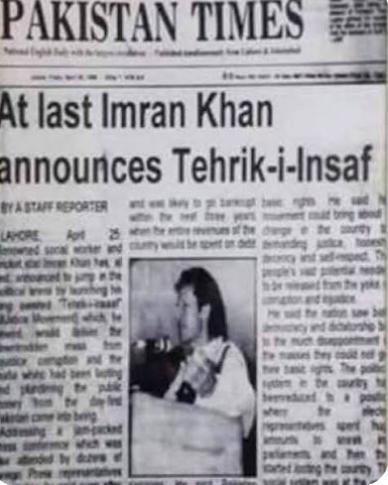
The political struggle of Imran Khan has entered a defining phase that many observers describe as unprecedented in Pakistan’s history. As of April 25, three years into what his supporters call a continuous movement for justice and true independence, the political landscape reveals a stark contrast between one leader standing firm and an entire political system appearing unified against him.
Before Imran Khan’s rise, Pakistan’s political environment was dominated by rivalry and confrontation among major parties such as Pakistan Muslim League (N) and Pakistan Peoples Party. These parties spent decades accusing each other of corruption, misgovernance, and abuse of power. Public rallies, parliamentary speeches, and media narratives were filled with harsh criticism as each side claimed to represent the true will of the people. However, since the removal of Imran Khan from power in 2022, a dramatic shift has taken place. Those same political forces that once stood in opposition now appear aligned, creating the perception that the entire system has come together on a single page.
Khan’s removal through a vote of no confidence was not just a political event but a turning point that exposed deeper fault lines within the state structure. He openly challenged powerful institutions, including elements often described as the establishment, and accused them of engineering political outcomes. This confrontation marked the beginning of an intense struggle that has only grown stronger over time. Unlike traditional politicians who tend to negotiate or retreat under pressure, Khan adopted a direct and confrontational stance, refusing to compromise on his narrative.
What followed was a systematic political tightening around him and his party Pakistan Tehreek-e-Insaf. Key leaders were arrested, forced into silence, or compelled to leave the party. Political spaces shrank, media coverage became restricted, and legal cases multiplied. Yet despite these pressures, Khan’s popularity did not collapse. Instead, it transformed into a deeper emotional connection with his supporters, who began to see him not just as a politician but as a symbol of resistance.
This is where the contrast becomes most striking. On one side stands a coalition of traditional political parties, many of whom have long histories of rivalry but now share a common objective. On the other side stands a single leader, largely isolated in terms of institutional support but strengthened by public backing. This alignment has led many to question whether the political competition in Pakistan is still between parties or whether it has evolved into a broader struggle between one narrative and an entire system.
Khan’s critics argue that his politics is divisive and destabilizing. They claim that his refusal to engage in compromise has deepened political uncertainty and strained democratic processes. However, his supporters counter that what is being labeled as instability is in fact a challenge to a deeply entrenched status quo. They argue that the sudden unity among previously hostile parties is not a coincidence but a reaction to a leader who threatens their collective interests.
One of the most powerful aspects of Khan’s movement is its consistency. Over the past three years, despite arrests, disqualification attempts, and increasing legal pressure, his message has remained unchanged. He continues to speak about rule of law, electoral transparency, and the need for accountability at all levels. This consistency has reinforced the perception that he is not willing to negotiate on principles, even if it costs him politically.
At the same time, the role of the establishment has come under unprecedented public scrutiny. For decades, discussions about institutional influence were often indirect or avoided altogether. Khan brought these conversations into the open, making them part of mainstream political discourse. This shift has had a lasting impact, as more citizens now openly question the balance of power within the state.
The unity among political parties against Khan has also raised important questions about democratic competition. If parties that once accused each other of corruption and incompetence can now work together seamlessly, it challenges the credibility of their past narratives. It creates a perception that their differences were never as deep as they claimed and that their current alignment is driven more by necessity than principle.
Despite the challenges, Khan’s ability to mobilize public support remains unmatched. Large gatherings, strong digital presence, and continuous engagement with supporters have kept his movement alive. Even in the absence of traditional political space, he has managed to maintain relevance and influence. This resilience has reinforced the image of a leader who stands alone yet refuses to back down.
The phrase one man standing is not just a slogan but a reflection of the current political reality. While others have adjusted their positions, formed alliances, or stepped back under pressure, Khan has maintained a consistent line. This does not mean his position is without criticism or complexity, but it does highlight a level of persistence that sets him apart in Pakistan’s political history.
As the country moves forward, the implications of this struggle will be significant. It is no longer just about elections or party competition. It is about the direction of the political system itself. Whether Pakistan moves toward greater transparency and accountability or returns to a more controlled and predictable political structure will depend largely on how this confrontation evolves.
Three years into this movement, the lines are clearly drawn. A unified political front stands on one side, while Imran Khan continues his fight on the other. In a system where alliances shift and loyalties change, his refusal to yield has become the defining feature of his political identity. Whether one agrees with him or not, it is difficult to ignore the reality that while many forces have come together, he remains the central figure challenging them all.
Post Disclaimer
The views and content presented in this article, news report, or video are solely those of the respective author or creator and do not necessarily reflect the official policy or position of BW Times Digital Online E-Paper.









Leave a comment