














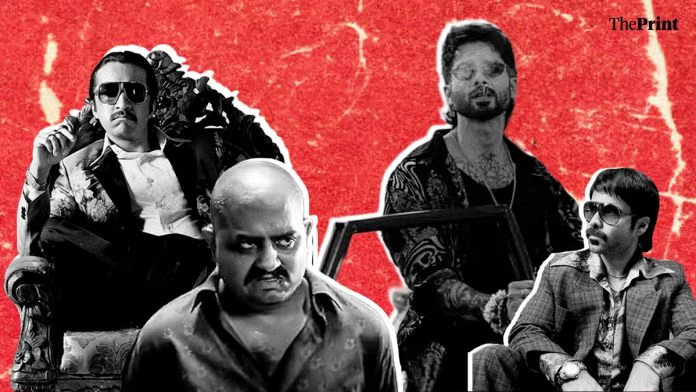
Books, bhais and Bollywood — every major Mumbai gangster film seems to trace its roots back to one name: Dawood Ibrahim.
Even decades after the 1993 Bombay blasts and his departure from India, the shadow of the Dongri-born don continues to loom large over Hindi cinema. With O’Romeo, Bollywood revisits the violent underworld of 1990s Mumbai — but this time with a twist. The don is no longer the central figure. Instead, the spotlight shifts to new, D-adjacent antiheroes.
Nearly every major Mumbai gangster film of the past three decades has drawn directly or indirectly from the Dawood Ibrahim era.
The Return of the Mumbai Mafia
Set in 1995, two years after the Bombay blasts, O’Romeo dives into peak underworld chaos. Directed by Vishal Bhardwaj, the film imagines Shahid Kapoor as Hussain Ustara — a real-life contract killer who once dared to challenge Dawood’s empire.
While Avinash Tiwary plays Jalal, a character loosely inspired by Dawood, the narrative avoids glorifying the don-of-dons. Instead, Bhardwaj builds the story around gang rivalries, forbidden love and revenge, signaling what may be a recalibration of Bollywood’s long-standing D-Company obsession.
The underworld genre, once dominant in the 1990s and 2000s, had faded during the era of hyper-nationalist and military-themed films. But recent projects such as Bambai Meri Jaan and the upcoming Dongri: Gangsters Paradise suggest the Mumbai mafia saga is back — though evolving.
From Black Friday to Company: The Dawood Blueprint
Much of Hindi cinema’s crime storytelling can be traced to investigative journalist-turned-author Hussain Zaidi. His 2002 book Black Friday became the blueprint for realistic underworld cinema when Anurag Kashyap adapted it into a film.
That film, Black Friday, set a new tone — gritty, research-driven, and documentary-like. It paved the way for films such as Company, D, and Shootout at Lokhandwala, all of which drew heavily from Dawood-era gang wars.
Zaidi’s influence extended further. His works inspired:
- Gangubai Kathiawadi
- Shootout at Wadala
- Phantom
- Class of ’83
Zaidi has often expressed discomfort with the mythologizing of Dawood in popular culture. He argues that the cinematic halo surrounding the fugitive gangster has overshadowed more complex criminal narratives.
Glamour, Scale and the Mumbai Myth
Why does Bollywood keep returning to Mumbai’s mafia?
According to content producer Sidharth Jain, Mumbai’s crime stories come with unmatched scale and cinematic glamour. Unlike smaller-town gang dramas such as Gangs of Wasseypur, or streaming hits like Mirzapur and Paatal Lok, the Mumbai underworld represents metropolitan myth-making — where only the biggest players survive.
Films like Once Upon a Time in Mumbaai capitalized on retro packaging and the Dawood-Haji Mastan era. Yet not every D-linked film succeeded. Projects like Haseena Parkar and D-Day struggled at the box office, proving that nostalgia alone is not enough.
O’Romeo and the Shift to New Antiheroes
Unlike earlier films, O’Romeo moves the narrative away from a towering don figure and focuses on Hussain Ustara and Sapna Didi — characters based on Zaidi’s 2011 book Mafia Queens of Mumbai.
The real-life duo were among the few who dared to defy Dawood in the late 1990s, though both were eventually killed. The film takes creative liberties, particularly in exploring their romantic arc, but keeps the emotional core intact.
Within a week of its February 13 release, O’Romeo reportedly earned Rs 72 crore worldwide — signaling that audiences still crave gangland drama, even without placing Dawood front and center.
The Lasting Legacy of D-Company
From novels to cinema to streaming platforms, the Mumbai underworld remains one of Bollywood’s richest storytelling mines. The intricate interplay between books and films — particularly through Zaidi’s reporting — has created a near-mythic crime universe that continues to evolve.
Whether Bollywood is finally moving beyond its D-fixation or simply reframing it through new antiheroes remains to be seen. But one thing is clear: as long as the legend of Dawood Ibrahim lingers, the Mumbai mafia story is far from over.
Post Disclaimer
The views and content presented in this article, news report, or video are solely those of the respective author or creator and do not necessarily reflect the official policy or position of BW Times Digital Online E-Paper.











Leave a comment