











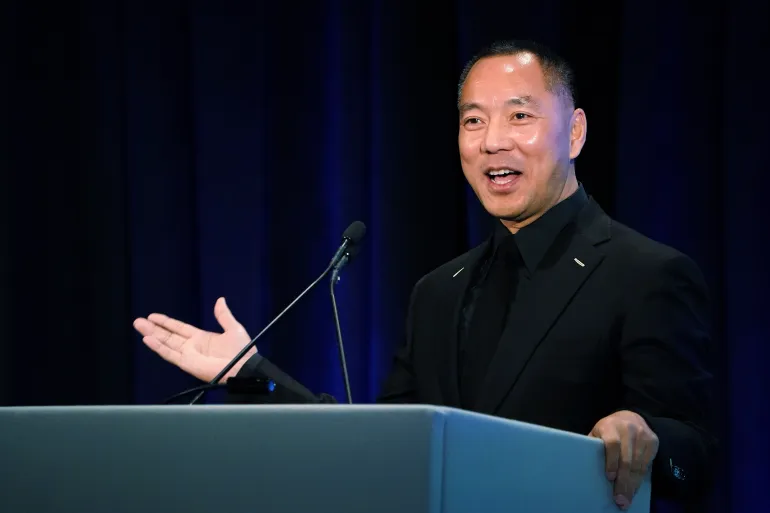
Self exiled Chinese billionaire Guo Wengui has been sentenced to 30 years in a United States federal prison after being convicted in a massive financial fraud scheme that prosecutors said defrauded more than 1,000 investors around the world of hundreds of millions of dollars.
The sentence was handed down by Judge Analisa Torres in a Manhattan federal court, where Guo was also ordered to forfeit approximately 889 million dollars and pay restitution to victims of the fraud.
Guo, who is also known as Miles Guo and Ho Wan Kwok, fled China in 2015 and settled in the United States, where he became a prominent critic of the Chinese Communist Party. He built a significant following among members of the Chinese diaspora by portraying himself as an advocate for democracy and political reform in China.
A federal jury convicted Guo in 2024 on multiple criminal charges, including securities fraud, wire fraud, money laundering and other financial offences. Prosecutors argued that between 2018 and 2023 he orchestrated an extensive investment scheme that persuaded supporters to invest in various business ventures and financial products by making false promises and misleading claims.
According to the prosecution, the funds raised from investors were not used as represented. Instead, prosecutors said Guo financed an extravagant lifestyle that included luxury properties, expensive vehicles, yachts and other high value personal assets while many investors lost their life savings.
The Federal Bureau of Investigation arrested Guo in 2023 at his luxury apartment overlooking Central Park in New York City following a lengthy investigation into his financial activities.
During Monday’s sentencing hearing, Judge Torres strongly criticised Guo’s conduct, stating that he had exploited people who believed in his political message and his campaign against the Chinese government. She said he had taken advantage of individuals seeking democratic change in China and used their trust to enrich himself.
The judge also referred to statements submitted by victims before sentencing. Many described suffering devastating financial losses, emotional distress and damaged family relationships after investing their savings in Guo’s ventures. Several said they had lost retirement funds and faced severe financial hardship as a result of the scheme.
Judge Torres noted that Guo had failed to accept responsibility for his actions and continued to insist that no one had been harmed by his conduct despite overwhelming evidence presented during the trial.
One of the victims, Wei Chen, who testified during the court proceedings, told the judge that the fraud had destroyed both her life and the lives of her family members.
Federal prosecutors had requested a sentence of at least 30 years, describing the fraud as one of extraordinary scale that financially and emotionally devastated hundreds of victims around the world.
Guo’s legal team argued for a reduced sentence, claiming their client had long been the target of political persecution by the Chinese Communist Party. His lawyers maintained that the Chinese government had conducted an extensive campaign against him because of his outspoken criticism of Beijing and warned that a lengthy prison sentence would further strengthen China’s efforts to silence political dissidents living abroad.
Addressing the court, Guo briefly spoke about his health and reiterated that his mission in coming to the United States had been to oppose the Chinese Communist Party. However, he offered little comment regarding the fraud convictions themselves.
Before becoming a political activist, Guo amassed considerable wealth through China’s real estate sector. After relocating to the United States, he established himself as one of the most vocal critics of the Chinese government while building close relationships with several conservative political figures.
Among his most notable associates was former White House adviser Steve Bannon. Together, they helped establish the New Federal State of China, an organisation promoting opposition to the Chinese Communist Party and advocating political change in China.
Their association attracted significant international attention after Bannon was arrested in 2020 aboard Guo’s luxury yacht in connection with a separate case involving the alleged misuse of donations raised for a private project to build sections of the United States border wall.
With Monday’s sentence, one of the most closely watched financial fraud cases involving a prominent Chinese exile has reached a significant legal conclusion. Guo will now serve one of the longest prison sentences imposed in a major investment fraud case in recent years while authorities continue efforts to recover funds for victims who suffered substantial financial losses.
Courtesy: aljazeera
Post Disclaimer
The views and content presented in this article, news report, or video are solely those of the respective author or creator and do not necessarily reflect the official policy or position of BW Times Digital Online E-Paper.








Leave a comment