















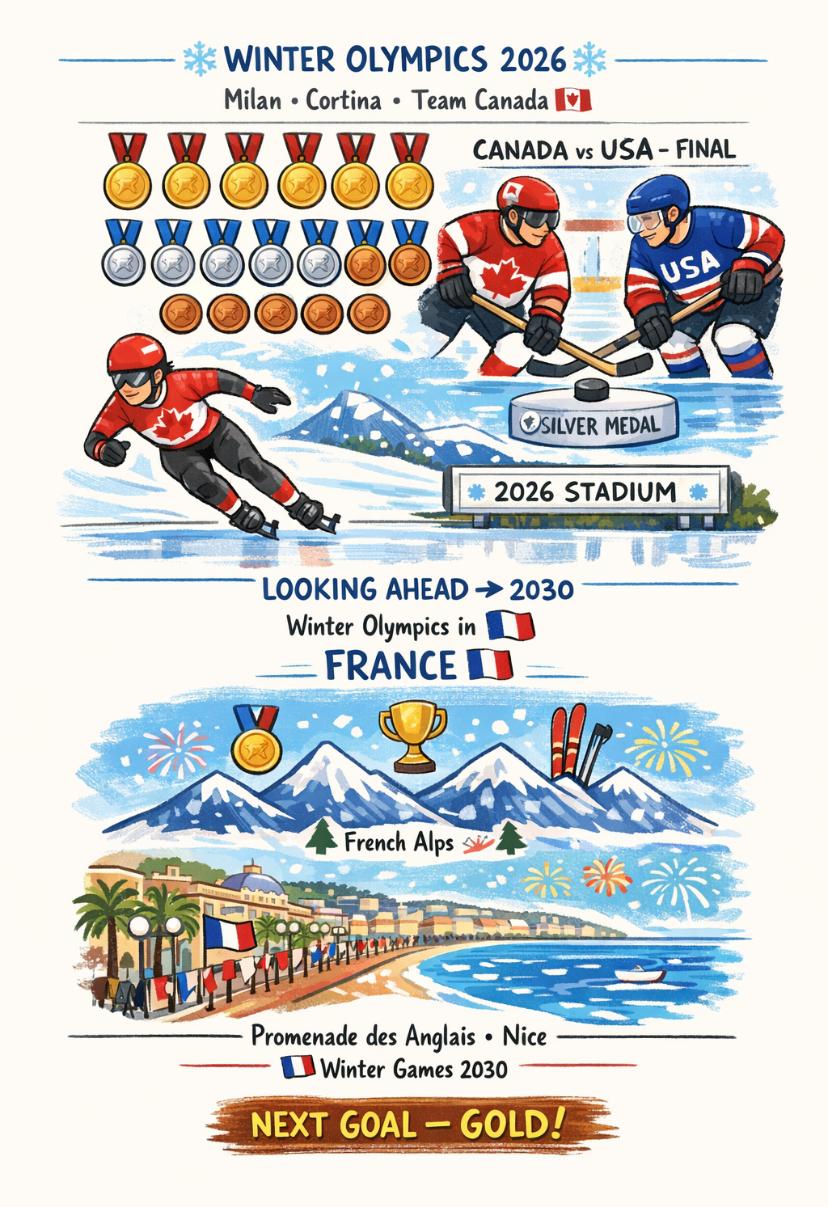
The 2026 Winter Olympics in Milan and Cortina d’Ampezzo, Italy, brought together the world’s finest winter athletes for more than two weeks of elite competition, national pride, and unforgettable sporting drama. From February 6 to February 22, nearly 3,000 athletes representing 92 countries competed across 116 medal events in 16 sports. Snow-covered alpine slopes, historic Italian venues, and state-of-the-art arenas set the stage for one of the most globally diverse Winter Games ever organized.
For Canada, these Games represented both opportunity and challenge. A total of 205 Canadian athletes — 99 men and 106 women — competed across 14 sports, making it one of the country’s larger Winter Olympic delegations. Canada entered events in alpine skiing, freestyle skiing, snowboarding, speed skating (long track and short track), figure skating, curling, biathlon, skeleton, luge, bobsleigh, ski jumping, Nordic combined, cross-country skiing, and ice hockey. The team carried strong expectations due to Canada’s long tradition of winter sport excellence.
The opening week proved difficult for Canadian athletes, as the team did not secure a gold medal in the early days of competition. The absence of an early podium finish drew attention back home, with analysts debating preparation cycles and competition timing. However, momentum shifted midway through the Games when Canada broke through with its first gold medal, igniting renewed confidence across the delegation.
By the closing ceremony on February 22, Canada had earned a total of 21 medals: 5 gold, 7 silver, and 9 bronze. This placed the country 11th overall in the final medal standings. While the ranking was lower than some previous Winter Olympic performances, the medal distribution demonstrated strength across multiple disciplines rather than reliance on a single sport.
Curling emerged as a bright spot for Canada. The men’s team delivered a composed and tactical performance throughout the tournament, ultimately capturing gold after a strong final match. The women’s curling squad added a bronze medal following a closely contested playoff round. Speed skating also contributed significantly to the medal total, particularly in mass-start and relay events, where Canadian skaters showed both endurance and strategy.
Ice hockey once again became the emotional centerpiece for Canadian fans. Both the men’s and women’s teams advanced to their respective gold medal games, each facing their longtime rivals from the United States. In two dramatic overtime contests, Canada narrowly fell 2–1 in both finals, earning silver medals in each division. Despite the disappointment of missing gold, the performances highlighted Canada’s continued dominance and competitiveness in international hockey.
Freestyle skiing and snowboarding provided additional podium finishes, with Canadian athletes executing technically demanding runs under high pressure. In events such as ski cross and moguls, Canada remained competitive against European and American contenders. Skeleton and bobsleigh athletes also delivered solid results, reflecting Canada’s continued investment in sliding sports.
Across the entire Games, approximately 2,900 athletes competed, making this one of the most inclusive Winter Olympics to date. Twenty-nine countries earned at least one medal, while nineteen countries secured at least one gold. Norway finished at the top of the medal table with 41 medals, including 18 gold, setting a new Winter Olympic benchmark. The United States placed second with 33 total medals, followed by the Netherlands and host nation Italy among the leading countries.
The broad distribution of medals highlighted the growing competitiveness of winter sport globally. Traditional powerhouses continued to dominate certain events — such as Nordic skiing and speed skating — but emerging nations also made history with breakthrough performances. This balance between established excellence and new achievement gave the 2026 Games a dynamic and unpredictable character.
For Canada, the overall review reflects a team that demonstrated resilience and depth. While the gold medal count was modest compared to some previous Olympics, the presence of 21 total podium finishes confirms that Canada remains among the top winter sport nations worldwide. Several young athletes gained valuable Olympic experience, suggesting potential growth heading toward future competitions.
Attention now turns to the next Winter Olympic Games, scheduled for February 1 to February 17, 2030. The 2030 Winter Olympics will be held in the French Alps, with events staged across alpine regions and the city of Nice. Preparations for those Games are already underway, as national sport organizations evaluate training programs, athlete development pathways, and funding priorities.
Between now and 2030, Canadian athletes will compete in world championships, World Cup circuits, and continental competitions, all serving as stepping stones toward the next Olympic stage. Lessons learned in Italy — from pacing strategies to mental preparation — are expected to shape Canada’s long-term performance planning.
The closing ceremony in Italy marked more than the end of competition; it symbolized the unity and determination displayed by athletes from around the globe. For Canada, the 2026 Winter Olympics will be remembered as a Games of perseverance, near victories, and steady contribution across multiple sports. While some fans may have hoped for a higher ranking, the experience provided both inspiration and motivation for the next generation of competitors.
As the Olympic flame was extinguished in Milan and Cortina d’Ampezzo, athletes departed knowing that their journey continues. The road to the 2030 Winter Olympics in France has already begun, and Canada’s winter sport community now looks ahead with renewed focus, aiming to build on the foundation established in 2026 and strive for even greater success on the world stage.
Post Disclaimer
The views and content presented in this article, news report, or video are solely those of the respective author or creator and do not necessarily reflect the official policy or position of BW Times Digital Online E-Paper.










Leave a comment