














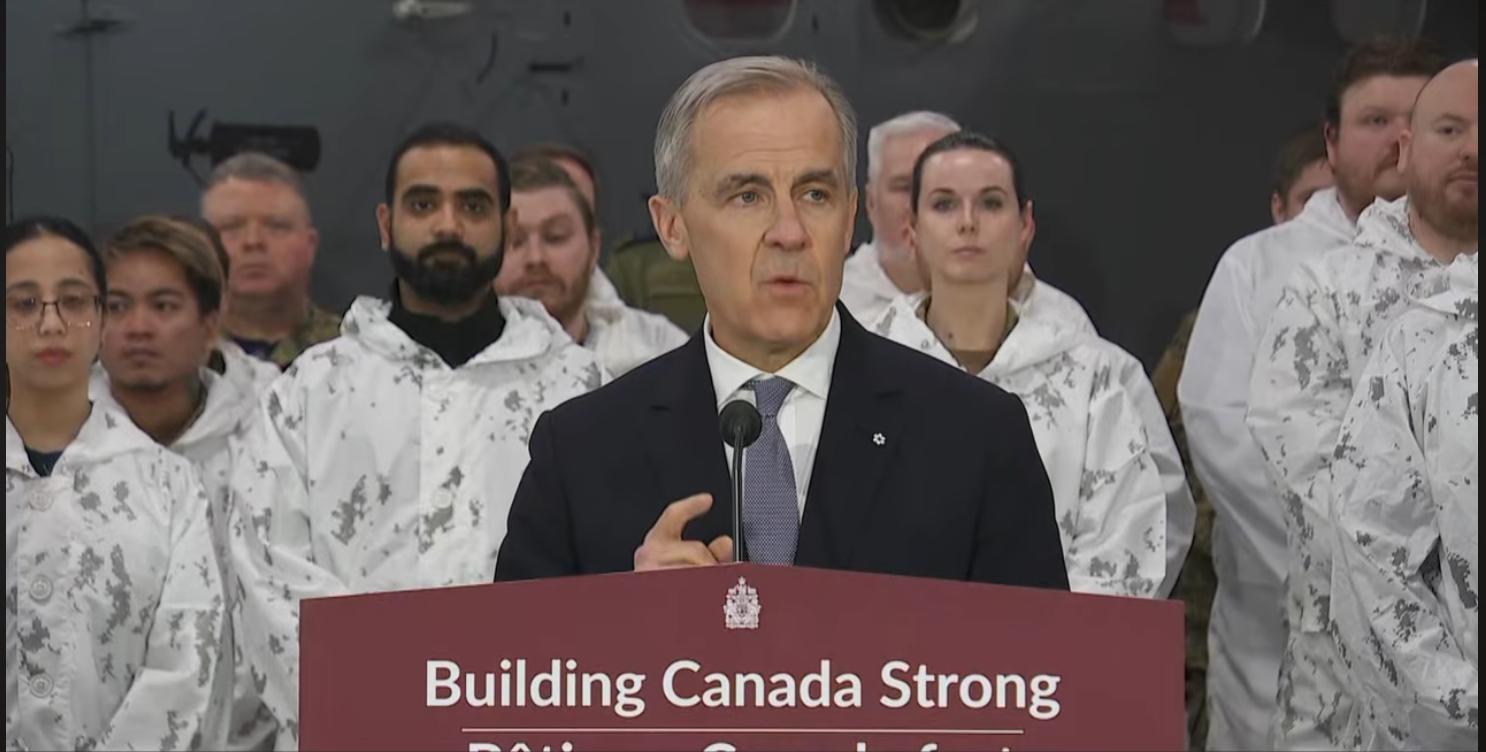
Prime Minister Mark Carney has announced a major new strategy aimed at strengthening defence, infrastructure, and economic development across Canada’s Arctic and northern regions.
Speaking in Yellowknife, Northwest Territories, the prime minister outlined a plan backed by more than $40 billion in combined investments designed to increase Canada’s presence in the North and reinforce national sovereignty.
Officials say the strategy reflects growing concern over global security pressures, climate change, and increased international interest in Arctic resources and shipping routes.
Large Defence Investments Across Northern Canada
A major part of the plan focuses on strengthening military readiness across northern regions.
The government will invest $32 billion in upgrades to military sites located in Yellowknife, Inuvik, Iqaluit, and 5 Wing Goose Bay.
The upgrades will include:
- airfield improvements
- new hangars
- fuel and ammunition facilities
- storage buildings
- information technology systems
- accommodations for military personnel
Officials say these upgrades will allow the Canadian Armed Forces to operate more independently in Arctic conditions.
New Northern Operational Support Network
The federal government also announced new northern military support centres.
Two Northern Operational Support Hubs will be created in Whitehorse and Resolute, while two Northern Operational Support Nodes will be established in Cambridge Bay and Rankin Inlet.
The project carries an investment of $2.67 billion.
Officials say this network will improve rapid deployment capability and strengthen year-round response capacity across remote Arctic regions.
Arctic Airports to Receive Upgrades
The plan also includes $294 million for airport modernization across northern communities.
Key upgrades will take place at Rankin Inlet Airport and Inuvik Airport.
These improvements are intended to allow larger aircraft to operate more efficiently, improving transportation for both civilians and military operations.
Officials say improved airport infrastructure could also lower travel costs for northern residents.
Major Northern Infrastructure Projects Move Forward
Several major transportation and development projects are being advanced through Canada’s major project approval process.
Mackenzie Valley Highway
The proposed 800-kilometre Mackenzie Valley Highway will improve year-round road access for northern and Indigenous communities.
The highway will connect Yellowknife to Inuvik and open new commercial opportunities across the region.
Grays Bay Road and Port Project
The Grays Bay Road and Port project aims to create Canada’s first overland link to a deepwater Arctic port.
The road and port system will connect mineral-rich areas of Nunavut to national transportation networks through the Northwest Territories.
Officials say this could improve export capacity for minerals including copper, gold, and zinc.
Arctic Economic and Security Corridor
A separate all-season road project will link strategic northern mining zones to future Arctic shipping infrastructure.
The project is designed to improve access to critical mineral deposits and support long-term economic development.
Taltson Hydro Expansion Planned
Energy development also forms part of the northern strategy.
The government plans to move forward with the Taltson Hydro Expansion Project, which will add 60 megawatts to the existing hydroelectric system.
Officials say the expansion will double hydro capacity in the Northwest Territories and provide cleaner energy to a large portion of residents.
Focus on Indigenous and Northern Communities
The government says the strategy places northern residents and Indigenous communities at the centre of future development.
Officials state the investments are intended to create stronger local infrastructure, improve transportation, lower living costs, and expand economic opportunities for approximately 140,000 northern residents.
Canada Expands Arctic Sovereignty Strategy
The plan builds on recent federal Arctic initiatives, including research and military programs linked to northern security.
Officials say Canada aims to reduce dependence on external support and strengthen independent capacity in the North.
The government argues that stronger northern infrastructure and defence systems are essential as Arctic geopolitical competition continues to grow.
Post Disclaimer
The views and content presented in this article, news report, or video are solely those of the respective author or creator and do not necessarily reflect the official policy or position of BW Times Digital Online E-Paper.










Leave a comment