










JERUSALEM, October 29, 2026: Israel faces a period of political uncertainty after Prime Minister Benjamin Netanyahu’s Likud party emerged as the largest party in the October 27 parliamentary election, but his political alliance failed to secure the majority required to form a new government.
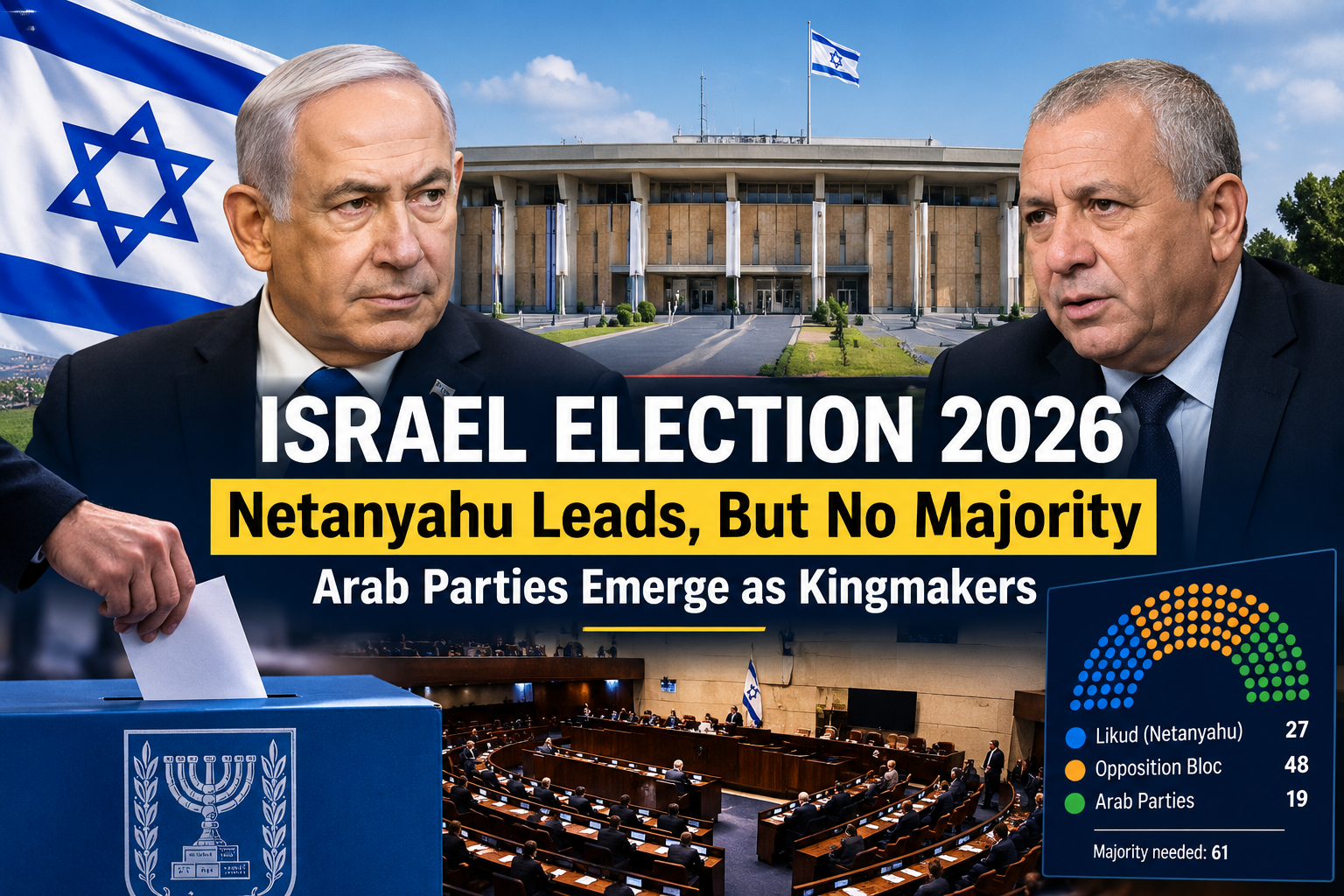
According to the latest vote count released by Israel’s Central Elections Committee, Netanyahu’s Likud party secured 27 seats in the 120-member Knesset, while his broader political bloc obtained 53 seats, eight short of the 61 needed for a parliamentary majority.
The opposition alliance seeking to remove Netanyahu, led by former military chief Gadi Eisenkot, secured 48 seats. Meanwhile, parties representing Israel’s Arab population achieved a combined 19 seats, placing them in a potentially decisive position in negotiations over the next government.
The results have created a complicated political situation in which neither Netanyahu nor his opponents can easily form a governing coalition without securing additional parliamentary support.
The election was widely viewed as a crucial test of Netanyahu’s political leadership following years of conflict, growing domestic divisions and international criticism over Israel’s military operations in Gaza.
Despite facing significant political pressure, Netanyahu demonstrated that he retains considerable electoral support. His Likud party finished ahead of its competitors, reinforcing his position as one of the most influential figures in Israeli politics.
However, the inability of his alliance to achieve a majority has raised serious questions about his ability to remain prime minister.
Eisenkot, whose Yashar party emerged as a major opposition force, has presented himself as an alternative to Netanyahu. His political campaign focused on leadership, national security and the need for a different direction after years of political confrontation.
The opposition now faces its own challenge. Although Netanyahu’s opponents collectively hold substantial parliamentary strength, ideological differences between the parties could complicate efforts to establish a united government.
One of the election’s most significant developments was the strong performance of Arab political parties, which together secured 19 parliamentary seats.
Their electoral success could influence the formation of the next government, particularly if opposition parties seek their parliamentary backing to prevent Netanyahu from returning to power.
However, cooperation between Jewish-led opposition parties and Arab political representatives remains politically sensitive. Several opposition leaders have previously expressed reservations about forming a government dependent on Arab parties.
The election has also been overshadowed by allegations of foreign interference and electoral misconduct.
Netanyahu and members of his political camp raised allegations concerning the involvement of foreign interests in efforts to influence voter participation among Arab citizens.
Israeli security authorities have opened an investigation into suspicions of improper foreign funding connected to election activities. The allegations have not been established as fact.
Qatar has rejected accusations that it interfered in the election, while Mansour Abbas, leader of the Arab Ra’am party, denied any involvement in wrongdoing and pledged cooperation with investigators.
Israeli President Isaac Herzog called for a thorough investigation while warning against attempts to discredit an entire community of voters.
Opposition leaders also expressed concern that allegations surrounding the election could undermine confidence in the democratic process.
Eisenkot accused Netanyahu of attempting to challenge the legitimacy of the results and said he would oppose any effort to delay the swearing-in of the newly elected parliament.
The political uncertainty comes at a particularly sensitive moment for Israel.
The consequences of the Gaza war, relations with neighbouring countries, domestic security concerns and economic pressures remain major issues confronting the next government.
The election results also reflect continuing divisions within Israeli society over Netanyahu’s leadership and the country’s political future.
Although Likud remains the largest party, the broader parliamentary outcome suggests that a significant portion of the electorate wants political change.
Under Israel’s parliamentary system, the president consults political parties before selecting a candidate to attempt to form a government. The process can involve lengthy negotiations as party leaders seek coalition agreements.
Netanyahu is expected to remain in office in a caretaker capacity until a new administration is established.
The election results are due to be formally certified by November 4, after which the process of forming a government will become the central focus of Israeli politics.
If neither political bloc can secure sufficient support, Israel could face prolonged coalition negotiations or potentially another election.
For Netanyahu, the election has produced a mixed political outcome. His party remains the strongest individual force in parliament, but his alliance lacks the numbers needed to govern independently.
For Eisenkot and the opposition, the results present an opportunity to challenge Netanyahu’s continued leadership, although forming a workable coalition may prove difficult.
The growing parliamentary influence of Arab political parties adds another dimension to the negotiations and could become a defining factor in Israel’s next political chapter.
With no clear governing majority emerging from the vote, Israel’s political future now depends less on which party finished first and more on which leader can assemble a coalition capable of commanding the confidence of parliament.
Post Disclaimer
The views and content presented in this article, news report, or video are solely those of the respective author or creator and do not necessarily reflect the official policy or position of BW Times Digital Online E-Paper.











Leave a comment