
















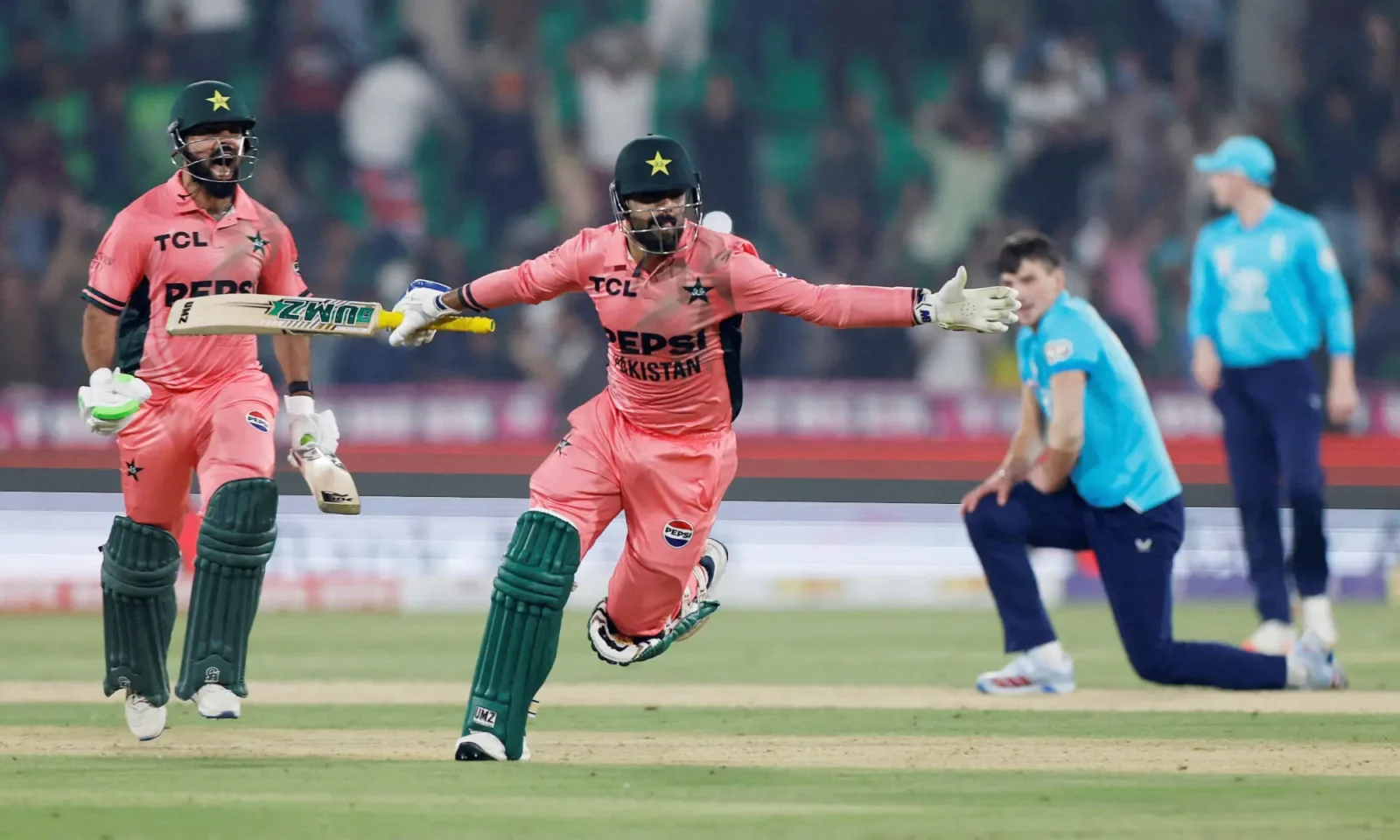
LAHORE, PAKISTAN: Pakistan produced one of the most extraordinary comebacks in One Day International cricket as Shadab Khan struck a sensational unbeaten century to secure a thrilling one-wicket victory over England at Gaddafi Stadium in Lahore on Sunday, October 25, 2026. The remarkable triumph confirmed Pakistan’s place in the ODI tri-series final on October 31 and delivered a memorable moment for cricket fans across the country.
With Pakistan struggling at 154 for nine while chasing England’s 241, defeat appeared almost certain. However, Shadab transformed the contest with an innings of exceptional courage, tactical intelligence and aggressive stroke play, finishing unbeaten on 113 from just 96 deliveries.
His spectacular performance included 13 boundaries and five sixes, while an astonishing unbeaten 89-run partnership with Haris Rauf for the final wicket completed one of the most dramatic successful run chases in ODI history.
Pakistan eventually reached 243 for nine in 47.1 overs, sealing victory with 17 deliveries remaining and leaving England stunned after appearing to have complete control of the match.
The final-wicket partnership between Shadab and Haris established a new record for the highest tenth-wicket stand in a successful ODI run chase, surpassing the previous record of 64 runs.
For Shadab, the innings was particularly special because it marked his first ODI century and placed him among a rare group of batters to score a hundred while batting at number eight or lower.
The victory was not merely an impressive individual achievement. It was a demonstration of Pakistan’s determination to fight until the final wicket, even when the possibility of victory seemed almost impossible.
Pakistan’s chase began disastrously as England’s bowlers dismantled the top order with disciplined bowling and early breakthroughs.
Fakhar Zaman managed only 10 runs, while Saim Ayub departed for six and experienced batter Babar Azam contributed just 10. The three early dismissals left Pakistan under severe pressure inside the opening seven overs.
Young wicketkeeper batter Saad Baig briefly revived the innings with an attacking 32 from 22 deliveries, striking seven boundaries and showing positive intent against England’s pace attack.
However, his dismissal at 74 for four brought another setback, and the situation deteriorated further when Hasan Nawaz departed for 15.
Arafat Minhas followed for just one run, leaving Pakistan struggling at 103 for five when Shadab arrived at the crease.
At that stage, England appeared firmly in command. Their bowlers had exposed Pakistan’s fragile batting order, and the hosts were facing the possibility of another disappointing collapse.
Shadab initially approached the situation cautiously, concentrating on rebuilding the innings and finding opportunities to rotate the strike.
Salman Ali Agha attempted to provide support, but his dismissal for 26 from 49 deliveries increased the pressure. Pakistan continued losing wickets as captain Shaheen Shah Afridi and Razaullah failed to establish meaningful partnerships.
When the ninth wicket fell at 154 in the 34th over, Pakistan still required 88 runs, with only Haris Rauf remaining to accompany Shadab.
What followed was an extraordinary display of batting under pressure.
Rather than accepting defeat, Shadab began taking calculated risks, attacking England’s bowlers with powerful drives, controlled pulls and innovative strokes.
He reached his half-century from 49 deliveries, demonstrating an impressive ability to balance aggression with responsibility.
With Haris providing determined resistance at the other end, Shadab gradually reduced the target while carefully managing the strike.
The partnership became a fascinating contest between England’s desperate search for the final wicket and Shadab’s determination to carry Pakistan across the finish line.
Haris played an equally important supporting role, surviving deliveries, protecting his wicket and allowing Shadab to take responsibility for scoring the majority of the remaining runs.
As the target moved closer, the atmosphere at Gaddafi Stadium became increasingly tense.
Shadab continued finding boundaries against England’s attack, using his footwork against spin and attacking the fast bowlers whenever they missed their lengths.
He moved into the nineties with a boundary against Sam Curran, bringing Pakistan within touching distance of an unlikely victory.
The most dramatic moment arrived during Gus Atkinson’s over when Shadab struck a six over fine leg but was then given out leg before wicket following an appeal from England.
For a brief moment, Pakistan’s extraordinary comeback appeared to have ended.
Shadab immediately challenged the decision through the Decision Review System, and television replays revealed an edge before the ball struck his pads.
The on-field decision was overturned, giving Pakistan another opportunity to complete the chase.
The reprieve proved decisive.
Shadab responded by striking consecutive boundaries to complete his maiden ODI hundred from 91 balls, before launching another powerful six over long-off.
With only a boundary required, Haris Rauf delivered the winning moment by driving debutant Henry Crocombe straight down the ground for four.
The shot sparked celebrations as Pakistan completed a victory that had appeared beyond reach for much of the second innings.
Haris finished unbeaten on three from 18 deliveries, but his contribution was far more significant than the runs suggested. His ability to remain at the crease allowed Shadab to construct one of the most remarkable innings of his international career.
Earlier, Pakistan’s bowling attack had produced an impressive performance after England were asked to bat.
Captain Shaheen Shah Afridi led from the front, claiming four wickets for 46 runs and dismantling England’s top order with a devastating opening spell.
England were reduced to 19 for three inside five overs as Tom Banton departed for four, Joe Root managed five and captain Harry Brook was run out for just one.
Haris Rauf then dismissed Jordan Cox for six, leaving England in serious difficulty at 52 for four.
However, Ben Duckett produced a determined century to rescue the visitors and provide England with a competitive total.
The left-handed batter displayed excellent technique and attacking confidence, combining effective stroke play with intelligent strike rotation.
Duckett reached his half-century from 56 deliveries and gradually rebuilt the innings alongside Sam Curran.
The pair added 93 runs for the fifth wicket, frustrating Pakistan’s bowlers and restoring stability after the early collapse.
Curran contributed 42 from 52 deliveries, striking five boundaries before Shaheen returned to break the partnership.
Duckett continued his resistance, reaching his fifth ODI century from 104 balls and recording his first hundred against Pakistan.
He eventually departed for 105 from 111 deliveries, having struck 10 fours and two sixes in an innings that prevented England from suffering a much heavier collapse.
Arafat Minhas removed Duckett, with Salman Ali Agha completing the catch at short fine leg.
Pakistan continued applying pressure through Razaullah and Arafat, who claimed important wickets during the middle and closing stages.
Will Jacks departed for 13, Liam Dawson managed five and Jamie Overton contributed 10 as England struggled to establish another substantial partnership.
Gus Atkinson provided late resistance with an unbeaten 36 from 28 balls, including three sixes, helping England reach 241 before being dismissed in 46.4 overs.
Shaheen completed his four-wicket performance by removing Henry Crocombe for eight, bringing England’s innings to an end.
At the halfway stage, Pakistan appeared to have a manageable target, particularly on a surface where disciplined batting could have secured victory without excessive risk.
However, England’s early bowling success transformed the contest, exposing Pakistan’s batting weaknesses and placing enormous responsibility on the lower order.
Shadab’s extraordinary century ultimately overshadowed those concerns and provided Pakistan with a victory that will be remembered for its dramatic circumstances.
Prime Minister Shehbaz Sharif congratulated the national team following the triumph, praising the determination and fighting spirit displayed by Shadab and Haris during their match-winning partnership.
The prime minister described Shadab’s century as a spectacular achievement and acknowledged the resilience shown by the players in overcoming an apparently hopeless situation.
For Pakistan captain Shaheen Shah Afridi, the result represented a particularly satisfying outcome after his own outstanding bowling performance had helped restrict England to a reachable total.
The match also highlighted the importance of experienced all-rounders in modern ODI cricket.
Shadab has long been recognised for his leg-spin bowling, athletic fielding and valuable lower-order batting contributions. However, this innings demonstrated his ability to take complete responsibility for a run chase under extreme pressure.
His performance could prove a defining moment in his international career, strengthening his reputation as a player capable of delivering when Pakistan needs him most.
For England, the defeat will be especially difficult to accept. Their bowlers had reduced Pakistan to the brink of defeat, yet they were unable to dismiss the final pair despite holding an overwhelming advantage.
The inability to secure the last wicket allowed Shadab to turn a seemingly lost contest into a famous Pakistani victory.
With qualification for the October 31 final now secured, Pakistan will enter the decisive match with renewed confidence and momentum.
Nevertheless, the dramatic victory also exposed areas requiring improvement, particularly the repeated failures of the top and middle order.
Pakistan cannot expect extraordinary lower-order recoveries to rescue every difficult situation, and greater consistency from specialist batters will be essential against stronger opposition in high-pressure matches.
Yet Sunday belonged entirely to Shadab Khan.
His unbeaten 113 was more than a maiden international century in the ODI format. It was an innings defined by courage, responsibility and an unwavering refusal to surrender.
From 154 for nine to 243 for nine, Pakistan completed a remarkable transformation that demonstrated the unpredictable beauty of cricket.
As Shadab and Haris celebrated their historic partnership at Gaddafi Stadium, they had not only secured Pakistan’s place in the tri-series final but also delivered a performance that will hold a special place in the country’s cricketing history.
Courtesy: DAWN
Post Disclaimer
The views and content presented in this article, news report, or video are solely those of the respective author or creator and do not necessarily reflect the official policy or position of BW Times Digital Online E-Paper.












Leave a comment