


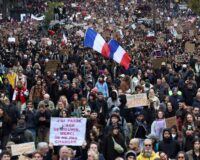














PARIS, October 17, 2026: France witnessed a massive wave of demonstrations on Saturday as hundreds of thousands of people took to the streets to protest rising living costs, deteriorating educational conditions and growing economic inequality. What began weeks ago as a student movement demanding improvements in public schools has developed into a nationwide expression of frustration with President Emmanuel Macron’s government.
Protest organizers claimed that more than 800,000 people participated in demonstrations across the country, although the figure has not been independently verified. Earlier, the powerful CGT labour union estimated that more than 500,000 demonstrators had joined the rallies.
The demonstrations brought together high school students, university activists, trade unions and members of the yellow vest movement, creating one of the broadest coalitions of public discontent seen in France in recent years.
Violence erupted in several cities as protesters clashed with riot police, erected burning barricades, damaged businesses and set fires. Police responded with tear gas and water cannons in an effort to disperse crowds and restore order.
Authorities reported more than 272 arrests nationwide as tensions escalated throughout the day. In Paris, hundreds of young demonstrators confronted police around Place de la République, while disturbances also spread to other prominent areas of the capital.
French police reported at least 140 demonstrations outside Paris, involving approximately 32,800 participants at the time of their assessment. The figures represented only part of the day’s protest activity and did not account for the much larger nationwide turnout claimed by organizers.
One of the most serious incidents occurred in Lyon, approximately 460 kilometres southeast of Paris, where the city’s main tourist information centre was set on fire during the unrest. The incident highlighted the growing intensity of demonstrations that have increasingly extended beyond traditional protest marches.
In Bordeaux, authorities reported vandalism targeting businesses and public property. Several storefronts were damaged, including a shoe shop whose windows were shattered and premises apparently looted. The official residence of regional prefect Sophie Brocas was also damaged.
Brocas condemned the destruction, accusing those responsible of deliberately targeting public institutions and private property. Police used tear gas against groups involved in confrontations and advised residents to avoid affected areas of the city centre.
The violence prompted French Prime Minister Sébastien Lecornu to issue a strong warning against arson, looting and attacks on property. He accused far-left groups of organizing violence in several cities and said others had exploited the demonstrations to engage in destruction and theft.
Lecornu defended the police response, emphasizing that peaceful demonstrations remain a fundamental democratic right but that criminal acts would not be tolerated. He said security forces had been instructed to protect citizens, prevent violence and arrest those responsible for criminal activity.
However, opposition politicians and demonstrators criticized the authorities’ handling of the protests, arguing that aggressive policing had contributed to the confrontations.
Jean-Luc Mélenchon, leader of the left-wing La France Insoumise party, accused police of creating unnecessary tensions by preventing protesters from reaching Place de la République, which had been identified as a gathering point for the demonstrations.
The political disagreement reflects a broader national debate over how the government should respond to growing public dissatisfaction while maintaining public safety.
Paris Mayor Emmanuel Grégoire appealed for calm as violence continued in parts of the capital. He condemned attacks and destruction while reaffirming the right of citizens to demonstrate peacefully.
Grégoire said protecting residents was the city’s immediate priority and announced efforts to coordinate municipal resources in response to the disturbances.
Saturday’s demonstrations marked a significant turning point in the protest movement because several groups with different grievances joined forces around shared economic and social concerns.
The unrest initially emerged from high school students demanding better learning conditions, additional teachers and increased investment in public education. Weeks of demonstrations disrupted schools and resulted in confrontations with police, arrests and injuries.
As images of clashes between students and security forces spread, other organizations began expressing solidarity with the young protesters.
Trade unions joined the movement over concerns about wages, public spending and declining purchasing power. University students also participated, while yellow vest activists returned to the streets after years of relatively limited public activity.
The yellow vest movement first emerged in 2018 in opposition to rising fuel prices and later developed into a broader campaign against economic inequality and government policies perceived as placing excessive financial pressure on working households.
Its renewed involvement has added political significance to the latest protests.
Prominent yellow vest activist Jérôme Rodrigues encouraged supporters to join Saturday’s demonstrations, arguing that students were experiencing the same frustration that had previously driven his movement.
Rodrigues said many French citizens felt ignored by political leaders despite working harder while facing worsening living conditions.
For many demonstrators, the rising cost of everyday necessities has become a central source of anger.
Sonia Mabrouk, a 40-year-old protester who attended the Paris demonstration with her high school daughter, expressed frustration with economic policies she believes disproportionately benefit wealthy citizens while placing additional pressure on lower-income families.
Mabrouk, who previously participated in yellow vest demonstrations, described widespread anger over the country’s economic direction.
Another demonstrator, a 19-year-old student identified as Lola, said protesters were concerned about expensive fuel, the increasing cost of living and the treatment of students demanding better educational opportunities.
These grievances suggest that the demonstrations are no longer limited to a single policy dispute. Instead, they reflect dissatisfaction with a combination of economic pressures, public service challenges and the government’s response to public protests.
The unrest also disrupted daily life in Paris, where residents and tourists encountered blocked roads, heavy police deployments and clouds of tear gas.
Some visitors reported avoiding major protest locations after witnessing increasingly chaotic scenes during the afternoon. Hotels and restaurants advised guests to stay away from areas where confrontations were taking place.
The demonstrations have also coincided with student unrest elsewhere in Europe.
In Belgium, hundreds of predominantly young protesters gathered in Brussels to express concern about the increasing cost of education. Demonstrations there also turned confrontational, with reports of an overturned vehicle and police using tear gas and water cannons.
Meanwhile, Albania has experienced several days of student-led demonstrations focused on corruption, unemployment and education standards. Protesters have demanded the resignation of Prime Minister Edi Rama, while confrontations with security forces have resulted in further unrest.
Although the movements in these countries have different political and economic backgrounds, their simultaneous emergence highlights growing frustration among younger Europeans over educational opportunities and financial pressures.
In France, the immediate challenge facing the Macron administration is how to address increasingly diverse demands from a protest movement that now includes students, workers and established anti-government activists.
The government faces pressure to improve education funding and respond to household financial difficulties while also dealing with the destruction and public safety concerns associated with violent demonstrations.
The participation of yellow vest groups is particularly significant because their earlier movement developed into a prolonged national political crisis that challenged the government’s economic agenda.
Saturday’s protests demonstrated how quickly public frustration over education can expand into a much wider confrontation over living standards and political accountability.
While the final scale of the demonstrations remains uncertain, the organizers’ claim of more than 800,000 participants illustrates the ambitions and potential reach of the movement.
With anger spreading across different sections of French society, the coming days could prove critical for the government as it seeks to prevent further escalation and respond to demands for economic relief, improved public services and greater political accountability.
Courtesy: CBC
Post Disclaimer
The views and content presented in this article, news report, or video are solely those of the respective author or creator and do not necessarily reflect the official policy or position of BW Times Digital Online E-Paper.












Leave a comment