















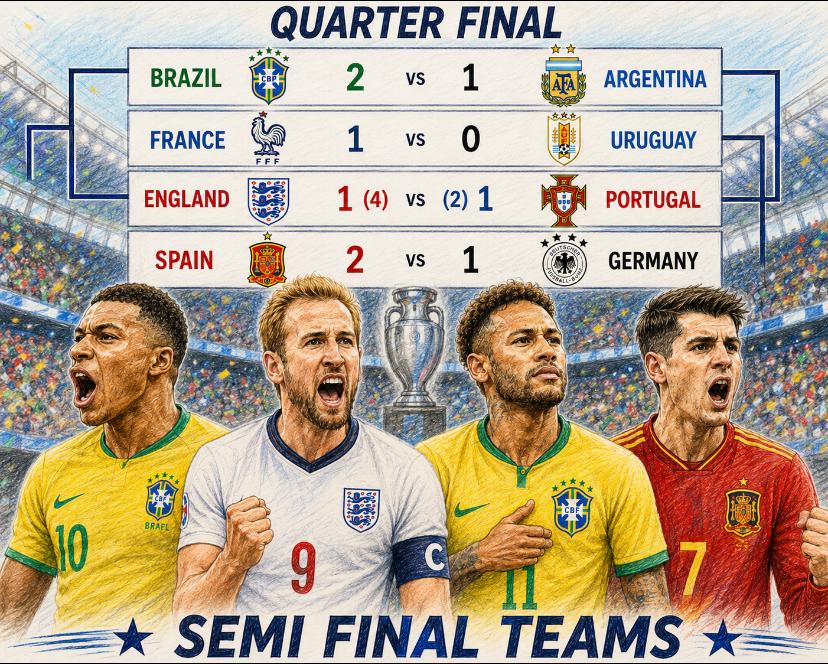
The FIFA World Cup 2026 has reached its defining stage after an unforgettable quarterfinal round produced world class football, emotional victories, heartbreaking exits and controversial moments that will remain part of World Cup history for years to come. Played across Canada, the United States and Mexico, this expanded tournament has showcased the highest standards of international football while bringing together millions of supporters from every corner of the globe. The quarterfinals demonstrated why the World Cup remains the most prestigious competition in sport, where a single moment of brilliance or a costly mistake can change the destiny of an entire nation.
Eight outstanding teams entered the quarterfinals carrying the hopes of their countries. Every squad had earned its place through determination, tactical discipline and impressive performances during the earlier rounds. Yet only four could continue their journey toward football’s greatest prize. When the final whistle sounded after four dramatic encounters, Argentina, England, France and Spain had secured their places in the semifinals, leaving behind disappointed opponents who had also produced memorable campaigns.
France became the first nation to book its place among the final four after overcoming a resilient Moroccan side that once again proved why it has become one of international football’s most respected teams. Morocco defended with remarkable organization and discipline, refusing to allow France easy opportunities. The African side frustrated the French attack for long periods while creating dangerous counterattacks whenever possession was regained. France remained patient, however, relying on experience and technical quality rather than panic. As the match progressed, the European giants gradually imposed their authority through intelligent movement and greater control of midfield. Their breakthrough eventually arrived, allowing France to manage the remainder of the contest with the confidence expected from one of the tournament favourites.
Spain’s meeting with Belgium produced another fascinating tactical contest between two technically gifted European nations. Spain controlled possession from the opening whistle, moving the ball with speed and precision while searching for openings inside Belgium’s disciplined defensive structure. Belgium relied upon physical strength and rapid counterattacks, attempting to punish Spain whenever possession changed hands. The contest remained competitive throughout much of the match, but Spain’s patience and technical excellence eventually proved decisive. The Spanish midfield dominated the rhythm of play, while their defenders successfully neutralized Belgium’s dangerous attacking threats. The victory confirmed Spain’s impressive return to the top level of international football and reinforced growing belief that another World Cup triumph is within reach.
England faced perhaps its toughest examination of the tournament against an ambitious Norwegian side that displayed tremendous courage and determination. Norway refused to be intimidated by one of Europe’s traditional football powers and matched England in intensity throughout the contest. Every challenge was fiercely contested, and both goalkeepers produced crucial saves to keep their teams alive. As normal time ended without a decisive result, the match entered extra time where physical fitness, mental strength and tactical discipline became increasingly important. England eventually found the decisive breakthrough through a well constructed attacking move that reflected patience and composure under pressure. The victory sent England into the semifinals, although the performance also highlighted the level of competition awaiting them in the closing stages of the tournament.
The most dramatic and controversial quarterfinal belonged to defending champions Argentina and a determined Swiss side that came within touching distance of producing one of the greatest upsets of the World Cup. Switzerland displayed exceptional defensive organization while remaining dangerous whenever opportunities appeared in attack. Argentina enjoyed greater possession but struggled to break through a disciplined Swiss defensive line that frustrated the South American stars for much of the match.
The defining moment arrived when Swiss striker Breel Embolo received a second yellow card and was sent off, reducing Switzerland to ten players. The dismissal immediately transformed the dynamics of the contest. Forced to defend with one player fewer, Switzerland found it increasingly difficult to maintain its earlier defensive structure. Argentina gradually took complete control of possession, increased pressure on the tiring Swiss defence and eventually found the breakthrough during extra time. The defending champions demonstrated the experience and composure expected from a team seeking consecutive World Cup titles, taking full advantage of the numerical superiority to secure qualification for the semifinals.
The red card shown to Embolo immediately became one of the biggest talking points of the tournament. Former referees, coaches, football analysts and supporters expressed sharply divided opinions regarding the decision. Many believed the second yellow card was excessively harsh considering the circumstances and importance of the match, while others argued that the referee correctly enforced the Laws of the Game without regard to the occasion. Whatever the interpretation, there is little disagreement that the dismissal significantly influenced the outcome. Argentina benefited from additional space across the field, while Switzerland’s hopes of continuing its remarkable campaign gradually faded against an opponent possessing world class attacking quality.
Refereeing has remained one of the central themes throughout the FIFA World Cup 2026. Video Assistant Referee technology has once again played an important role in reviewing goals, penalty decisions and disciplinary incidents. While many decisions have been corrected successfully through technology, debate continues regarding consistency in interpreting challenges, handball situations and yellow card offences. Football remains a sport driven by emotion, and controversial decisions continue to generate passionate discussion among supporters long after the final whistle.
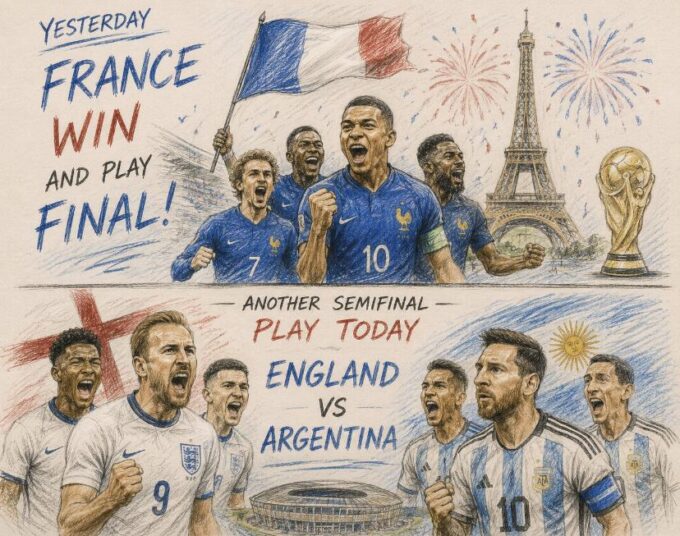
With the quarterfinals complete, attention now turns toward two semifinal encounters worthy of a World Cup finale. Argentina will face England in one of football’s greatest international rivalries. Meetings between these two nations have produced unforgettable chapters in World Cup history, ensuring that another encounter carries enormous significance. Argentina enters the match as defending champions determined to retain the trophy, while England believes its talented generation possesses the quality and maturity to reach the final and challenge for a long awaited world title. Every department of the field promises compelling battles, from midfield control to defensive organization and attacking efficiency.
The second semifinal between France and Spain offers another outstanding spectacle between two nations that have consistently demonstrated excellence throughout the tournament. France combines athleticism, pace and remarkable attacking depth with valuable championship experience. Spain approaches the game through intelligent passing, technical precision and collective movement that has become the hallmark of its football philosophy. Both teams have produced some of the tournament’s most attractive football, making this semifinal exceptionally difficult to predict. Tactical adjustments, individual brilliance and concentration during crucial moments may ultimately determine which nation advances.
The winners of these two semifinals will earn the opportunity to compete in the FIFA World Cup 2026 Final on July 19 at the magnificent MetLife Stadium in East Rutherford, New Jersey. Before the championship match, the losing semifinalists will contest the third place playoff, while the finalists prepare for football’s ultimate occasion. Every player dreams of lifting the famous golden trophy, and only one nation will fulfil that ambition after the final whistle.
The closing stages of every World Cup demand not only technical excellence but also mental resilience. Pressure increases with every passing minute because mistakes become more costly and opportunities become increasingly rare. Coaches carefully analyse every tactical detail while players understand that a single pass, tackle, save or finish could define their international careers forever.
The quarterfinals reminded the football world that championships are decided by the smallest margins. Outstanding teamwork, disciplined defending, inspired goalkeeping and moments of individual genius all played decisive roles in determining which nations survived. At the same time, controversial refereeing decisions demonstrated how quickly momentum can change during elite competition. The dismissal of a single player can transform an evenly balanced contest into a completely different game, highlighting the importance of discipline as well as technical ability.
Supporters across the globe now eagerly await two magnificent semifinal clashes featuring four of international football’s most successful nations. Argentina, England, France and Spain have each shown they possess the quality, determination and experience required to become world champions. Yet only two will earn the right to compete in the final, and ultimately only one nation will lift football’s most prestigious trophy.
As FIFA World Cup 2026 approaches its dramatic conclusion, anticipation continues to grow among football fans everywhere. The tournament has already delivered unforgettable matches, spectacular goals, emotional celebrations and moments of controversy that will be remembered for generations. The remaining matches promise even greater excitement as four football giants battle for the greatest honour the sport can offer. Soon the world will know which nation has earned the title of FIFA World Cup 2026 champion and secured its place in football history.
Post Disclaimer
The views and content presented in this article, news report, or video are solely those of the respective author or creator and do not necessarily reflect the official policy or position of BW Times Digital Online E-Paper.










Leave a comment