













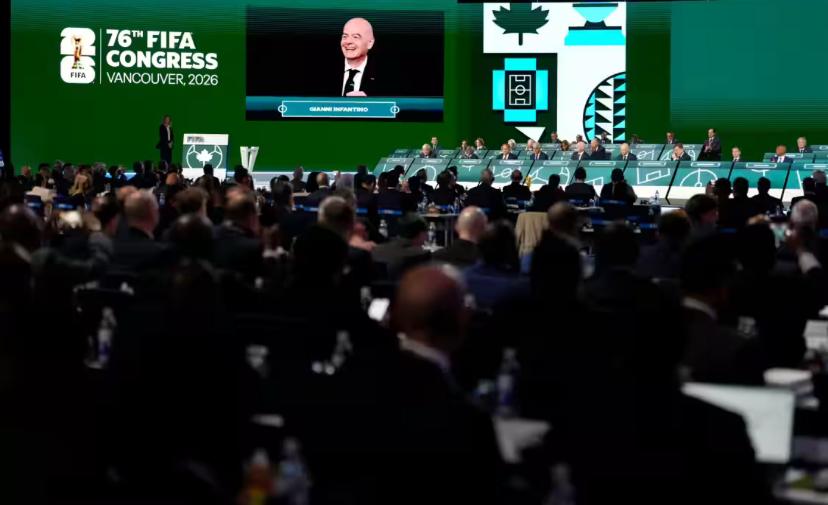
The 76th FIFA Congress held in Vancouver on April 30, 2026 emerged as far more than a routine administrative gathering. It became a defining global moment where football intersected with politics, economics, and international tensions. As preparations intensify for the expanded 2026 FIFA World Cup to be hosted across Canada, the United States, and Mexico, this Congress carried unusual weight and scrutiny. What is typically a formal assembly of member associations transformed into a platform where the realities of a divided world shaped the direction of the sport.
The Congress represents the highest decision making body of FIFA, bringing together over 200 national football associations, each with equal voting power regardless of size or influence. Delegates gather to approve policies, financial plans, development strategies, and governance reforms. In Vancouver, however, the atmosphere reflected something deeper. There was a visible awareness that football today cannot exist in isolation from global events.
At the center of attention was Gianni Infantino, who delivered a speech that attempted to balance diplomacy with clarity. His message focused heavily on unity, repeating the idea that football must serve as a bridge in a fragmented world. He emphasized that FIFA’s mission is to ensure inclusion and participation, even when political tensions threaten to interfere.
A major portion of his remarks addressed Iran, a topic that dominated discussions throughout the Congress. Infantino confirmed that Iran would participate in the 2026 World Cup and would play matches in the United States as scheduled. He framed this decision as a commitment to the universality of football rather than a political position. According to him, FIFA cannot allow global conflicts to determine who participates in the game. Football, in his view, must remain open to all nations.
Despite this firm stance, the situation surrounding Iran added a layer of complexity to the Congress. The absence of Iranian officials was widely noted and became a central talking point. Their inability to attend highlighted how political realities can influence even the most global sporting institutions. Outside the venue, protests drew attention to concerns about human rights and representation. Demonstrators argued that participation in global tournaments should reflect broader ethical considerations, while others defended the principle that athletes should not be excluded because of political disputes.
Inside the Congress, this issue created a tension between FIFA’s long standing commitment to neutrality and the increasing demand for accountability. Infantino maintained that FIFA’s responsibility is to the sport and its players, not to geopolitical conflicts. His position underscored a recurring dilemma in modern football, where decisions intended to preserve inclusivity can also attract criticism for appearing disconnected from global concerns.
Beyond political discussions, the Congress placed significant emphasis on the business and financial future of football. The upcoming World Cup is expected to be the largest and most commercially successful in history. With the expansion to 48 teams, the tournament represents a new era in scale and revenue generation. FIFA leadership highlighted projections of record breaking income, driven by broadcasting rights, sponsorships, and global fan engagement.
Infantino addressed concerns about rising ticket prices and the commercialization of the sport. He acknowledged that affordability remains an issue for many fans but defended FIFA’s financial strategy. He argued that the revenue generated from major tournaments plays a critical role in funding football development worldwide. Through programs such as FIFA Forward, funds are distributed to member associations to support grassroots initiatives, infrastructure, and youth development. The narrative presented was one of redistribution, where global success fuels local growth.
The Congress also explored how media and communication shape the global image of football. The presence of international media ensured that every development was instantly shared and analyzed. Coverage focused heavily on political tensions, financial transparency, and the logistical challenges of hosting a tournament across three countries with different systems and policies.
Canadian officials used the opportunity to present the country as an inclusive and welcoming host. They emphasized multiculturalism and openness, projecting confidence in Canada’s ability to manage a global event. This messaging was particularly important given concerns about travel restrictions and visa processes that could affect fans and teams.
However, the event was not without criticism at the local level. In Vancouver, community groups raised concerns about the social impact of hosting large scale international events. Issues such as housing pressure, increased security measures, and public spending were part of the conversation. These concerns reflected a broader global pattern where major sporting events bring both opportunities and challenges to host cities.
Within the Congress, governance and leadership were also key topics. Infantino signaled his intention to continue leading FIFA beyond his current term, suggesting stability at a time when the organization faces both growth and scrutiny. His leadership has been marked by expansion and financial success, but also by ongoing debates about transparency and decision making.
Technology and innovation were another important focus. Discussions included advancements in video assistant refereeing, data analytics, and digital fan engagement. FIFA is investing heavily in these areas to ensure that football remains competitive in an evolving entertainment landscape. The aim is to enhance the experience for both players and fans while maintaining the integrity of the game.
Despite these forward looking initiatives, the Congress repeatedly returned to the influence of geopolitics. The situation involving Iran served as a clear example of how external factors can shape internal decisions. It raised important questions about whether true neutrality is possible in a world where politics increasingly intersects with sport.
Infantino’s response throughout the Congress was grounded in optimism. He consistently promoted the idea that football has the power to unite people across cultures and conflicts. His vision positioned FIFA as a platform for connection rather than division. At the same time, the challenges highlighted in Vancouver demonstrated that achieving this vision is far from simple.
The Congress ultimately reflected the dual nature of modern football. It is both a global celebration and a mirror of the world’s complexities. The discussions in Vancouver showed that while FIFA aims to stay above politics, it cannot entirely escape the realities that shape international relations.
As the Congress concluded, attention shifted toward the 2026 World Cup and the expectations surrounding it. The tournament is set to be historic in scale, but it will also be closely watched for how it navigates political sensitivities, economic pressures, and social responsibilities. The decisions made during the Congress will play a significant role in shaping that outcome.
The 76th FIFA Congress will be remembered not just for its formal resolutions, but for the broader questions it raised. It highlighted the challenge of maintaining unity in a divided world, balancing commercial success with fairness, and preserving the spirit of the game amid external pressures.
Football remains one of the most powerful cultural forces globally, capable of bringing millions together. Yet, as demonstrated in Vancouver, it also exists within a complex framework of politics, economics, and human values. The path forward for FIFA will require careful navigation of these forces while staying true to its mission.
In the end, the Congress served as a reminder that football is more than a sport. It is a global institution that reflects both the aspirations and the tensions of the world it connects.
Post Disclaimer
The views and content presented in this article, news report, or video are solely those of the respective author or creator and do not necessarily reflect the official policy or position of BW Times Digital Online E-Paper.










Leave a comment