















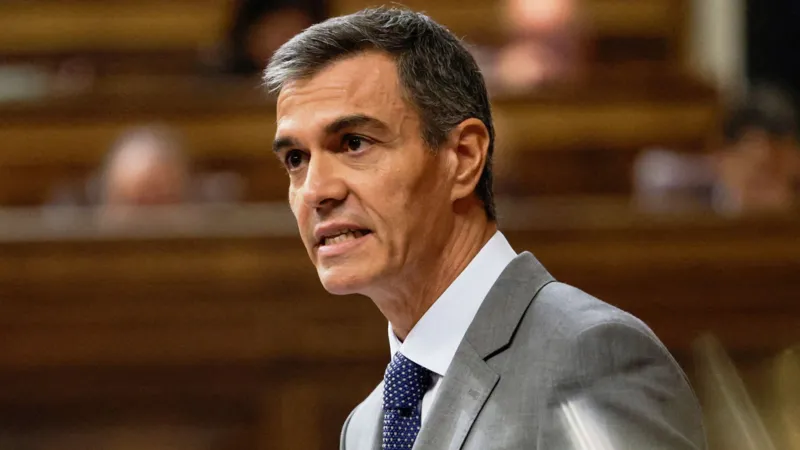
Spanish Prime Minister Pedro Sánchez has called an early general election for November 29, bringing forward a vote that was originally expected to take place in 2027.
The announcement follows a major parliamentary setback for Sánchez’s minority government, after lawmakers rejected two measures designed to address Spain’s worsening housing crisis. The defeat came as large demonstrations spread across the country, with protesters demanding stronger protections for tenants and greater access to affordable housing.
Sánchez said in a televised address that his government needed broader public support to advance its reform agenda. He argued that a stronger progressive majority would allow his administration to move forward with measures aimed at reducing inequality, improving public services and tackling the shortage of affordable homes.
The housing crisis has become one of the most politically sensitive issues in Spain. Rents and property prices have risen sharply in many parts of the country, placing increasing pressure on households, particularly lower income families, younger people and vulnerable tenants.
Public anger intensified after the eviction of 87 year old Maricarmen Abascal from her Madrid apartment. Abascal had lived in the property for more than seven decades, and her case became a symbol of the difficulties faced by tenants struggling with rising housing costs.
According to reports, her rent had increased dramatically after a legal change allowed her landlord to raise the monthly payment. She was eventually removed from the apartment and taken to hospital. Her lawyer later said she would be able to return home.
The case helped fuel demonstrations in Madrid, Barcelona, Valencia and other Spanish cities. Tens of thousands of people joined protests calling for stronger tenant protections and government action on housing.
Sánchez’s coalition responded with emergency measures intended to protect vulnerable renters and expand access to affordable accommodation. Among the proposals were restrictions on evictions in certain cases, extensions for some rental agreements, higher taxes on tourist accommodation and measures targeting large property investors.
Another proposal sought greater protection for tenants by automatically extending certain rental contracts. The measure faced strong opposition from conservative parties and other lawmakers who argued that excessive government intervention could discourage landlords from offering properties for rent and ultimately contribute to higher prices.
The parliamentary defeat exposed the difficulties faced by Sánchez’s coalition, which does not hold a majority in Congress and has relied on negotiations with smaller parties to pass legislation.
Sánchez has been prime minister since 2018. His Socialist Party finished second in the 2023 general election, while the conservative People’s Party won the largest number of seats but failed to secure enough support to form a government.
Sánchez subsequently remained in power after reaching agreements with left wing parties as well as Catalan and Basque nationalist and pro independence groups.
His government has faced increasing political pressure in recent months, with housing becoming only one of several major challenges.
Several corruption investigations involving people connected to the Socialist Party and Sánchez’s political circle have added to the pressure. His wife, Begoña Gómez, has faced a corruption case, allegations she has denied. Sánchez has described the accusations as politically motivated.
The Socialist Party has also faced scrutiny over separate investigations, including a case involving former transport minister José Luis Ábalos, who was convicted and sentenced to a lengthy prison term over his involvement in a corruption network linked to Covid era mask contracts.
Migration has created another major challenge. Sánchez’s government has faced criticism over its handling of increased arrivals in Spain’s North African territory of Ceuta, while opposition parties have demanded tougher action and questioned the government’s migration policies.
The upcoming election will therefore be fought against a backdrop of housing pressure, political controversy, immigration and growing tensions within Spain’s fragmented parliament.
The conservative People’s Party welcomed Sánchez’s decision to call an early election. Its leader, Alberto Núñez Feijóo, said the vote would give Spaniards an opportunity to decide the country’s direction.
Opinion polls have generally placed the People’s Party ahead of Sánchez’s Socialists, although forming a government could depend on negotiations with other political forces, including the right wing Vox party.
For Sánchez, the election provides an opportunity to seek a stronger parliamentary mandate after years of governing without a clear majority. His decision also places the housing crisis at the centre of the political debate at a time when public frustration over housing costs is growing.
For Spanish voters, the November 29 election will offer a chance to weigh competing approaches to housing, public services, immigration, taxation and the wider direction of government.
The campaign is likely to focus heavily on whether Spain should expand tenant protections and public housing or concentrate on increasing construction and private housing supply.
With the country facing mounting pressure over affordability and a divided parliament struggling to pass major legislation, the November election is set to become a crucial test of Spain’s political direction.
Courtesy: BBC
Post Disclaimer
The views and content presented in this article, news report, or video are solely those of the respective author or creator and do not necessarily reflect the official policy or position of BW Times Digital Online E-Paper.







Leave a comment