









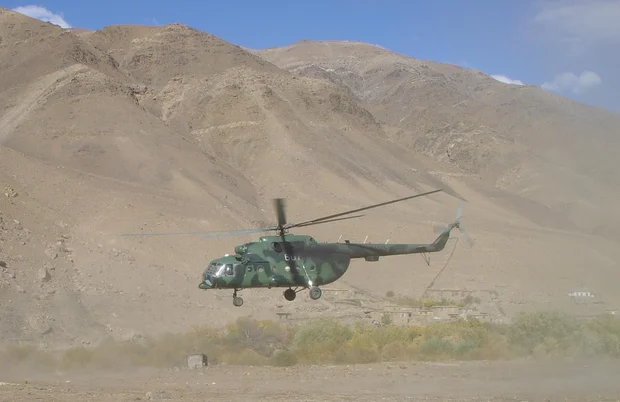
Twenty five years after the September 11 attacks, a Soviet designed helicopter at CIA headquarters in Virginia is preserving the story of one of the first American missions into Afghanistan after the attacks that changed U.S. foreign policy for decades.
On September 26, 2001, just 15 days after the attacks, a seven member CIA team known as JAWBREAKER landed in Afghanistan’s Panjshir Valley. The team carried millions of dollars in cash to help build relationships with Afghan forces and prepare for the U.S. campaign against al Qaeda and the Taliban.
The aircraft that transported them was a Mi 17 helicopter, a Russian designed machine that had been acquired by the CIA years earlier. It was chosen partly because its appearance would allow it to operate without immediately standing out in a region where similar helicopters were widely used.
The mission marked an early step in what would eventually become America’s longest war.
The helicopter is now displayed at CIA headquarters in Langley, Virginia, where it recently underwent extensive restoration ahead of the 25th anniversary of the mission.
Former CIA officer David Tyson later travelled aboard the same helicopter after joining another team sent into Afghanistan. He recalled the aircraft as extremely noisy and uncomfortable, with fuel leaking during the journey.
Despite its condition, Tyson said the pilots assured him that the helicopter was safe to fly.
Why the CIA Chose a Russian Helicopter
The Mi 17 was selected for practical reasons.
Both the Northern Alliance and Taliban forces used similar Russian built helicopters, making the aircraft less conspicuous than an American Black Hawk operating behind enemy lines.
CIA historian Rob Byer explained that blending into the local environment was particularly important for covert missions.
The helicopter was also capable of operating at the extreme altitude required to reach the Panjshir Valley. The route involved crossing the Anjuman Pass, which rises to approximately 14,500 feet above sea level.
The aircraft was modified to reduce the risk of being mistaken for an enemy helicopter by American forces. It carried no transponder that could identify it to U.S. aircraft, so its crew painted “USA” and an American flag on the upper surfaces of its stabilizers.
The flag was left unfinished because the crew did not have enough blue paint.
The helicopter was also given the call sign “9 11 01”, directly linking the aircraft to the attacks that had triggered the mission.
It eventually completed more than 300 missions in Afghanistan before being taken out of operational service in 2012.
Team Alpha Enters the War
Tyson had extensive experience in Central Asia and spoke several regional languages, including Uzbek, Turkmen and Russian.
On September 11, he was travelling to Britain for a meeting connected to an earlier CIA effort to recover Stinger missiles that had remained in Afghanistan following the Soviet war.
After arriving, Tyson quickly began preparing to return to the region. He believed his language skills and experience would make him useful to the operation that was rapidly taking shape.
On October 17, less than three weeks after the JAWBREAKER team entered the Panjshir Valley, Tyson and other members of Team Alpha were deployed to another part of northern Afghanistan.
They became among the first Americans sent behind Taliban lines and were tasked with working alongside forces commanded by Uzbek military leader Abdul Rashid Dostum as part of the campaign against the Taliban and al Qaeda.
Tyson’s principal responsibilities involved intelligence gathering and liaison work. His knowledge of Uzbek helped the team communicate with Dostum’s forces and better understand the people and terrain around them.
The conditions were demanding. American personnel travelled alongside Afghan fighters on horseback through mountainous terrain, sometimes spending as many as 14 hours in the saddle.
Tyson later recalled that the horses themselves presented another challenge, describing them as difficult animals that fought, bit and kicked.
The Battle at Qala i Jangi
By late November 2001, Taliban forces had suffered major setbacks across northern Afghanistan. Hundreds of foreign fighters surrendered and were taken to Qala i Jangi, a large 19th century fortress near Mazar e Sharif.
On November 25, Tyson and fellow CIA officer Johnny Micheal “Mike” Spann entered the compound.
Their initial mission was to identify the prisoners and determine their backgrounds. Tyson said many of the detainees openly identified themselves as members of al Qaeda or people who had pledged allegiance to Osama bin Laden.
Among the prisoners was John Walker Lindh, an American who had travelled to the region and joined the Taliban.
The situation changed dramatically several hours later when the prisoners launched an uprising.
Explosions and gunfire erupted inside the compound. Tyson recalled moving through the fighting and eventually hearing Spann call his name.
He then saw Spann’s body on the ground.
Tyson believed Spann had already been killed when he reached him. He fired at the men around his colleague and took Spann’s rifle before fighting his way to safety.
Spann, who was 32, became the first American killed in combat in Afghanistan. His name was later added to the CIA Memorial Wall.
Tyson continued using Spann’s rifle for the remainder of his deployment. It is now preserved at the CIA Museum alongside the boots Tyson wore during his time in Afghanistan.
His young son had called them “Dad’s lucky boots.”
For Tyson, the rifle remains a powerful reminder of his colleague and friend.
Preserving the Helicopter’s History
After completing its final operational mission in 2012, the Mi 17 was transported to CIA headquarters in 2018.
It was originally placed outside on a display designed to resemble the Afghan landscape. However, years of exposure to weather and sunlight caused the aircraft’s paint to fade and allowed animals to get inside.
The CIA undertook a major restoration project during the past year.
Openings in the aircraft were sealed and its exterior was repainted to more closely match its appearance in 2001.
Restorers also restored the number “607”, which belonged to the Afghan pilot who flew the first JAWBREAKER mission.
The number had been painted on both sides of the helicopter during the original operation. It helped the aircraft resemble a Northern Alliance helicopter while also providing a visual signal to allied aircraft that it was friendly.
A Mission That Continued Beyond the War
For Tyson, the helicopter is only one part of a much larger personal history.
He continues to remember Spann and the events at Qala i Jangi decades later. He has also become involved with Badger Six, a nonprofit established in 2022 and named after Spann’s call sign.
The organisation supports Afghan fighters who worked with Team Alpha and assists their families with needs including food, medicine, relocation and resettlement.
It currently supports around 35 families, according to the organisation.
The work reflects an unresolved consequence of the Afghanistan war. When U.S. forces withdrew in 2021 and the Taliban returned to power, some Afghans who had worked alongside American forces were left behind and faced potential retaliation.
For Tyson, helping those former partners represents an obligation that did not disappear when the war ended.
The restored Mi 17 now stands as a physical reminder of the opening days of America’s Afghanistan campaign, the risks taken by CIA officers operating behind enemy lines and the relationships formed with Afghan partners.
For those who were there, however, its significance is more personal. It represents the beginning of a mission that shaped their lives, the loss of colleagues such as Mike Spann and the lasting responsibility they continue to feel toward the people who stood alongside them.
Courtesy: cbsnews
Post Disclaimer
The views and content presented in this article, news report, or video are solely those of the respective author or creator and do not necessarily reflect the official policy or position of BW Times Digital Online E-Paper.







Leave a comment