















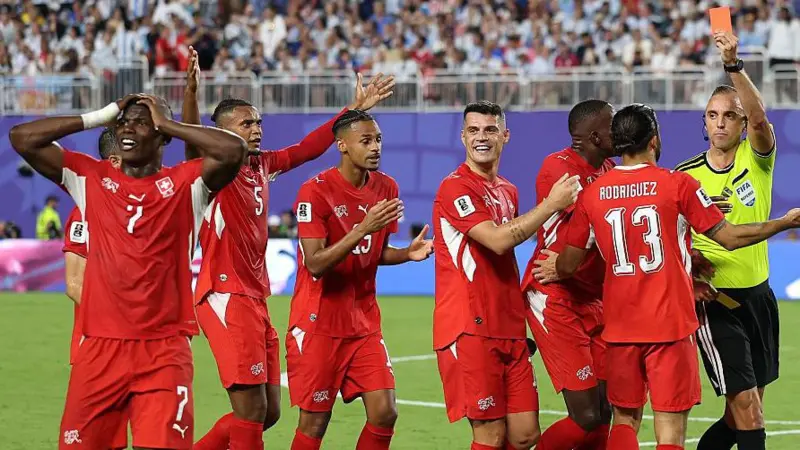
Switzerland striker Breel Embolo became the first footballer in FIFA World Cup history to be sent off under the tournament’s newly introduced mistaken identity rule during his country’s dramatic quarterfinal defeat to Argentina.
The controversial incident occurred during the second half of Switzerland’s knockout clash with the defending world champions. With the match level at 1-1, Embolo appeared to win a foul after going down inside the attacking area following what initially looked like a challenge from Argentina midfielder Leandro Paredes.
The referee immediately awarded the foul and issued a yellow card to Paredes. However, following a recommendation from the Video Assistant Referee, the official reviewed the incident on the pitch side monitor.
After examining the replay, the referee concluded that Paredes had not committed a foul and instead ruled that Embolo had attempted to deceive the referee by simulating contact. The yellow card shown to the Argentine midfielder was withdrawn and transferred to Embolo under FIFA’s newly adopted mistaken identity regulation.
Because Embolo had already received a yellow card earlier in the match, the second caution resulted in his dismissal. The Swiss forward became visibly emotional after receiving the red card and left the field in tears while being comforted by teammates as Switzerland faced the remainder of the match with ten players.
The dismissal proved to be a turning point in the contest. Despite Switzerland’s determined defensive effort, Argentina took advantage of the numerical superiority during extra time and secured a 3-1 victory to advance to the FIFA World Cup semifinals, where they will meet England.
Following the match, Switzerland head coach Murat Yakin strongly criticized both the decision and the regulation itself. He argued that the incident did not warrant a yellow card and questioned whether VAR should have intervened in such circumstances.
Yakin expressed disappointment that the match was significantly influenced by the application of a newly introduced rule, saying he believed the decision changed the outcome of the game. Despite the defeat, he praised his players for their resilience and commitment after being reduced to ten men.
Football analysts offered differing opinions on the controversial moment. Some believed the replay clearly showed simulation by Embolo and supported the referee’s decision to issue the second yellow card. Others sympathized with the Swiss striker while acknowledging that the incident ultimately proved costly for his team during one of the tournament’s biggest matches.
The new mistaken identity rule was introduced by FIFA ahead of the 2026 World Cup to improve fairness during matches involving VAR reviews. Under the regulation, if a referee initially books or sends off the wrong player after mistakenly believing an opponent committed a foul, the decision can now be corrected following video review.
Previously, referees were generally unable to reverse yellow cards after play had restarted, even when video evidence showed another player was responsible. The new law allows officials to correct such situations by cancelling the original booking and applying disciplinary action to the appropriate player.
The rule had already been used earlier in the tournament when a yellow card shown to a United States player was overturned after VAR determined that an opposing player had simulated a foul. However, Embolo’s dismissal marked the first occasion in which the regulation directly resulted in a player receiving a second yellow card and being sent off.
The incident has sparked widespread debate among players, coaches and football supporters over the role of VAR and the expanding use of technology in officiating major international tournaments. While many agree that correcting obvious errors is important, others have questioned whether such interventions should decide matches of this magnitude.
For Switzerland, the controversial red card overshadowed an otherwise determined performance against one of the tournament favourites. For FIFA, the incident represents the first major test of a new law that is likely to remain the subject of discussion throughout the remainder of the 2026 World Cup and beyond as football continues to adapt its rules in pursuit of greater accuracy and fairness.
Courtesy: BBC
Post Disclaimer
The views and content presented in this article, news report, or video are solely those of the respective author or creator and do not necessarily reflect the official policy or position of BW Times Digital Online E-Paper.











Leave a comment