
















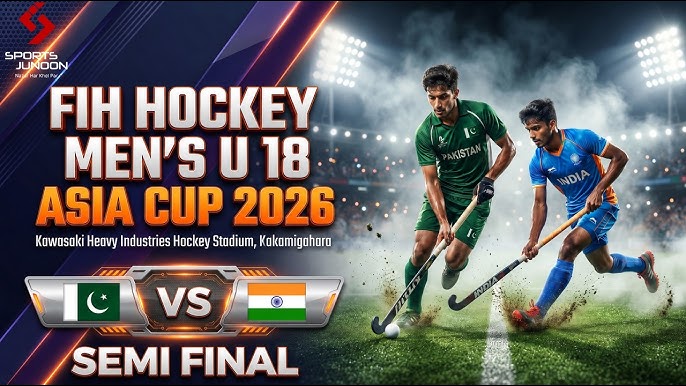
Few sporting contests in Asia carry the emotion, history, and passion associated with a hockey match between Pakistan and India. For decades, the two neighboring nations dominated international hockey, producing legendary players, unforgettable matches, and some of the finest moments in the history of the sport. When the teams met in the semi-final of the Men’s U-18 Asia Cup 2026 in Japan, the encounter represented far more than a place in the tournament final. It was another chapter in one of hockey’s most celebrated rivalries and a glimpse into the future of the sport in both countries.
India emerged victorious with a 5-3 win in a thrilling contest that showcased attacking hockey, individual brilliance, and the growing gap in youth development between the two nations. While Pakistan displayed flashes of their traditional flair and creativity, India’s superior structure, fitness, tactical discipline, and finishing quality ultimately proved decisive.
The Men’s U-18 Asia Cup is one of the most important development tournaments in Asian hockey. Organized under the umbrella of the Asian Hockey Federation, the competition provides a platform for the continent’s most promising young players to gain international experience and prepare for future senior-level competition. Nations view the tournament as a testing ground for future stars who could eventually represent their countries in major events such as the Asian Games, Hockey World Cup, and Olympic Games.
For Pakistan, the tournament carried additional significance. The country has been striving to rebuild its hockey program after decades of decline. Once considered the most successful nation in world hockey history, Pakistan has struggled to maintain its position among the global elite since the sport transitioned to artificial turf and modern high-performance systems. The U-18 competition was viewed as an opportunity to demonstrate that a new generation of talent is emerging.
The semi-final began at a high tempo, with both teams determined to seize the initiative. India started aggressively, pressing high and forcing Pakistan into defensive errors. Their willingness to attack through quick passing combinations and overlapping runs immediately placed pressure on the Pakistani defense.
From a technical perspective, India’s biggest advantage was their ability to control possession in crucial areas of the field. Rather than relying solely on individual dribbling skills, Indian players moved the ball rapidly between lines, stretching Pakistan’s defensive structure and creating spaces in dangerous positions.
Pakistan, meanwhile, showed many of the qualities that historically made its hockey teams famous. The players demonstrated excellent stick work, natural creativity, and an eagerness to attack. However, hockey analysts noted that Pakistan struggled to maintain defensive organization whenever India increased the pace of play.
One of the most significant factors behind India’s victory was its effectiveness inside the attacking circle. Modern hockey is often decided by efficiency rather than possession statistics alone. India converted opportunities at a much higher rate and punished defensive mistakes with ruthless precision.
Pakistan created chances of its own and remained competitive throughout much of the match. However, several promising attacks broke down in the final third due to rushed decision-making, inaccurate passing, or an inability to finish under pressure. These moments proved costly against an Indian side that capitalized on nearly every defensive lapse.
Fitness and conditioning also played a major role in determining the outcome. Throughout the tournament, India displayed impressive stamina and intensity. Against Pakistan, Indian players maintained their pressing game deep into the match, forcing turnovers and preventing Pakistan from establishing sustained periods of control.
Many hockey critics believe this aspect reflects the investment India has made in youth development over the past decade. Advanced training facilities, sports science programs, professional coaching structures, and regular international exposure have helped produce technically sound and physically prepared players capable of competing at the highest levels.
Pakistan’s young players undoubtedly possess talent, but the match highlighted areas requiring further development. Defensive coordination, penalty-corner efficiency, transition play, and game management remain areas where improvement is needed if Pakistan hopes to return to the top tier of international hockey.
The result also reflected broader trends within Asian hockey. India has successfully modernized its hockey system and consistently produces competitive teams at junior and senior levels. Their recent achievements in international competitions demonstrate the effectiveness of a long-term development strategy focused on infrastructure, coaching education, and athlete support.
Pakistan’s hockey history remains extraordinary. The nation has won multiple World Cups, Olympic medals, and Asian titles. Legendary players from Pakistan helped shape the sport and inspired generations around the world. However, modern hockey demands far more than natural talent. Success now requires sophisticated development pathways, financial investment, sports science support, and continuous international competition.
Despite the defeat, Pakistan’s performance offered reasons for optimism. The team reached the semi-final of a major continental event and demonstrated courage against one of the strongest youth teams in Asia. Several players showed technical ability and attacking instincts that could become valuable assets for Pakistan’s future senior teams.
For India, the victory was another indication that its hockey future remains bright. The young squad displayed composure, tactical maturity, and confidence throughout the tournament. Their ability to handle the pressure of a high-profile match against Pakistan underlined the strength of India’s emerging generation.
The rivalry between Pakistan and India continues to hold a special place in world hockey. Every meeting carries historical significance and attracts attention far beyond the boundaries of the sport. While the balance of power has shifted in recent years, the passion and intensity remain unchanged.
India’s 5-3 victory secured a place in the final, where they completed a successful campaign by capturing the U-18 Asia Cup title. Pakistan left the tournament disappointed by the result but encouraged by signs of progress among its young players.
As both nations look toward the future, the match served as a reminder of hockey’s rich heritage in South Asia. India celebrated a deserved victory built on tactical discipline and clinical finishing, while Pakistan was left with valuable lessons and renewed motivation to restore its place among the sport’s leading nations.
The semi-final may have ended with India advancing, but it also demonstrated that the famous rivalry remains alive and capable of producing memorable contests. For hockey supporters across Asia, that is perhaps the most encouraging outcome of all.
Post Disclaimer
The views and content presented in this article, news report, or video are solely those of the respective author or creator and do not necessarily reflect the official policy or position of BW Times Digital Online E-Paper.













Leave a comment