














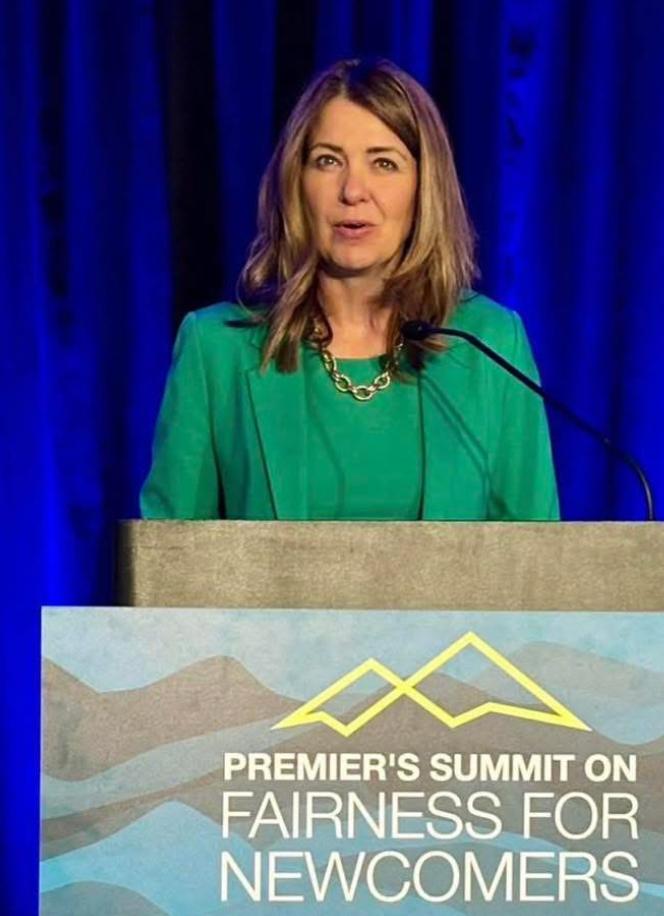
The political theatre around immigration policy in Alberta took a more serious and, at moments, uncomfortable turn this week as Premier Danielle Smith convened what was officially called the Summit on Fairness for Newcomers. Framed as a listening exercise, the gathering quickly evolved into a revealing snapshot of the province’s competing priorities, where economic urgency collided with long standing concerns about equity, recognition, and dignity for those who arrive with hope but often face systemic exclusion.
From the outset, Smith’s remarks carried the tone of a leader attempting to balance two pressures that do not always sit easily together. On one side was Alberta’s aggressive push for economic expansion, particularly in sectors facing acute labour shortages. On the other was the persistent criticism that newcomers continue to be underutilized, underpaid, and in many cases overlooked despite credentials that should place them in the province’s professional core rather than its margins.
In her keynote address, Smith spoke plainly about what she described as a “mismatch that Alberta can no longer afford.” She argued that fairness must move beyond rhetoric and into measurable outcomes, stating that a system that welcomes skilled immigrants but fails to integrate them meaningfully is neither economically efficient nor morally defensible. She pointed to engineers driving taxis, doctors working survival jobs, and internationally trained professionals navigating years of regulatory limbo as examples of a structural failure that undermines both individual potential and provincial prosperity.
Yet while the Premier’s words struck a chord, they also raised an unavoidable question. Why has this mismatch persisted for so long under successive governments, including her own administration’s watch. Critics at the summit did not hesitate to press this point, turning what might have been a routine policy forum into a more pointed exchange about accountability.
Among the participants were Muhammad Yaseen, Muhammad Yaseen, Rajan Sawhney, and Joseph Schow, alongside senior officials connected to the Alberta Advantage Immigration Program. Representatives from regulatory bodies, post secondary institutions, and major employers also contributed to the discussion, each bringing their own perspective on where the system is falling short.
What emerged from these exchanges was a rare level of consensus on the problem, if not yet on the solution. Employers acknowledged that they often hesitate to hire internationally trained professionals due to uncertainty around credentials. Regulators defended the need for standards but admitted that processes can be slow and opaque. Educators highlighted the gap between academic equivalency and workplace readiness. Newcomers themselves, perhaps the most compelling voices in the room, described a system that demands patience but rarely rewards it in a timely or fair manner.
Smith’s response to these concerns was assertive, though not without ambiguity. She pledged to accelerate credential recognition pathways and expand bridging programs, emphasizing that Alberta must become the most attractive destination in Canada not only for investment but for talent. She argued that fairness is not charity but strategy, insisting that a province competing on the global stage cannot afford to waste human capital.
Still, the summit exposed a deeper tension within Alberta’s immigration narrative. The government’s focus on economic alignment, while pragmatic, risks reducing newcomers to units of labour rather than participants in a broader social contract. Several community leaders at the event pushed back against this framing, urging the province to consider integration in its fullest sense, including access to housing, healthcare, and cultural inclusion.
The presence of business leaders added another layer to the debate. Many spoke candidly about the urgency of filling vacancies in sectors ranging from healthcare to construction and technology. Yet their calls for faster access to skilled workers were met with a counterargument that speed must not come at the expense of fairness or transparency. The question, ultimately, is not just how quickly newcomers can be absorbed into the workforce, but whether they are being placed in roles that reflect their true capabilities.
What made this summit stand out was not the novelty of its themes but the clarity with which those themes were articulated. For years, policymakers have acknowledged the gap between immigration intake and labour market integration. What has often been missing is the political will to confront the institutional inertia that sustains that gap. Smith’s rhetoric suggests an awareness of this challenge, but rhetoric alone will not close it.
There is also a political dimension that cannot be ignored. Immigration remains a sensitive issue across Canada, and Alberta is no exception. By framing the conversation around fairness, Smith is attempting to reposition the debate away from numbers and toward outcomes. It is a calculated move, one that seeks to appeal both to economic pragmatists and to communities that have long demanded a more just system.
Whether this approach will translate into meaningful change remains uncertain. Summits, by their nature, generate momentum but not necessarily results. The real test will lie in the policies that follow and the speed with which they are implemented. Newcomers in Alberta have heard promises before. What they are waiting for now is proof.
In the end, the Summit on Fairness for Newcomers may be remembered less for what was said and more for what it revealed. It exposed a system under strain, a government under pressure, and a population of newcomers whose patience is wearing thin. If Premier Danielle Smith is serious about fairness, the path forward will require more than dialogue. It will demand decisive action, institutional reform, and a willingness to measure success not by announcements but by outcomes that can no longer be delayed.
Post Disclaimer
The views and content presented in this article, news report, or video are solely those of the respective author or creator and do not necessarily reflect the official policy or position of BW Times Digital Online E-Paper.











Leave a comment