




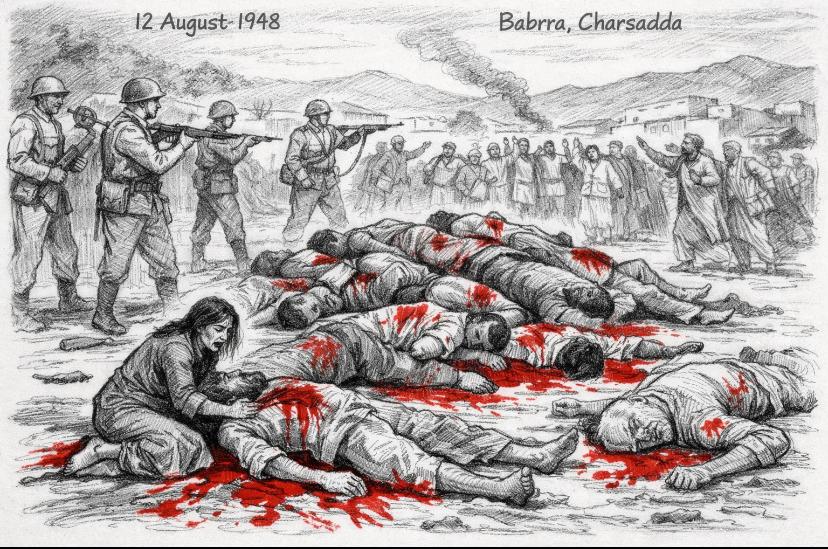
The tragic events of 12 August 1948 at Babrra in Charsadda remain one of the most painful memories in the early history of Pakistan. Only one year after the country achieved independence, a peaceful political gathering turned into a day of bloodshed that still echoes in the political and social history of the region. The incident involved supporters of the Khudai Khidmatgar, a movement founded by the renowned Pashtun leader Abdul Ghaffar Khan who was widely respected for promoting non violence, social reform, and education among the Pashtun people.
In the months following the creation of Pakistan in 1947, the political situation in the then North West Frontier Province became increasingly tense. The Khudai Khidmatgar movement had played an important role during the struggle against British colonial rule and had maintained close political cooperation with the Indian National Congress before partition. Because of this history, the new provincial government led by Abdul Qayyum Khan viewed the movement with suspicion and decided to ban its activities. Many leaders and activists associated with the movement were arrested, creating strong resentment among their supporters, especially in Charsadda where the movement had deep roots.
As the arrests increased and political pressure grew, Khudai Khidmatgar supporters organized a gathering in Babrra village near Charsadda on 12 August 1948. Thousands of villagers, activists, and sympathizers reportedly arrived in the area to protest against the arrests and to demand the release of their leaders. The gathering was intended to be peaceful, reflecting the philosophy of non violence that had always been emphasized by Bacha Khan. Many participants were ordinary villagers who believed they were exercising their right to protest against what they saw as political injustice.
However, the provincial authorities considered the gathering illegal because the organization had already been banned. Police forces were deployed around the area and ordered the crowd to disperse immediately. Witnesses later recalled that the protesters refused to leave, insisting they had assembled peacefully and had no intention of causing violence. The situation soon became tense as police surrounded the gathering and attempted to force the crowd to break up.
What happened next turned the protest into one of the most tragic incidents in the region’s political history. Security forces opened fire on the crowd and panic spread among the protesters as people tried to escape from the area. Many ran toward nearby fields and irrigation canals in an attempt to save their lives while others fell to the ground after being struck by bullets. Eyewitness accounts later described scenes of chaos and fear as unarmed villagers struggled to flee from the gunfire.
The exact number of casualties has remained a matter of debate ever since. Official reports at the time stated that around fifteen to twenty people were killed. However, many local sources, historians, and political activists have long argued that the number was far higher and that dozens or even hundreds of people may have lost their lives during the firing. Because there was no comprehensive independent investigation conducted at the time, the true scale of the tragedy has never been fully established.
The Babrra incident quickly became a deeply emotional issue for the Pashtun population of the region. Supporters of Bacha Khan and the Khudai Khidmatgar movement described the event as a brutal suppression of a peaceful political protest. For many families in Charsadda and surrounding districts, the tragedy left a lasting scar as relatives mourned those who had been killed or injured during the incident.
Following the incident, the political environment in the province became even more strained. Many activists associated with the Khudai Khidmatgar movement were arrested or forced to withdraw from political activities. Over time the movement lost much of its organizational strength, although its message of non violence and social reform continued to influence many people in the region.
Decades later, the memory of the Babrra massacre remains alive in Charsadda and across Khyber Pakhtunkhwa. For many historians and political observers, the event represents one of the earliest examples of political confrontation in the newly formed state. Memorial gatherings and discussions are still held by some groups to remember those who lost their lives that day and to reflect on the lessons of tolerance, dialogue, and political rights.
Even after more than seventy years, the events of 12 August 1948 continue to be discussed in political debates, historical writings, and public conversations in the region. The tragedy at Babrra stands as a reminder of how political tensions during the early years of Pakistan shaped the course of its history and left a legacy that is still remembered by many today.
Post Disclaimer
The views and content presented in this article, news report, or video are solely those of the respective author or creator and do not necessarily reflect the official policy or position of BW Times Digital Online E-Paper.





Leave a comment