













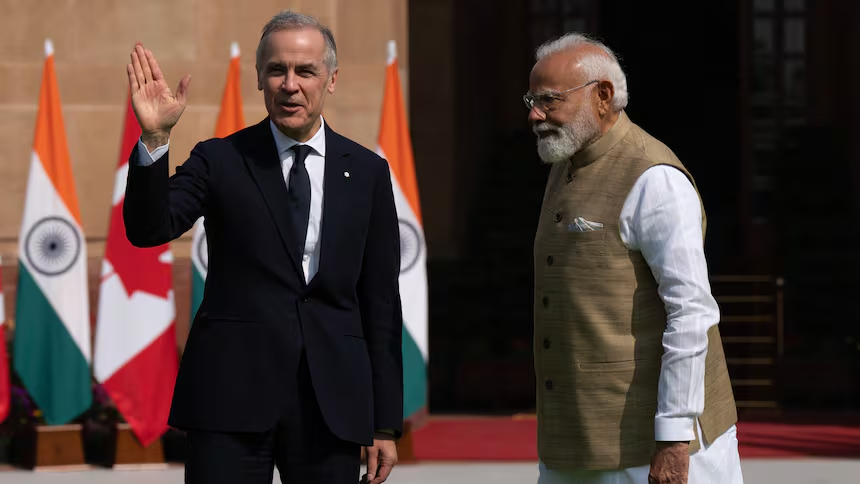
Prime Minister Mark Carney and Indian Prime Minister Narendra Modi released a sweeping joint statement in New Delhi outlining a renewed and expanded India–Canada Strategic Partnership built on trade, energy security, defence cooperation, innovation and people-to-people ties.
Carney’s February 27–March 2 visit marks his first official trip to India since becoming prime minister and the first bilateral visit by a Canadian prime minister to India since 2018.
The leaders commemorated 79 years of diplomatic relations and reaffirmed that the partnership is grounded in democratic values, sovereignty, rule of law and strong people-to-people connections.
A New Framework: “One Earth, One Family, One Future”
The two leaders agreed to adopt the guiding principle of “Vasudhaiva Kutumbakam” (One Earth, One Family, One Future) as the overarching framework for the renewed partnership.
They aligned India’s Viksit Bharat vision with Canada’s Build Canada Strong agenda, emphasizing cooperation in:
- Energy transition
- Food and nutrition security
- Critical minerals
- Digital and AI ecosystems
- Supply chain resilience
- Talent mobility
- Sustainable development
Trade and Economic Partnership Accelerated
At the core of the reset is the launch of formal negotiations toward a Comprehensive Economic Partnership Agreement (CEPA).
Both leaders expressed confidence in concluding the agreement by the end of 2026, with a shared goal of expanding bilateral trade to CAD $70 billion annually by 2030.
The leaders also welcomed:
- Reconstitution of the India–Canada CEO Forum
- A renewed Ministerial Dialogue on Trade and Investment
- A new Finance Ministers’ Economic Dialogue
- Four reciprocal ministerial-led trade missions
Strategic Energy Partnership
Energy cooperation emerged as a cornerstone of the partnership. The leaders announced the advancement of an India–Canada Strategic Energy Partnership covering:
- Clean energy
- Conventional oil and gas
- Civil nuclear cooperation
- Hydrogen and biofuels
- Battery storage
- Carbon capture, utilization and storage (CCUS)
- Critical minerals
A major highlight was the CAD $2.6 billion uranium supply agreement between Cameco and India’s Department of Atomic Energy, strengthening India’s civil nuclear energy capacity.
Canada also reaffirmed its ambition to become a leading global supplier of liquefied natural gas (LNG), targeting:
- 50 million tonnes annually by 2030
- Up to 100 million tonnes annually by 2040
India signaled interest in sourcing LNG and expanding long-term LPG arrangements with Canada.
Critical Minerals and Clean Energy Cooperation
The leaders welcomed the signing of a Memorandum of Understanding on Critical Minerals Cooperation, supporting secure and diversified supply chains.
India endorsed the G7 Critical Minerals Action Plan, while both sides committed to expanding cooperation in:
- Solar
- Wind
- Bioenergy
- Small hydro
- Energy storage
- Grid modernization
They also announced plans to convene a Canada–India Renewable Energy and Storage Summit in 2026.
India welcomed Canada’s intention to pursue membership in the International Solar Alliance and upgrade participation in the Global Biofuels Alliance.
Education, Talent and Innovation
Education and research mobility were highlighted as pillars of the relationship.
The leaders welcomed:
- A new Joint Talent and Innovation Strategy
- Expanded academic partnerships
- Offshore campuses of Canadian institutions in India
- AICTE–MITACS collaboration enabling 300 Indian students annually to conduct research in Canada
- 24 new education-related MOUs
They also committed to revitalizing the Joint Working Group on Higher Education.
Science, Space and AI Collaboration
Technology and innovation will be supported by the relaunch of the Joint Science and Technology Cooperation Committee.
Space cooperation between the Canadian Space Agency and the Indian Space Research Organisation will expand into:
- Space robotics
- Human spaceflight
- Atmospheric sciences
- Quantum communications
The leaders also agreed to explore joint AI integration in space technologies, healthcare diagnostics and smart grid systems.
They welcomed progress under the Australia–Canada–India Technology and Innovation Partnership and signed a trilateral MOU to deepen cooperation in AI and digital technologies.
Security and Defence Cooperation
Security formed the first “foundational layer” of the renewed partnership.
The leaders agreed to:
- Institutionalize an India–Canada Defence Dialogue
- Launch a Maritime Security Partnership
- Enhance joint training and professional exchanges
- Strengthen cooperation against terrorism, violent extremism and organized crime
- Address illegal narcotics and fentanyl precursor flows
- Expand cybersecurity and law enforcement coordination
Canada will appoint a Defence Attaché to India, while India will accredit its Defence Attaché in Washington to Canada.
Indo-Pacific and Multilateral Engagement
Both leaders reaffirmed commitment to a free, open, inclusive and resilient Indo-Pacific.
India welcomed Canada’s interest in joining the Indian Ocean Rim Association as a Dialogue Partner. The two sides pledged greater cooperation on maritime security, disaster preparedness, climate resilience and digital inclusion.
Cultural and People-to-People Ties
A new Memorandum of Understanding on Cultural Cooperation will expand collaboration in:
- Arts and heritage
- Audiovisual media
- Creative industries
- Emerging technologies such as AI and virtual reality
The leaders also emphasized support for Indigenous and Tribal communities, highlighting platforms like Bharat Tribal Festival 2026 to strengthen inclusive growth.
Conclusion
Prime Minister Carney expressed appreciation for India’s hospitality and reaffirmed Canada’s commitment to advancing the comprehensive partnership.
Both leaders stated that the renewed India–Canada Strategic Partnership is designed to deliver tangible economic, security and technological benefits while contributing to global stability and sustainable development.
Post Disclaimer
The views and content presented in this article, news report, or video are solely those of the respective author or creator and do not necessarily reflect the official policy or position of BW Times Digital Online E-Paper.











Leave a comment