















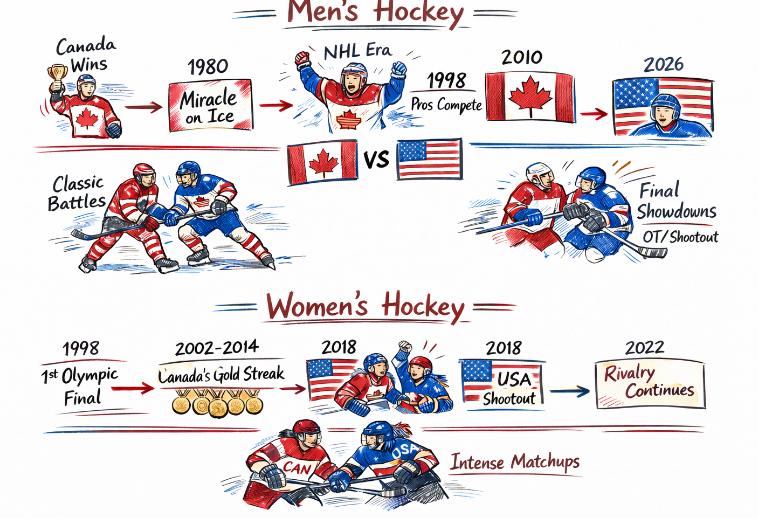
Ice hockey between Canada and United States has grown into one of the most intense rivalries in international sport. On both the men’s and women’s sides, the two neighbours have faced each other hundreds of times over the past century, building a history filled with championship games, political drama, and unforgettable moments.
In men’s international hockey, Canada and the United States have met more than 200 times in officially recognized tournaments and exhibition games dating back to the early 20th century. Their Olympic rivalry began in 1920, when Canada defeated the United States in the gold medal game at the Antwerp Games. Since then, the two nations have crossed paths repeatedly at the Winter Olympics, the IIHF World Championship, the World Cup of Hockey, and various international competitions.
At the Winter Olympics alone, the Canadian and American men have played each other around 20 times. Canada historically held the upper hand in early decades, when the country dominated the amateur era of Olympic hockey. The United States had its breakthrough in 1960 on home ice in Squaw Valley, capturing gold. Two decades later came the unforgettable 1980 semifinal at the Lake Placid Games, when a young American team defeated the heavily favored Soviet Union before going on to win gold. Although Canada was not the opponent in that famous semifinal, the U.S.–Canada rivalry intensified in the years that followed, especially as professional players began to enter Olympic competition in 1998.
One of the defining modern Olympic moments between the two countries occurred in 2010 in Vancouver. In front of a home crowd, Canada defeated the United States 3–2 in overtime in the gold medal game, with Sidney Crosby scoring what became known nationwide as the “Golden Goal.” Four years later in Sochi, Canada once again beat the United States in the semifinal round. Across Olympic history, Canada has won more head-to-head games overall, but many contests have been decided by a single goal, reflecting how closely matched the programs have become.
Outside the Olympics, the rivalry has flourished at the IIHF World Championship and World Cup of Hockey. Canada has traditionally enjoyed deeper professional talent pools, while the United States has relied on speed and structured defensive systems. In recent decades, especially since the 1990s, the results have become more balanced. The Americans captured the World Cup of Hockey in 1996 by defeating Canada in a best-of-three final, a landmark victory that shifted perceptions of the rivalry. Overall, Canada still leads the all-time men’s series in total wins, but the gap has narrowed compared with the early decades.
If the men’s rivalry is historic, the women’s rivalry is even more concentrated and dramatic. Since women’s ice hockey was introduced at the 1998 Nagano Winter Games, Canada and the United States have met in the gold medal game in six of the seven Olympic tournaments played so far. That level of dominance by two countries is rare in global sport.
In Olympic women’s hockey, the two nations have faced each other roughly 10 times. Canada won the inaugural Olympic gold in 1998, but the United States responded with gold in 2018 in PyeongChang after a dramatic shootout victory. Canada reclaimed the title in 2022 in Beijing. Most of their Olympic clashes have been either preliminary round meetings or gold medal finals, and nearly all have been decided by narrow margins.
Beyond the Olympics, the women’s teams have met more than 180 times in international play, including at the IIHF Women’s World Championship, the Four Nations Cup, and various exhibition series. Canada dominated the early 2000s, winning multiple world titles and Olympic gold medals, but the United States gradually built a program capable of matching Canada’s depth and physical style. By the mid-2010s, the rivalry had become almost perfectly balanced, with both teams trading world championship victories.
What makes the women’s rivalry particularly intense is the familiarity between players. Many compete against each other in professional leagues in North America, creating a year-round competitive bond. Olympic finals between the two often feature dramatic momentum swings, overtime periods, and shootouts. The 2018 Olympic final, decided in a shootout, symbolized just how evenly matched the programs have become.
In total combined men’s and women’s competition, Canada and the United States have faced each other well over 400 times in officially recorded international games. Canada leads the overall men’s series historically, while the women’s series is nearly even in recent decades despite Canada’s early dominance.
The rivalry goes beyond statistics. It reflects geography, shared culture, and a battle for supremacy in a sport both countries consider central to their identity. When Canada and the United States meet on Olympic ice, it is rarely just another game. It is often a final, often dramatic, and almost always remembered long after the medals are awarded.
Post Disclaimer
The views and content presented in this article, news report, or video are solely those of the respective author or creator and do not necessarily reflect the official policy or position of BW Times Digital Online E-Paper.










Leave a comment