





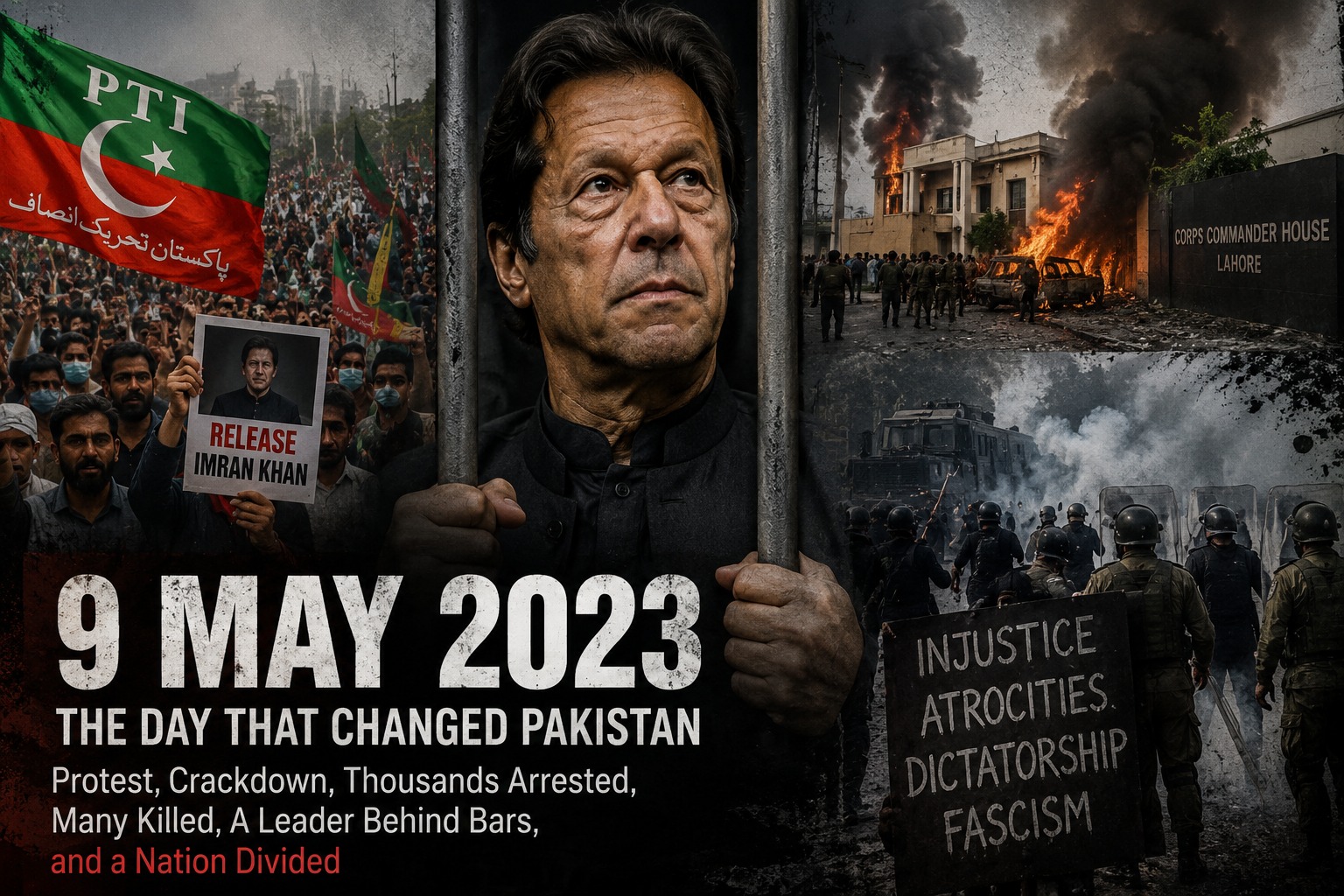
The events of 9 May 2023 became one of the most painful, controversial, and politically transformative moments in Pakistan’s modern history. What started as the sudden arrest of former Prime Minister Imran Khan from the Islamabad High Court rapidly turned into nationwide unrest, violent protests, clashes with security forces, and a political crisis whose impact continues to dominate Pakistan’s political environment years later. For supporters of Pakistan Tehreek-e-Insaf, the day represented not only anger over the arrest of their leader but also the beginning of what they describe as a systematic campaign to politically dismantle the party and silence dissenting voices across the country.
As news of Imran Khan’s arrest spread across Pakistan, thousands of PTI supporters came onto the streets in major cities including Lahore, Islamabad, Rawalpindi, Karachi, Peshawar, Quetta, Faisalabad, Multan, and other urban centers. Demonstrations quickly intensified and several incidents of violence took place. Military properties, government buildings, and public installations were attacked by angry protesters. Among the most controversial incidents was the attack on the Corps Commander House in Lahore, which shocked the country because criticism or confrontation involving military institutions had traditionally remained highly sensitive in Pakistan’s political culture.
The government immediately described the events as organized attacks on state institutions and accused PTI leadership of encouraging unrest. PTI denied involvement in planned violence and maintained that peaceful protesters had been mixed with unidentified elements whose actions later became the justification for a wider crackdown against the party. From that point onward, the political narrative in Pakistan became deeply divided. One side viewed 9 May as an unacceptable assault on national institutions, while the other considered the aftermath a coordinated effort to eliminate the country’s largest political opposition movement.
Following the protests, thousands of PTI workers, supporters, activists, and local leaders were arrested across the country. Human rights organizations, lawyers, and civil society groups raised concerns regarding detentions, anti-terrorism charges, military court discussions, media restrictions, and pressure on political workers. PTI repeatedly claimed that many innocent workers were detained without proper legal process and accused authorities of using intimidation to weaken the party’s organizational structure. The government rejected those allegations and insisted that arrests were linked to violence, vandalism, and attacks on military sites and public property.
The human cost of the unrest also became a major subject of political debate. Official reports stated that around 8 to 14 civilians were killed during clashes and protests linked to the events of 9 May. Many deaths reportedly occurred in Punjab and Khyber Pakhtunkhwa during confrontations between demonstrators and security forces. PTI supporters, however, claimed that the actual number of casualties was much higher and accused authorities of using excessive force against protesters. Families of some victims continued demanding accountability and independent investigations into the deaths and injuries that occurred during the crackdown. Alongside fatalities, hundreds of people were reportedly injured while thousands faced arrests during and after the protests.
For many PTI supporters, 9 May became more than a single day of unrest. It became the symbol of what they believe was a broader political engineering process involving multiple power centers in Pakistan. PTI leaders openly accused the establishment of playing a direct or indirect role in attempts to politically isolate Imran Khan after relations between the former prime minister and powerful institutions deteriorated following his removal from office through a vote of no confidence in 2022. Government representatives and military officials repeatedly denied such accusations and insisted that legal proceedings against PTI leaders were based entirely on violations of law and attacks on national institutions.
Political observers inside Pakistan often describe the crisis as part of a recurring cycle in the country’s political history where alliances between civilian leaders and powerful institutions eventually collapse into confrontation. Imran Khan himself was once viewed by opponents as a politician who benefited from establishment support during the 2018 elections. However, after leaving office, his political narrative transformed completely. He increasingly accused state institutions of interfering in democratic politics and claimed efforts were being made to permanently remove him and his party from meaningful political participation.
Since August 2023, Imran Khan has remained imprisoned in multiple legal cases. PTI leaders and supporters describe his imprisonment as politically motivated and frequently allege that he has faced harsh treatment, restricted communication, limited meetings with family and lawyers, and pressure from authorities. His supporters portray him as a political prisoner and a symbol of resistance against state power. Government officials reject those claims and insist that all legal proceedings are being conducted under Pakistani law through the judicial system.
The crackdown after 9 May also dramatically weakened PTI’s political structure. Many senior leaders either left the party, announced temporary withdrawal from politics, or publicly condemned the attacks on military installations. PTI supporters argued that many departures occurred under pressure, while government supporters maintained that responsible politicians distanced themselves from violence. Dozens of party workers and leaders were later convicted in anti-terrorism cases linked to the unrest, while many more cases remain pending in courts across the country.
The media environment in Pakistan also changed significantly after the events. Journalists and political commentators raised concerns about increasing censorship, restrictions on television coverage involving PTI, and pressure against media organizations perceived as sympathetic to Imran Khan. Social media emerged as the main political battleground where PTI supporters inside Pakistan and abroad continued campaigning aggressively in support of the jailed former prime minister. Overseas Pakistanis especially remained vocal, organizing demonstrations and online campaigns demanding Imran Khan’s release and criticizing the Pakistani government and establishment.
Despite imprisonment and legal challenges, Imran Khan continued maintaining strong public support among large sections of society, particularly youth and overseas Pakistanis. His supporters viewed him as a leader punished for challenging entrenched political interests, while opponents argued that no political figure could remain above the law. This division further deepened polarization within Pakistani society, where politics increasingly became a battle not only between parties but also between competing visions of democracy, accountability, and institutional power.
The events of 9 May left permanent scars on Pakistan’s political landscape. Trust between institutions and political forces deteriorated sharply, and national politics entered a period of extreme instability and confrontation. Economic uncertainty, political anger, judicial battles, media restrictions, and public frustration all intensified after the crisis. Many analysts warned that excluding a major political force from democratic participation could create long-term instability for the country, while supporters of the state insisted that violent attacks on military installations could not be tolerated under any circumstances.
Years later, the debate surrounding 9 May remains emotionally charged across Pakistan. To some, it was a dark day when political protests crossed dangerous lines and threatened state stability. To others, it marked the beginning of one of the harshest political crackdowns in the country’s democratic history. The truth remains deeply contested between competing narratives shaped by politics, institutions, media, and public opinion.
What remains undeniable is that 9 May fundamentally reshaped Pakistan’s political direction. It altered the relationship between PTI and the establishment, intensified political polarization, brought thousands of workers into prisons and courts, and transformed Imran Khan from a former prime minister into the central figure of one of the country’s most divisive political struggles. Even today, the consequences continue unfolding across Pakistan’s political system, courtrooms, media landscape, and public life, with no clear end to the crisis in sight.
Post Disclaimer
The views and content presented in this article, news report, or video are solely those of the respective author or creator and do not necessarily reflect the official policy or position of BW Times Digital Online E-Paper.








Leave a comment