










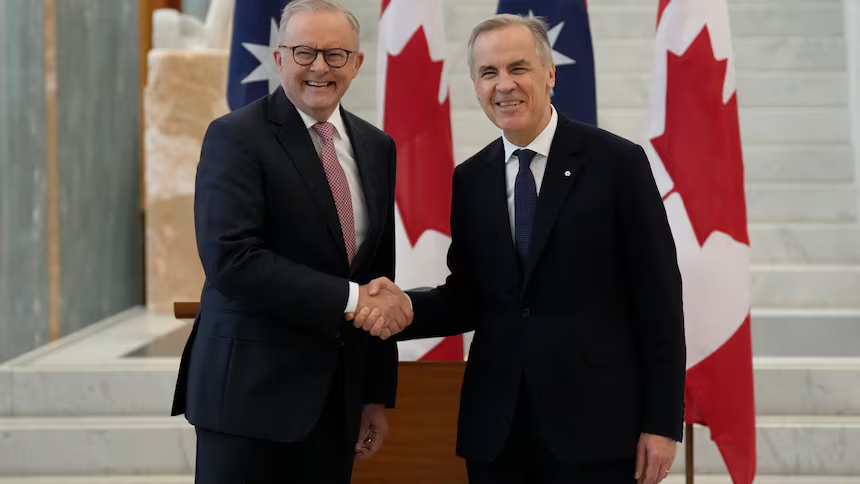
Canada is strengthening its strategic relationship with Australia as both nations move to deepen cooperation in key sectors such as critical minerals, defence, artificial intelligence, and investment. During an official visit to Australia, Canadian Prime Minister Mark Carney held high-level meetings with Australian Prime Minister Anthony Albanese in Canberra and Sydney, marking the first bilateral visit by a Canadian prime minister to Australia in nearly twenty years. The discussions focused on expanding economic cooperation, enhancing security partnerships, and building new technology collaborations in an increasingly uncertain global environment.
Both leaders highlighted the long-standing relationship between Canada and Australia, rooted in shared democratic institutions, similar parliamentary systems, and comparable economic structures built on strong natural resource and agricultural sectors. Officials from both governments emphasized that deeper cooperation could provide greater stability and economic opportunity for citizens in both countries while helping diversify global supply chains and strengthen international partnerships.
One of the central outcomes of the visit was Australia joining the Critical Minerals Production Alliance, an initiative launched during Canada’s G7 presidency to strengthen global supply chains for minerals used in modern technologies and defence industries. Canada and Australia both hold large reserves of critical minerals such as lithium, uranium, and rare earth elements, which are essential for batteries, electric vehicles, advanced manufacturing, and emerging artificial intelligence technologies. Through closer cooperation, the two countries aim to increase production, attract investment, and develop new opportunities in clean energy and resource processing.
The two governments also launched a new Clean Energy Partnership designed to accelerate investment in renewable energy technologies, support innovation, and modernize electricity infrastructure. The initiative is expected to encourage joint projects between Canadian and Australian companies while helping both countries scale up their clean energy sectors and improve energy security.
Defence cooperation was another major focus of the visit. Canada and Australia already conduct regular military exercises and intelligence cooperation in the Indo-Pacific region, and leaders agreed to further strengthen that partnership. As part of this effort, Canadian Armed Forces personnel are expected to begin training in Australia in mid-2026 on the Arctic Over-the-Horizon Radar system. The radar technology is an important part of Canada’s modernization of the North American Aerospace Defense Command system, enabling long-range detection of airborne threats and improving surveillance capabilities across Canada’s Arctic region.
Officials also confirmed that both countries will explore mechanisms to simplify the movement of military personnel and defence equipment between Canada and Australia. Discussions are underway to potentially establish a Status of Forces Agreement that would reduce administrative barriers and strengthen operational collaboration. In addition, the two governments are studying ways to integrate their defence industries more closely through joint research, technology sharing, and co-production of advanced military capabilities.
Beyond defence and resources, Canada and Australia are also expanding cooperation in artificial intelligence. Both countries are investing heavily in sovereign AI infrastructure and research. To enhance collaboration, the governments welcomed a new agreement between their national AI safety institutes aimed at sharing expertise and coordinating research on the safe development of advanced AI systems.
Canada, Australia, and India are also working together to expand technology cooperation through the Australia-Canada-India Technology and Innovation Partnership. Under this initiative, the three countries plan to formalize collaboration on artificial intelligence development, technology commercialization, and industry partnerships. Officials say the agreement will create new opportunities for private companies, including small and medium-sized technology firms and startups.
Economic investment also played a key role during the visit. Canadian pension funds and Australian superannuation funds signed an agreement to deepen financial cooperation and remove barriers to investment in major infrastructure and development projects. The agreement is intended to help mobilize massive long-term investments while supporting economic growth in both countries.
During meetings with business leaders in Sydney, Canadian officials engaged with Australian pension fund executives who collectively manage nearly seven trillion dollars in assets. Investment firm IFM also announced plans to potentially invest up to ten billion dollars in Canadian projects, reflecting growing investor interest in sectors such as infrastructure, energy, and technology.
Leaders from both countries additionally agreed to begin negotiations to modernize the Canada-Australia tax treaty. Updating the agreement is expected to encourage greater two-way investment by simplifying tax rules and improving financial cooperation between businesses operating in both countries.
Trade between Canada and Australia has grown steadily in recent years. In 2025, bilateral goods trade between the two countries reached approximately 7.8 billion dollars, while services trade totalled about 4.6 billion dollars. Canadian direct investment in Australia reached nearly 58.8 billion dollars in 2024, making Australia the largest destination for Canadian investment in the Indo-Pacific region. Australian investment in Canada has also expanded, reaching approximately 27 billion dollars.
Both countries are members of the Comprehensive and Progressive Agreement for Trans-Pacific Partnership, a major free-trade pact connecting economies across the Asia-Pacific region. The agreement provides access to a market of hundreds of millions of consumers and represents a significant portion of global economic activity.
Government officials say the new agreements and partnerships announced during the visit demonstrate the growing strategic importance of the Canada-Australia relationship. In a world facing geopolitical tensions, shifting alliances, and rapid technological change, both countries are seeking to build stronger economic networks and security partnerships with trusted allies.
Leaders emphasized that closer cooperation in resources, technology, defence, and investment could help both nations strengthen their economies while contributing to stability and innovation across the Indo-Pacific region.
Post Disclaimer
The views and content presented in this article, news report, or video are solely those of the respective author or creator and do not necessarily reflect the official policy or position of BW Times Digital Online E-Paper.








Leave a comment