














Trump’s 2026 State of the Union: A Look at Promises Kept and Promises Still in Progress
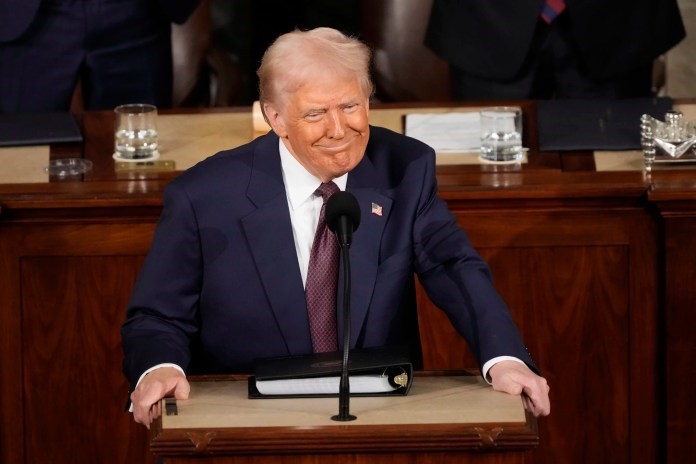
When Donald Trump addressed a joint session of Congress last March, he confidently declared, “America is back.” Though not officially a State of the Union, the speech outlined his second-term priorities, from border security and economic reform to reshaping the federal government.
As Trump prepares to deliver his first official 2026 State of the Union address, a review of the past year shows a mix of fulfilled pledges and ongoing challenges.
Promises Kept: Immigration, DEI Rollbacks and Federal Workforce Cuts
One of Trump’s most significant policy achievements has been his immigration crackdown. During last year’s address, he highlighted declaring a national emergency at the southern border and deploying military and Border Patrol resources.
Recent operational statistics from U.S. Customs and Border Protection reported record-low encounters at the border and consecutive months with zero releases of illegal immigrants into the interior. GOP strategist Ford O’Connell described immigration enforcement as the policy area where Trump has delivered most decisively.
Trump also fulfilled promises to freeze federal hiring and require federal employees to return to in-person work. Through the Department of Government Efficiency, led by Elon Musk, approximately 317,000 federal workers left their positions by the end of 2025, according to the Office of Personnel Management. Workforce reductions came through layoffs, early retirements and voluntary resignations.
On diversity, equity and inclusion initiatives, Trump followed through with executive orders eliminating DEI programs across federal agencies and restricting federal contractors from implementing similar policies. The administration also moved to end DEI initiatives within the Pentagon.
Additionally, Trump withdrew the United States from the Paris Climate Agreement and dismantled the U.S. Agency for International Development, arguing that federal spending needed to be redirected toward domestic priorities.
Promises Delayed: Economy, Tariffs and Global Ambitions
While Trump has claimed economic victories, including passing the “Big Beautiful Bill” — a sweeping tax and spending cuts package that eliminated taxes on tips — economic indicators present a mixed picture.
According to the Bureau of Economic Analysis, fourth-quarter GDP growth in 2025 reached 1.4%, below expectations of 3%. Annual GDP growth for 2025 stood at 2.2%, exceeding some late-year projections but not matching the administration’s more optimistic forecasts.
Energy prices have also been uneven. Data from the Bureau of Labor Statistics show electricity prices rising 6.3% year-over-year and natural gas increasing nearly 10%, though gasoline prices declined by 7.5%.
Trump’s tariff strategy faced a major setback when the Supreme Court ruled that he lacked authority under the International Emergency Economic Powers Act to impose sweeping global tariffs. In response, Trump imposed a new 10% global tariff under Section 122 of the Trade Act of 1974, asserting he had sufficient authority without additional congressional approval.
Polling suggests voters remain divided on Trump’s economic management, with more respondents in recent surveys indicating disapproval than approval.
Foreign Policy Goals Still Unresolved
Trump’s ambitions abroad have proven more complex. He reiterated last year his desire to acquire Greenland, an autonomous territory of Denmark. While discussions about a future framework agreement with NATO were announced, Greenland remains under Danish sovereignty.
Similarly, Trump pledged to reclaim control of the Panama Canal to limit China’s regional influence. Though legal challenges have emerged regarding contracts held by subsidiaries of Hong Kong-based CK Hutchison, the canal remains under Panama’s authority.
On the Russia-Ukraine war, Trump promised to push for an end to the conflict. However, negotiations with Russian President Vladimir Putin and Ukrainian President Volodymyr Zelensky have been described as difficult, with no definitive resolution achieved.
Looking Ahead to 2026
As Trump prepares to address Congress, he can point to tangible achievements in border enforcement, federal restructuring and rolling back DEI initiatives. Yet economic headwinds, tariff battles and unresolved foreign policy objectives continue to shape his second-term agenda.
The upcoming State of the Union will likely serve as both a defense of his record and a roadmap for navigating the challenges that remain.
Post Disclaimer
The views and content presented in this article, news report, or video are solely those of the respective author or creator and do not necessarily reflect the official policy or position of BW Times Digital Online E-Paper.









Leave a comment