















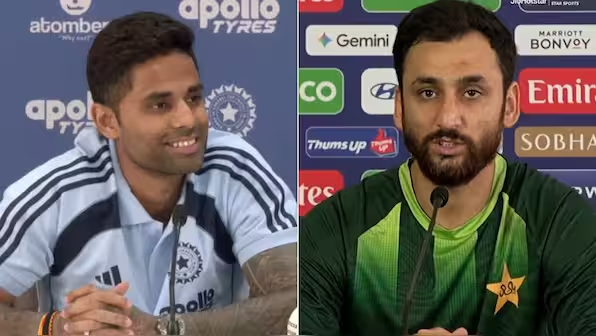
The cricketing world once again turns its full attention to the most anticipated rivalry in the sport as Pakistan and India prepare to face each other in the ICC T20 World Cup 2026. More than just a group-stage fixture, this encounter carries history, politics, pressure and a weight of expectation that few contests in international sport can match.
Since the inception of the T20 World Cup in 2007, Pakistan and India have met eight times in the tournament’s history. Out of those eight clashes, India have emerged victorious seven times, while Pakistan have managed just one win. That lone Pakistani triumph came in 2021, when they delivered a commanding 10-wicket victory, rewriting years of heartbreak. India, however, have largely maintained dominance, including their famous win in the inaugural 2007 final and several close finishes in subsequent editions. The overall head-to-head record in T20 World Cup history stands firmly in India’s favour at 7–1.
The build-up to this year’s clash has not been without tension. Earlier in the tournament cycle, uncertainty surrounded whether Pakistan would participate in the fixture due to political sensitivities and scheduling disputes. There were discussions at administrative levels, and concerns over venue arrangements briefly cast doubt on the match. However, after negotiations and tournament obligations under ICC regulations, both boards confirmed participation. The contest now goes ahead under tight security and immense global scrutiny.
On current form, Pakistan enter the match with a balanced and confident unit. The batting revolves around Babar Azam and Mohammad Rizwan, a pair known for building steady platforms in high-pressure games. Fakhar Zaman provides explosive capability at the top, while the middle order, led by Salman Ali Agha and Iftikhar Ahmed, offers power-hitting depth. In the bowling department, Shaheen Shah Afridi remains Pakistan’s strike weapon with the new ball, supported by Haris Rauf’s pace and Shadab Khan’s all-round abilities. Pakistan’s recent performances suggest improved consistency, particularly in defending totals.
India, meanwhile, arrive with one of the most formidable T20 squads in the tournament. Rohit Sharma’s leadership experience, combined with Virat Kohli’s record in high-pressure chases, strengthens their batting core. Suryakumar Yadav brings innovation and aggression in the middle overs, while Hardik Pandya provides balance as a pace-bowling all-rounder. Jasprit Bumrah leads a disciplined bowling attack capable of controlling death overs, an area often decisive in Indo-Pak encounters.
From a purely statistical standpoint, India hold the psychological edge due to their overwhelming record in T20 World Cup meetings. However, Pakistan’s 2021 breakthrough proved that momentum can shift dramatically. In global betting markets and analyst projections, India appear slight favourites because of squad depth and historical dominance. Yet Pakistan’s pace attack and improved middle-order stability make them a serious threat.
In contests of this magnitude, numbers only tell part of the story. The emotional intensity, the pressure of millions watching across continents, and the fine margins of T20 cricket often override history. Whether India extend their dominance or Pakistan level the psychological battlefield further, one certainty remains: when these two sides meet, the game transcends sport and becomes an event that captures the attention of the entire cricketing world.
Post Disclaimer
The views and content presented in this article, news report, or video are solely those of the respective author or creator and do not necessarily reflect the official policy or position of BW Times Digital Online E-Paper.






Leave a comment