















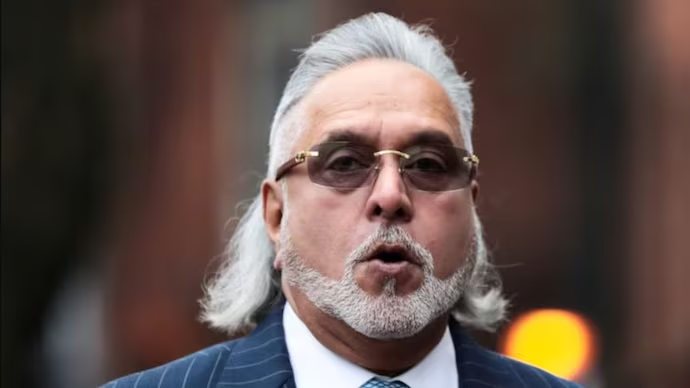
Fugitive businessman Vijay Mallya told the Bombay High Court he cannot specify when he will return to India due to UK court restrictions and the revocation of his passport.
Fugitive businessman Vijay Mallya on Wednesday informed the Bombay High Court that he is unable to provide a clear timeline for his return to India, citing legal restrictions imposed by courts in the United Kingdom.
Mallya made the submission through his counsel, Amit Desai, before a bench comprising Chief Justice Shree Chandrashekhar and Justice Gautam Ankhad. The statement was filed in response to an earlier direction from the court asking him to clarify whether he intended to return to India to face trial while simultaneously challenging the order that declared him a fugitive economic offender.
Mallya, who left India in March 2016, has been accused of defaulting on multiple loan repayments amounting to several thousand crores. In January 2019, he was declared a Fugitive Economic Offender under the Fugitive Economic Offenders Act, 2018, by a special court dealing with cases under the Prevention of Money Laundering Act (PMLA). Following this declaration, extradition proceedings were initiated against him in the United Kingdom.
In his latest submission, Mallya stated that he is currently barred from leaving England and Wales under orders passed by UK courts. According to the statement, he is not permitted to leave or attempt to leave the jurisdiction, nor is he allowed to apply for or possess any international travel documents. As a result, he said he cannot precisely state when he would be able to return to India.
His counsel further argued that Mallya’s physical presence in India is not required for the High Court to proceed with hearing his petitions. These petitions challenge both the declaration of him as a fugitive economic offender and the constitutional validity of the Fugitive Economic Offenders Act.
Opposing the plea, Solicitor General Tushar Mehta, appearing on behalf of the Centre, contended that Mallya had approached the High Court by invoking its extraordinary writ jurisdiction, which is discretionary and equitable in nature. He argued that a person who does not comply with the law should not be entitled to seek such relief from the court.
Mehta submitted that it is a well-established legal principle that a person who fails to comply with the law cannot be granted discretionary relief through prerogative writs. He maintained that Mallya’s conduct should be considered while deciding whether to entertain his petitions.
After hearing the arguments from both sides, the bench directed that Mallya’s informal statement be formally filed as an affidavit. The matter has now been posted for further hearing next month.
The case continues to draw significant attention, as it involves high-value financial defaults, ongoing extradition proceedings, and important legal questions surrounding the Fugitive Economic Offenders Act.
Source: India Today
Post Disclaimer
The views and content presented in this article, news report, or video are solely those of the respective author or creator and do not necessarily reflect the official policy or position of BW Times Digital Online E-Paper.











Leave a comment