















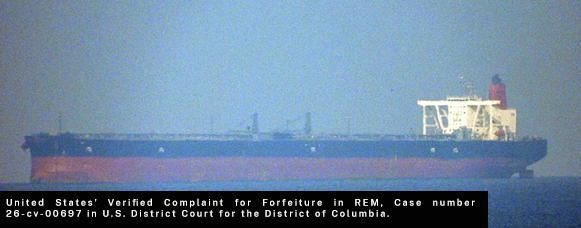
WASHINGTON – The United States has filed a civil forfeiture complaint seeking permanent seizure of an oil tanker and approximately 1.8 million barrels of crude oil allegedly tied to sanctions-evasion operations benefiting Iran and Venezuela, federal officials announced.
The complaint, filed in the U.S. District Court for the District of Columbia, targets the Motor Tanker Skipper, a vessel seized on the high seas in December 2025. U.S. authorities allege the tanker was part of a long-running network used to transport illicit petroleum shipments that generated revenue supporting the Islamic Revolutionary Guard Corps (IRGC), including its Qods Force, which is designated by the United States as a foreign terrorist organization.
According to investigators, the cargo aboard the vessel originated from Petróleos de Venezuela, S.A. (PdVSA), Venezuela’s state-owned oil company. Officials argue that both the tanker and its oil cargo are subject to forfeiture because they allegedly served as financial assets enabling sanctioned entities to operate and expand influence.
Alleged Sanctions-Evasion Network
Federal authorities claim the vessel operated as part of a so-called “ghost fleet” — ships that conceal ownership, registration and routes to bypass international sanctions. The forfeiture complaint alleges that from at least 2021 onward, the tanker transported crude oil from Iran and Venezuela through complex ship-to-ship transfers designed to obscure the origin and destination of shipments.
Investigators say the vessel used tactics such as falsifying its maritime identity, spoofing location data and sailing under false flags to evade detection. At the time of seizure, the tanker was reportedly claiming a Guyanese flag, which authorities say rendered it effectively stateless under maritime law.
Officials also allege that in 2024 the ship delivered roughly three million barrels of Iranian crude oil to Syria and continued transporting illicit cargo into 2025.
Cargo Linked to Multiple Sanctioned Entities
The latest shipment, loaded in November 2025 at Venezuela’s José Terminal, included approximately 1.8 million barrels of Venezuelan-origin crude oil. Documentation indicated that about 1.1 million barrels were intended for Cubametales, a Cuban state-run oil import and export company previously sanctioned by the U.S. Treasury.
Authorities argue that profits generated through these shipments contributed to financing activities attributed to the IRGC, including weapons proliferation, support for militant groups and alleged human rights abuses.
Federal Agencies Highlight Enforcement Efforts
U.S. officials described the forfeiture action as part of broader enforcement efforts targeting financial networks linked to sanctioned regimes. The Department of Justice, FBI, Homeland Security Investigations and national security prosecutors jointly supported the investigation.
Attorney General Pamela Bondi said the action reflects a commitment to dismantling operations that allegedly channel funds to adversarial governments and organizations. FBI Director Kash Patel added that enforcement agencies intend to continue disrupting maritime networks used to evade sanctions.
National security prosecutors emphasized that dismantling shadow shipping operations is a priority, arguing that such fleets generate billions of dollars in revenue for sanctioned actors.
Seizure at Sea
The tanker was seized on Dec. 10, 2025, under a judicially authorized warrant while operating in international waters. Following the seizure, U.S. authorities transported the vessel and its cargo to waters off the Texas coast.
The civil forfeiture process now seeks court approval to permanently confiscate both the ship and the oil cargo. Civil forfeiture cases proceed independently of criminal charges and require judicial review before assets can be transferred to government control.
Officials say the case signals continued enforcement of U.S. sanctions aimed at restricting illicit oil trade networks tied to Iran and Venezuela.
Post Disclaimer
The views and content presented in this article, news report, or video are solely those of the respective author or creator and do not necessarily reflect the official policy or position of BW Times Digital Online E-Paper.










Leave a comment