











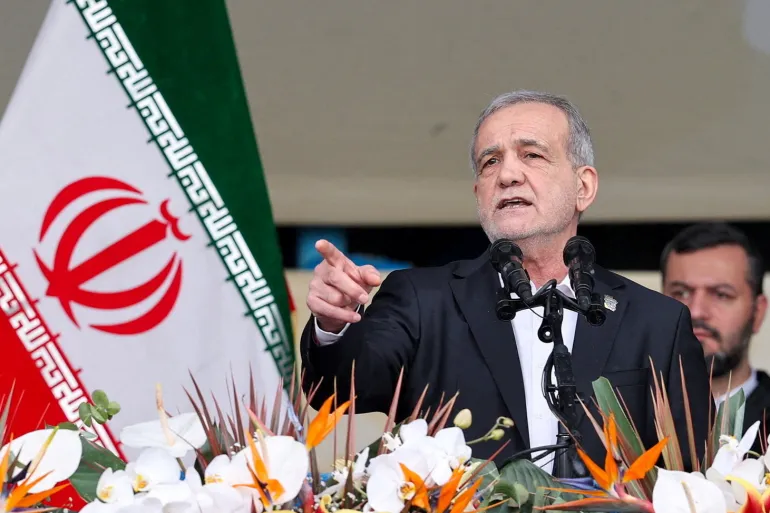
Iranian President Masoud Pezeshkian has declared that Tehran will not surrender to pressure from the United States as tensions escalate over Iran’s nuclear program. His remarks come after US President Donald Trump said he is considering limited military strikes if a nuclear agreement is not reached.
Speaking at a ceremony honoring Iran’s Paralympic team, Pezeshkian insisted that Iran would stand firm despite mounting US military deployments in the Gulf region.
“We will not bow down in the face of these difficulties,” Pezeshkian said. “World powers may try to pressure us, but we will not lower our heads.”
Rising Military Tensions in the Gulf
The warning comes as Washington significantly increases its military presence in the Middle East. According to US reports, more than 120 aircraft have been deployed to the region in recent days. The USS Gerald R. Ford — the world’s largest aircraft carrier — is en route to join the USS Abraham Lincoln strike group already stationed in the Arabian Sea.
Observers describe the current US airpower buildup as the largest in the region since the 2003 Iraq invasion.
Iran has responded by sending a letter to the United Nations Security Council, warning that the military buildup “must not be treated as mere rhetoric.” Tehran stressed that while it does not seek war, any aggression would be met with a “decisive and proportionate” response.
Nuclear Talks at a Crossroads
Iran and the United States recently resumed indirect nuclear talks in Oman, followed by a second round in Switzerland. While both sides described discussions as generally positive, no breakthrough has yet been achieved.
Iranian Foreign Minister Abbas Araghchi said a diplomatic solution remains within reach and indicated that Tehran may finalize a draft proposal within days.
However, President Trump has intensified pressure, warning that “bad things will happen” without what he calls a meaningful deal. He later suggested that Iran has “10 to 15 days” to negotiate seriously and confirmed he is considering limited military action if talks fail.
Public Anxiety Inside Iran
Residents in Tehran are closely watching developments as fears of conflict grow.
Many citizens expressed concern about the possibility of war, particularly for the future of their children and the fragile state of the economy. Others believe the United States would ultimately avoid full confrontation.
The situation echoes last year’s failed diplomatic efforts, which collapsed after Israel launched attacks on Iranian targets, triggering a 12-day conflict. The United States later joined by striking nuclear facilities at Fordow, Natanz and Isfahan.
Threats and Regional Risks
Earlier this year, Trump renewed threats following Iran’s crackdown on antigovernment protests. Tehran responded by warning it could target US military bases in the region and potentially close the Strait of Hormuz — a critical oil transit route for Gulf states.
The growing standoff has prompted several countries, including Sweden, Serbia, Poland and Australia, to advise their citizens to leave Iran amid fears of a wider regional conflict.
A Critical Moment for Diplomacy
With both sides hardening their rhetoric and military forces positioned across the Gulf, the Iran-US nuclear negotiations appear to be at a decisive moment. While Tehran insists it does not seek war, it has made clear it will not accept terms it views as surrender.
Whether diplomacy prevails or tensions escalate further may become clear in the coming days.
Post Disclaimer
The views and content presented in this article, news report, or video are solely those of the respective author or creator and do not necessarily reflect the official policy or position of BW Times Digital Online E-Paper.







Leave a comment