















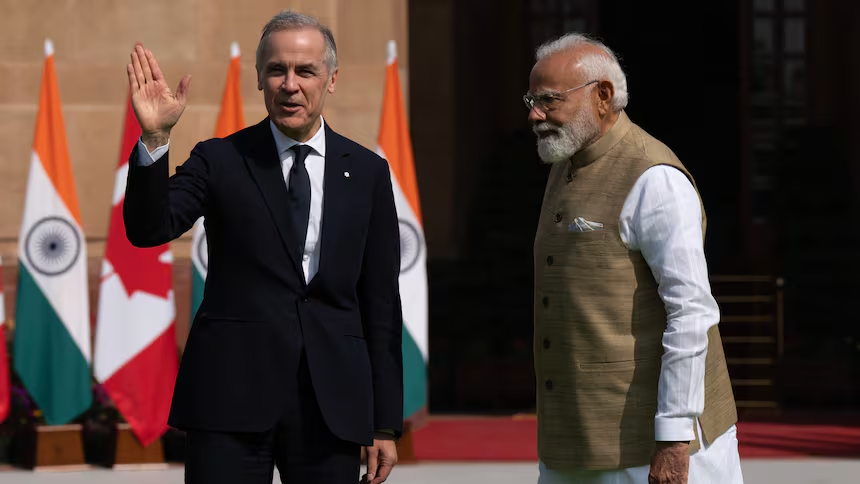
NEW DELHI – Prime Minister Mark Carney and Indian Prime Minister Narendra Modi have unveiled what they describe as a transformative new chapter in Canada–India relations, signing billions of dollars in agreements and committing to finalize a free trade deal by the end of the year.
The announcement follows a high-level meeting at Hyderabad House in New Delhi, where both leaders outlined plans to expand trade, strengthen security cooperation and rebuild diplomatic trust after years of strained relations.
Free Trade Deal Targeted for 2026
At the center of the renewed partnership is a proposed Comprehensive Economic Partnership Agreement, a free trade framework that both governments aim to complete before December.
Carney said the goal is to more than double annual bilateral trade to approximately $70 billion by 2030. The initiative forms part of Canada’s broader strategy to diversify trade beyond its heavy reliance on the United States.
Calling India a “natural partner,” Carney described the shift as more than a restoration of past ties.
“This is not merely a renewal — it is an expansion with new ambition and focus,” he said during remarks alongside Modi.
Modi praised Carney’s leadership and emphasized India’s readiness to deepen economic cooperation, particularly in energy and technology sectors.
$5.5 Billion in Agreements Signed
The two countries signed five memorandums of understanding valued at approximately $5.5 billion, covering energy, critical minerals, artificial intelligence, pharmaceuticals, agriculture and defence collaboration.
Among the largest agreements:
- A $2.6 billion deal between the Government of India and Cameco to supply nearly 22 million pounds of uranium from 2027 to 2035, benefiting Saskatchewan’s uranium industry.
- HCL Technologies will open new AI centres in Calgary and Mississauga while expanding operations in Vancouver, increasing Canadian employment significantly.
- Jubilant Pharmanova will invest $155 million to triple sterile injectable production at its facility in Kirkland, Quebec.
- Elk Valley Resources will export 1.2 million tonnes of coal to India in a deal worth hundreds of millions of dollars.
- McCain Foods will invest $135 million to expand its potato-processing operations in Gujarat.
Saskatchewan also announced the creation of a joint pulse protein centre of excellence with Indian partners, aimed at strengthening agricultural collaboration.
Security and Foreign Interference Discussions
The diplomatic thaw follows a period of heightened tensions between the two Commonwealth nations.
Relations deteriorated under former prime minister Justin Trudeau after allegations surfaced linking Indian agents to the killing of Canadian Sikh activist Hardeep Singh Nijjar. The Royal Canadian Mounted Police later alleged foreign interference activities, including intimidation and violence targeting members of Canada’s Sikh community.
During this visit, Carney raised concerns about transnational repression and emphasized that Canada will continue to take measures to combat such activities.
According to the Prime Minister’s Office, both leaders agreed to enhance bilateral cooperation in law enforcement and security, with a focus on tackling organized crime and the trafficking of fentanyl precursors.
Foreign Affairs Minister Anita Anand underscored the importance of engagement despite past tensions, stating that diplomatic dialogue remains necessary to make progress.
A Strategic Shift in Foreign Policy
Government officials say engagement between Ottawa and New Delhi has increased significantly in recent months, paving the way for the agreements signed this week.
For Canada, strengthening ties with India represents a strategic move within the Indo-Pacific region and aligns with efforts to build resilient supply chains and secure new export markets.
For India, the partnership offers access to Canadian energy resources, critical minerals and agricultural expertise.
While critics continue to question how concerns over foreign interference will be addressed, the two leaders presented the agreements as the beginning of a more stable and mutually beneficial relationship.
What This Means for Canada
The new agreements could have major implications for:
- Energy exports, particularly uranium and coal
- Artificial intelligence and technology sector growth
- Pharmaceutical manufacturing expansion
- Agricultural trade development
- Broader Indo-Pacific economic engagement
If finalized, the proposed free trade agreement would mark one of Canada’s most significant trade expansions in recent years.
As both governments move forward, attention will remain on whether economic cooperation can fully coexist with ongoing security and human rights concerns.
Post Disclaimer
The views and content presented in this article, news report, or video are solely those of the respective author or creator and do not necessarily reflect the official policy or position of BW Times Digital Online E-Paper.











Leave a comment